
When to Use Purchase Order Financing: 2026 Guide
Updated: Sep 20
Turning down a massive growth opportunity because you lack the cash to fulfill it shouldn't be the cost of doing business. You've likely felt that knot in your stomach when a major retailer places an order that exceeds your current manufacturing capacity. It's frustrating to have the demand but not the working capital to bridge the gap between supplier payments and customer delivery. Knowing exactly when to use purchase order financing can be the difference between scaling your brand and watching a competitor take your shelf space.
This guide will show you how to leverage your customers' creditworthiness to fund production, allowing you to secure large contracts without taking on restrictive long-term debt. We will provide a clear framework to determine if this strategic tool fits your current deal, how to evaluate supplier lead times, and what it takes to secure a funding partner who understands your supply chain. By the end of this article, you'll have a roadmap for turning purchase orders into immediate manufacturing power.
Table of Contents
What is Purchase Order Financing and How Does It Bridge the Cash Flow Gap?
Purchase order financing is a short-term funding solution designed specifically to cover the cost of goods sold (COGS). It isn't a traditional bank loan; instead, it's a form of asset-based lending where the transaction itself provides the security. This tool allows businesses to fulfill orders that are currently beyond their financial reach by providing the capital needed to pay suppliers upfront. It's a tactical choice for companies that have outpaced their current liquid reserves.
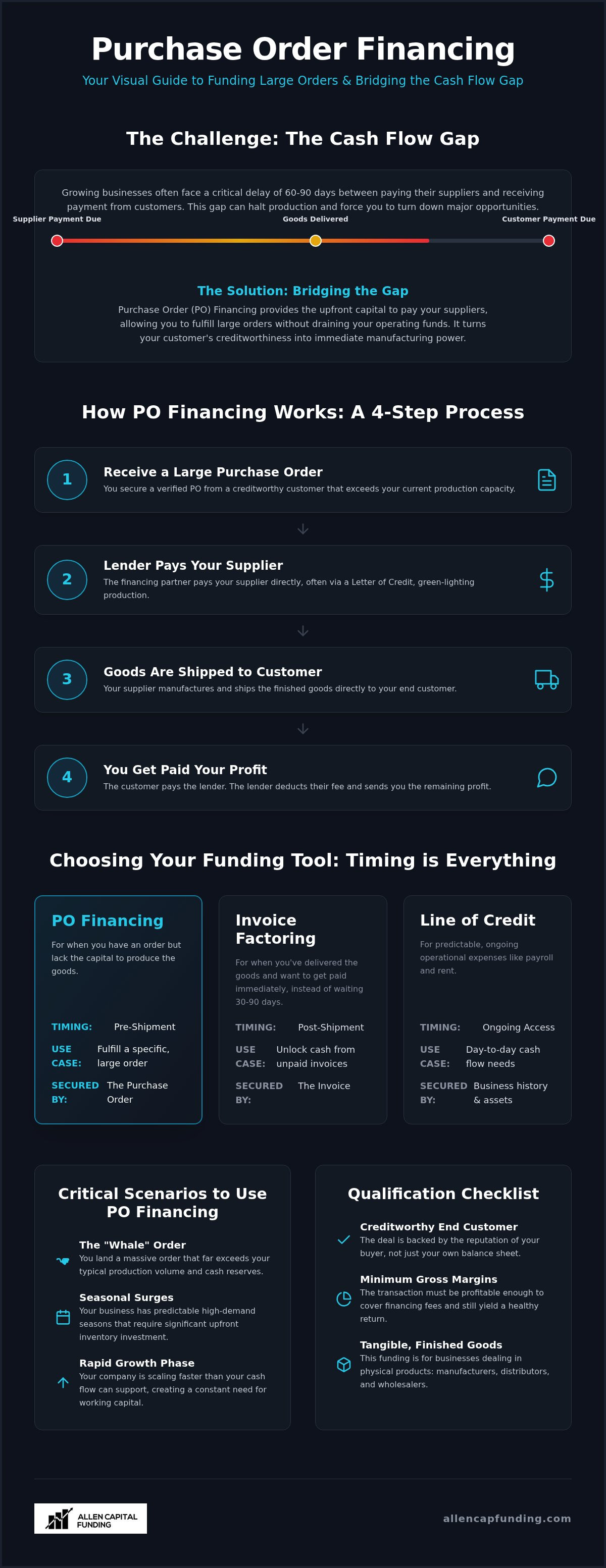
The primary challenge this solves is the "Cash Flow Gap." This gap represents the stressful period between when your supplier demands payment and when your end customer finally settles their invoice. For many growing companies, this period can last 60 to 90 days. Knowing when to use purchase order financing is critical because it prevents you from draining your operating reserves or turning down a life-changing contract due to a lack of cash. By using this method, you use the creditworthiness of your customer to back the deal.
Unlike a standard line of credit, this is transaction-specific. The lender looks at the strength of the Purchase Order and the reputation of the buyer rather than just your own balance sheet. Because the financing is tied to a specific deal, it doesn't sit on your books as long-term debt. This makes it an incredibly flexible option for rapid scaling without the weight of permanent liabilities.
The Mechanics of a PO Financing Transaction
The process follows a logical, four-step progression to ensure security for all parties involved. It begins when you receive a verified order from a creditworthy customer. Once the lender approves the deal, they pay your supplier directly, often via a Letter of Credit or cash. The supplier then manufactures and ships the goods directly to your customer. Finally, the customer pays the lender, who then sends you the remaining profit minus a small fee. This streamlined flow ensures that production never stalls due to payment delays.
Who Benefits Most: Manufacturers, Distributors, and Wholesalers
This funding model is built for businesses that deal in tangible products. Manufacturers, distributors, and wholesalers find it most useful because their success depends on high-volume inventory turnover. Service-based businesses usually don't qualify because they lack a physical product that can be used as collateral. Lenders prefer "finished goods" or "near-finished goods" because these items have a clear market value and are ready for immediate delivery. Purchase order financing serves as a tactical bridge for inventory-heavy businesses that need to move products faster than their current cash flow allows.
The 2026 Comparison: PO Financing vs. Factoring vs. Lines of Credit
Choosing the right capital tool depends entirely on where your business stands in the fulfillment cycle. While many owners group these options together, they serve very different strategic purposes. Understanding when to use purchase order financing versus other methods ensures you don't overpay for capital or miss a production deadline. Each tool has a specific "trigger" event that unlocks the funds you need to keep moving forward.
PO Financing vs. Invoice Factoring
The fundamental difference between these two lies in the timing of the transaction. PO financing happens before goods are shipped. It provides the capital required to pay a supplier so they can begin manufacturing your order. In contrast, invoice factoring occurs after you've already delivered the goods and generated an invoice. Factoring helps you bridge the 30 to 90 day wait for customer payment, but it won't help you if you can't afford the initial production costs.
Smart operators often use these two in a revolving strategy. You might use Purchase Order Financing to get the products made and then transition that debt into a factoring arrangement once the invoice is issued. This "double-play" creates a continuous flow of liquidity. To understand how to leverage your company's existing inventory or orders, it's helpful to review the principles of asset-based lending for small business to maximize your total borrowing power.
When a Line of Credit is Better (and When It Is Not)
A traditional business line of credit is your best friend for predictable, ongoing operational expenses like rent, utilities, and payroll. It's flexible and usually carries a lower cost of capital. However, many bank lines have rigid limits based on your historical revenue or personal credit. If you land a "whale" order that is five times your usual size, a standard bank line will likely fall short. This is exactly when to use purchase order financing, as the funding limit is based on your customer's ability to pay, not your current bank balance.
For owners who need general flexibility for day-to-day hurdles, our Business Line of Credit guide offers a deep dive into maintaining that safety net. But when a massive growth opportunity arrives, don't let a capped bank line stop you. You can perform a quick Financial Check-Up with our specialists to see which tool fits your current deal best. The goal is to ensure the cost of the financing never outweighs the gross profit of the order itself. If your margins are healthy, the speed of PO financing is almost always worth the trade-off.
Critical Scenarios: When to Use PO Financing
Identifying the right moment to seek external capital is a strategic skill. Knowing when to use purchase order financing is essential for businesses facing specific growth triggers that outpace their current cash flow. These scenarios often involve high-stakes opportunities where traditional bank lending is too slow or too limited to be effective. By focusing on the strength of the transaction, you can fulfill orders that would otherwise be impossible to handle with your current reserves.
The "Whale" Order: This occurs when a single contract is so large it exceeds your current credit limits or total cash on hand. Turning it down could mean losing a key client to a competitor forever.
Seasonal Demand Surges: Many businesses see a massive spike during Q4 or industry-specific peaks. PO financing allows you to stock up for these surges without draining the operating reserves needed for daily expenses.
Rapid Expansion: When your sales growth is outstripping your ability to manufacture or procure inventory, this tool acts as an immediate capital injection to keep pace with demand.
Government Contracts: Fulfilling large-scale public sector orders requires strict adherence to delivery timelines. These contracts often have rigid terms that don't align with your standard accounts payable cycle.
Using PO Financing for Government and Enterprise Contracts
Enterprise and government customers are ideal candidates for this funding model because they have exceptionally strong credit profiles. Lenders are more willing to provide capital when the end payer is a reputable entity with a history of reliable payments. Having this backing also proves your "financial capability" during the bidding process, showing agencies that you have the resources to deliver on time. Purchase order financing allows small firms to punch above their weight class in bidding against much larger competitors. To get a better sense of what purchase order financing is in the context of large-scale contracts, it's helpful to view it as a project-specific partner that facilitates production.
Managing Supplier Demands and International Trade
Global supply chains often move faster than traditional finance. When suppliers demand payment upfront or on very short terms, it creates an immediate liquidity crisis for the buyer. This is particularly true in international trade where manufacturing lead times are long and trust must be established across borders. In addition to financing, coordinating with a customs broker like Customs and Trade Logistics can ensure that your goods clear international hurdles smoothly. Using Letters of Credit in international PO financing provides a guarantee to the supplier that they'll be paid upon shipment. This reduces the risk of order cancellation due to funding delays and keeps your production schedule on track. It ensures that your growth isn't held hostage by a supplier's rigid payment requirements or your own temporary cash constraints.
Readiness for capital is often about the strength of your contracts rather than the depth of your pockets. Knowing when to use purchase order financing requires a shift in how you view credit, moving from your own historical performance to the future potential of a single, high-value order. Lenders aren't looking for a perfect balance sheet; they're looking for a perfect transaction. Before you apply, you should evaluate your deal against these four pillars of eligibility:
Verified Purchase Orders: Your orders must come from reputable B2B or B2G customers. Lenders prioritize orders from established corporations or government agencies because their payment history is predictable.
Healthy Profit Margins: The transaction should typically have a gross margin of 20% or higher. This ensures there's enough profit to cover the financing fees while still leaving you with a meaningful gain.
Supplier Reliability: A lender will vet your supplier's track record for quality and on-time delivery. If your supplier has a history of delays, it increases the risk that the customer might cancel the order.
Tangible Finished Goods: This tool is designed for products that are ready for sale or require minimal final assembly. It is not suitable for complex manufacturing projects with high R&D risks.
The "Creditworthy Customer" Requirement
The most empowering aspect of this funding model is that the lender looks at your customer's credit score more than yours. If you're selling to a Fortune 500 company or a federal agency, their financial strength carries the deal. This makes it an excellent path for startups or established businesses that have faced recent credit challenges. If your own credit history is a barrier, reviewing our guide on Asset-Based Lending can show you how to leverage current inventory to build additional liquidity alongside your PO funding.
Supplier Due Diligence
Because the lender is paying your supplier directly, they will perform their own due diligence on the factory or manufacturer. They need to verify manufacturing capacity and ensure the supplier can meet the specific terms of the order. You should prepare your supplier for this third-party involvement by ensuring a Master Purchase Agreement is in place. This document outlines the legal responsibilities of all parties and streamlines the funding process. To see if your current deal and supplier relationship qualify for a growth surge, schedule a financial check-up with our specialists today. Clear communication with your manufacturing partners early in the process prevents delays when it's time to release the funds.
Securing Your Growth Surge with Allen Capital Funding
Fulfilling a massive order requires more than just a signature on a contract; it requires a partner who understands the logistics of your supply chain. Allen Capital Funding acts as a strategic guide to help you navigate complex capital solutions. We don't just provide a funding source; we provide the expertise needed to ensure the transaction is structured for maximum profit. Deciding when to use purchase order financing is a high-stakes choice, and having an authoritative ally ensures you don't leave your growth to chance.
The primary benefit of working with an expert brokerage is access to a national network of specialized lenders. Going directly to a single lender often limits your options to their specific criteria and risk appetite. We leverage our relationships to find the best rates and terms that fit your specific industry needs. This approach removes the barriers to capital and allows you to focus on delivery while we handle the financial heavy lifting. We integrate this tool into a broader Financial Check-Up to ensure that every deal contributes to your long-term fiscal health.
Tailored Funding Options for National Growth
Our specialists provide a comprehensive range of services, including SBA loans, working capital, and credit lines. This variety is essential because a single purchase order often triggers other financial needs. For example, if your new contract requires you to upgrade your production line or add specific machinery, we can facilitate Commercial Equipment Loans to bridge that gap. We match the lender to your unique operational requirements, ensuring that your funding scales as fast as your sales team can close deals.
Simplified Onboarding and Rapid Execution
Timing is everything in manufacturing and distribution. A delay of even a few days can lead to order cancellations or strained supplier relationships. Our commitment is to simplify the path to capital through a streamlined onboarding process. We focus on the creditworthiness of your customer and the reliability of your supplier to move you toward your first draw quickly. This proactive approach eliminates the friction often found in traditional banking environments.
Getting started is a straightforward process designed to respect your time. We begin by reviewing your current purchase orders and analyzing your supplier agreements to ensure a smooth transition of funds. If you're ready to stop turning down large contracts and start scaling your operations, the first step is a professional strategy session. Book your consultation with Allen Capital Funding today to map out a fulfillment strategy that secures your company's future.
Mastering Your Next Growth Surge
Mastering your next growth surge requires the right financial tools at the right time. You now understand that purchase order financing is a tactical bridge designed to help you fulfill massive orders without depleting your operating cash. By leveraging the creditworthiness of your enterprise or government customers, you can scale your manufacturing and distribution capacity immediately. Knowing exactly when to use purchase order financing ensures that you never have to turn down a lucrative contract due to temporary liquidity gaps.
Our dedicated loan specialists provide the expert guidance you need to navigate these complex transactions. We offer access to a national network of specialized lenders to ensure you receive tailored capital solutions that match your industry requirements. Don't let manufacturing lead times or supplier demands hold your business back from its true potential. Your next big opportunity is waiting, and we're ready to help you seize it.
Unlock your growth potential with a custom PO financing solution from Allen Capital Funding. We look forward to helping your business reach its next milestone.
Frequently Asked Questions
How much does purchase order financing typically cost?
Fees are usually based on a percentage of the purchase order value per 30-day period. Factors include the creditworthiness of the end customer, the reliability of the supplier, and the total transaction volume. Costs are transaction-specific and are deducted from the final payment after the customer settles the invoice. It's generally more expensive than a bank loan but faster to secure for urgent growth. This setup keeps your balance sheet free from permanent debt.
Can I use PO financing for service-based contracts?
No, purchase order financing is specifically designed for businesses that sell tangible, finished goods. Lenders require a physical product as collateral to mitigate risk during the production and shipping phases. Service-based businesses, such as consulting firms or software developers, typically don't qualify. These companies should instead explore other options like working capital loans or credit lines to manage their payroll and operational expenses while waiting for client payments to arrive.
Is purchase order financing considered a business loan?
Technically, it is a form of asset-based lending rather than a traditional term loan. It's a short-term, transaction-specific funding tool where the purchase order itself acts as the primary collateral. Unlike a standard loan, it doesn't typically appear as long-term debt on your balance sheet. This distinction is important for owners looking to avoid restrictive debt covenants while fulfilling large, profitable orders that exceed current cash reserves or standard bank credit limits.
Do I need a high personal credit score for PO financing?
No, your personal credit score is not the primary factor for approval. Lenders focus almost entirely on the creditworthiness of your end customer and the manufacturing track record of your supplier. This makes it an accessible solution for startups or businesses with historical credit challenges. As long as you have a verified order from a reputable B2B or B2G entity, your personal financial history carries significantly less weight in the final funding decision.
What happens if my customer cancels the purchase order?
Customer cancellation is a significant risk that lenders mitigate through rigorous upfront due diligence. If an order is cancelled after funding has been released, you're generally responsible for the outstanding balance. However, most financing agreements include specific protections and insurance requirements to manage these rare events. This is why lenders insist on working with reputable enterprise or government buyers who have a low probability of defaulting or retracting a verified contract after production begins.
How long does it take to get approved for PO financing?
Initial approval for a new client typically takes between one and two weeks. This time is used to verify the purchase order, vet the supplier, and perform a credit check on the end customer. Once you have an established relationship with a funding partner, subsequent transactions can often be processed in just a few business days. Speed is a major advantage when determining when to use purchase order financing for time-sensitive seasonal surges.
Can I use PO financing for international suppliers?
Yes, many lenders specialize in international trade and can facilitate payments to overseas manufacturers. This is often handled through a Letter of Credit, which provides the supplier with a guarantee of payment once the goods are shipped. This tool is particularly effective for wholesalers and distributors who source products globally but need to manage the cash flow gap created by long manufacturing lead times and transit durations across different international borders.
What is the minimum order size for purchase order financing?
Most specialized lenders look for a minimum transaction size to cover their due diligence and administrative costs. While this varies by provider, it often starts at $50,000 per order. Smaller transactions are usually better suited for credit lines or factoring. Understanding these thresholds helps you decide when to use purchase order financing for "whale" contracts that require a significant capital injection to fulfill successfully without draining your company's operating cash.



Comments