
Small Business Working Capital: 2026 Funding Guide
Updated: Sep 18
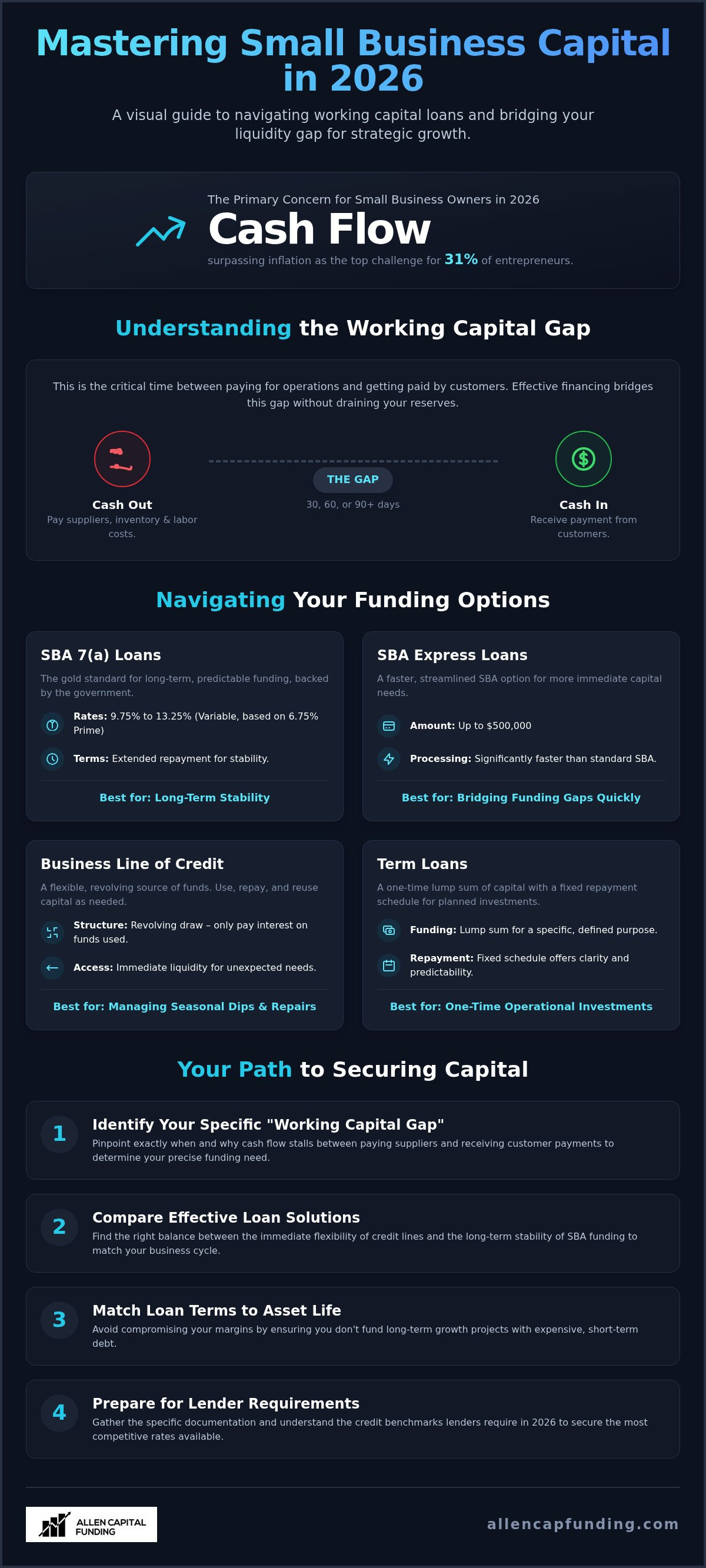
Cash flow has officially surpassed inflation as the primary concern for 31% of small business owners in 2026. You likely feel this shift every day as you balance the cost of daily operations against the need for strategic expansion. It's exhausting to manage growth when liquidity gaps keep you tethered to the present. You want to move forward, but the fear of "bad" debt or confusing factor rates often stalls your progress. Finding the right working capital loans for small business should provide a clear path to success, not another layer of financial complexity.
We believe that capital should act as a facilitator for your goals. This guide will help you master the complexities of working capital and discover how to secure the ideal funding structure to fuel your daily operations and long-term growth. We will examine the current 2026 lending environment, compare flexible credit lines with SBA options, and provide clear advice on strategic capital allocation. You'll learn how to identify a sustainable funding partner that understands your business cycle and helps you bridge the gap between your current state and your future objectives.
Table of Contents
Understanding the Working Capital Gap: Why Liquidity Matters
Working capital represents the financial pulse of your company, calculated simply as the difference between your current assets and your current liabilities. While the math is straightforward, the application is where many leaders struggle. The "Working Capital Gap" is the specific interval of time between when you pay your suppliers for raw materials or labor and when you finally receive cash from your customers. For many, this gap isn't just a minor delay; it's a structural barrier to progress. Securing working capital loans for small business allows you to bridge this chasm without depleting your emergency reserves.
Rapid expansion often masks an underlying liquidity crisis. When sales spike, your need for inventory and additional staff increases immediately, yet your accounts receivable may not catch up for 30, 60, or even 90 days. This creates a scenario where a "healthy" business on paper can actually run out of cash. The working capital cycle serves as the primary metric for your company’s operational health.
Calculating Your Actual Funding Need
To avoid the pitfalls of misaligned funding, you must first quantify your liquidity position using two key formulas. The current ratio, found by dividing current assets by current liabilities, provides a broad view of your ability to cover short-term obligations. For a more rigorous test, use the quick ratio, which excludes inventory to show how easily you can meet debts using only your most liquid assets. Distinguishing between a temporary seasonal dip and a structural cash flow issue is vital for long-term stability. While you need enough cushion to operate, over-borrowing can be just as dangerous as under-funding because it saddles your margins with unnecessary interest costs.
The Strategic Role of Short-Term Debt
Smart debt isn't just about survival; it's a tool for strategic advantage. Many vendors offer early-pay discounts, such as a 2% reduction if invoices are settled within ten days. If the cost of your capital is lower than the discount offered, you're essentially making money by borrowing. Access to working capital loans for small business also enables you to make opportunistic inventory purchases when prices drop or demand suddenly surges. It acts as a buffer against accounts receivable delays, ensuring that a slow-paying client doesn't derail your entire production schedule or prevent you from taking on the next big project.
Types of Working Capital Loans: Navigating Your Funding Options
Modern working capital loans for small business are no longer one-size-fits-all products. The 2026 lending landscape offers a diverse toolkit designed to match the specific velocity of your cash flow. Whether you need immediate liquidity to bridge a 24-hour gap or a steady reservoir of capital to fund a multi-year expansion, the goal is to align the cost and structure of the debt with your operational reality. Choosing the wrong instrument doesn't just cost more in interest; it can create restrictive covenants that stifle your ability to pivot when opportunities arise.
For many established firms, SBA 7(a) loans remain the gold standard for long-term stability. In late 2026, with the Prime Rate at 6.75%, these government-backed options offer variable rates typically ranging from 9.75% to 13.25%. While the application process is more rigorous, the extended repayment terms provide a level of predictability that traditional bank loans often lack. If your needs are more immediate, SBA Express loans now offer up to $500,000 with significantly faster processing times, acting as a bridge between high-speed online lenders and traditional institutional banking.
Lines of Credit vs. Term Loans
Deciding between a business line of credit and a term loan depends on the nature of your funding gap. A line of credit offers a revolving draw structure, meaning you only pay interest on the capital you're currently using. This is ideal for managing seasonal dips or unexpected repairs. Conversely, term loans provide a lump sum better suited for specific, one-time operational investments. If you're funding a permanent increase in inventory levels due to a new contract, a term loan’s fixed schedule might offer more clarity than a revolving line.
Asset-Based Solutions: Factoring and PO Financing
When your balance sheet is heavy with unpaid invoices, asset-based lending for small business can unlock liquidity without adding traditional debt. Invoice factoring allows you to sell your outstanding receivables to a partner for immediate cash, which is particularly effective for industries with 60- or 90-day payment cycles. If the challenge occurs even earlier in the cycle, Purchase Order (PO) financing covers the cost of producing goods before you've even sent an invoice. This allows you to fulfill large contracts that exceed your current cash capacity, ensuring you never have to turn away a major client. A quick financial check-up can help you determine which of these specialized tools will most effectively accelerate your success.
Strategic Selection: Which Solution Fits Your Business Model?
Selecting the right funding requires more than just looking at the interest rate. You must evaluate the "Speed vs. Cost" tradeoff. In 2026, 24-hour funding is readily available through online lenders, but it often carries higher rates ranging from 14% to 36%. Understanding the various Types of Working Capital Loans helps you decide if the premium for speed is worth the immediate liquidity. For urgent operational gaps, the higher cost of an online lender might be a small price to pay for continuity, but for planned growth, the lower rates of an SBA or bank loan are far more sustainable.
A common mistake is mismatching the loan term to the asset life. You shouldn't fund five-year expansion projects with six-month debt. This puts immense pressure on your monthly cash flow. Service-based businesses might need unsecured working capital loans for small business to cover payroll during growth spurts, while manufacturers often use their inventory or equipment as collateral to secure better rates. Retailers and contractors, on the other hand, benefit from high-velocity capital that turns over quickly; integrating consumer financing solutions like Zip-Loan can further optimize this cycle by allowing customers to pay over time while the business receives funds upfront. The goal is to match the repayment schedule to the revenue generation of the project to protect your margins.
The High-Growth Scenario
Fast-growing companies often find that their traditional bank's lending limits can't keep up with their success. When your revenue doubles, your capital needs often triple. We recommend a "stacking" strategy to solve this. By combining a flexible line of credit with strategic business equipment financing, you can preserve your cash for operations while the equipment pays for itself through increased production. This layered approach ensures you have the right type of capital for every part of your balance sheet. It prevents you from hitting a "growth ceiling" where your lack of cash prevents you from accepting new contracts.
The Seasonal and Cyclical Scenario
If your business follows a seasonal pattern, your funding needs fluctuate. Retailers often face massive inventory surges before the holidays, while landscaping or construction firms deal with winter slowdowns. Revolving credit lines allow you to draw funds during the off-season to cover overhead and pay them back when revenue peaks. You can also use PO financing to fulfill large orders during your busiest months without draining your reserves. Building this liquidity cushion before the slow season hits is the hallmark of a proactive, well-guided financial strategy. This proactive approach turns your seasonal cycle into a predictable growth engine rather than a source of stress.
Qualification and Preparation: Securing the Best Rates in 2026
The lending environment in 2026 has evolved into a highly data-driven landscape. While your credit score remains a factor, lenders now use sophisticated AI tools to analyze your real-time cash flow and industry-specific performance benchmarks. Traditional banks and SBA programs generally require a FICO score of 650 or higher, but many online lenders now accept scores as low as 600 if your business demonstrates strong operational health. Consistent monthly revenue is the #1 factor for unsecured working capital.
Lenders prioritize your Debt Service Coverage Ratio (DSCR) to determine how much "room" you have for additional debt. This ratio compares your net operating income to your total debt obligations. Most institutional lenders look for a DSCR of 1.25 or higher, meaning your business generates $1.25 for every $1.00 of debt payment. Clean, professionally prepared profit and loss statements and balance sheets are essential to proving this capacity. Without accurate documentation, you risk being pushed toward higher-cost working capital loans for small business that could strain your margins.
The 5-Step Preparation Checklist
Step 1: Conduct a "Financial Check-Up" to identify balance sheet weaknesses and hidden liquidity opportunities.
Step 2: Aggregate 6 to 12 months of business bank statements to demonstrate revenue consistency and average daily balances.
Step 3: Resolve any outstanding tax liens or legal encumbrances that might cloud your title or freeze your funding options.
Step 4: Update your accounts receivable aging report to show the quality and reliability of your customer payments.
Step 5: Calculate your current DSCR to ensure your income comfortably supports the new funding structure you're seeking.
Navigating Credit Challenges
A less-than-perfect credit profile doesn't have to be a barrier to growth. Many modern funding structures rely on personal guarantees or specific business assets rather than just a FICO score. If you're facing complex qualification hurdles, a dedicated SBA loan specialist can help package your application to highlight your business's strengths and future potential. This expert guidance is often the difference between a flat denial and a tailored approval. To start building a stronger financial profile and secure the capital you need, you can schedule your strategic financial check-up today.
Accelerating Success: The Allen Capital Funding Advantage
Choosing the right funding partner is as critical as the capital itself. When you apply at a single bank, you're limited to their specific risk appetite and narrow product suite. Allen Capital Funding acts as a strategic bridge, connecting you to a national network of lending partners. We provide the expert guidance needed to identify the most efficient working capital loans for small business, ensuring your debt structure matches your operational velocity. Our role is to act as your dedicated guide, removing the barriers that often stall progress in the traditional banking world.
Success requires a tailored approach rather than a one-size-fits-all product. We specialize in customizing your capital mix, whether that involves a flexible credit line for seasonal dips or a long-term SBA loan for structural growth. Our team streamlines the origination process to prioritize speed to market. We understand that in a competitive environment, waiting weeks for a decision can mean missing a vital opportunity. By handling the complexities of the application and advocacy process, we save you time and allow you to stay focused on running your company.
Expert Guidance vs. Automated Algorithms
Many online platforms rely strictly on automated algorithms that ignore the nuances of your business model. While these tools offer speed, they often fail to capture the full picture of complex needs like purchase order financing or SBA 7(a) applications. Human expertise remains essential for navigating these hurdles. We advocate for your business by highlighting your strengths to our lending partners; this often secures terms that an algorithm would simply overlook. Our strategic solutions are designed to evolve as your company grows, providing a steady hand through every stage of your business lifecycle.
Getting Started: Your Online Consultation
Your journey toward accelerated success begins with a comprehensive capital assessment. During this initial consultation, we'll conduct a financial check-up to identify your specific funding gaps and growth opportunities. We look beyond basic credit scores to understand your cash flow patterns and long-term objectives. This partnership-driven approach ensures that the capital you receive today supports the goals you have for tomorrow. You can explore our tailored capital solutions today to begin the process of securing the ideal working capital loans for small business. Our team is ready to help you move from your current state to your future goals with clarity and confidence.
Securing Your Strategic Growth Path
Managing the working capital gap requires more than just a quick cash injection; it demands a calculated alignment between your funding structure and your operational velocity. We've explored how the right working capital loans for small business can act as a facilitator for expansion, provided you match the loan term to your asset life and maintain clean financial documentation. Whether you choose the flexibility of a credit line or the stability of an SBA loan, the goal is to protect your margins while unlocking your company's full potential.
Allen Capital Funding offers national reach with a partnership-driven approach, providing expert guidance on SBA loans, credit lines, and factoring. We focus on your long-term goals rather than just today's transaction. Our tailored capital solutions are designed to evolve alongside your business, ensuring you always have the liquidity needed for accelerated success. Book a Strategic Funding Consultation with Allen Capital Funding to begin your financial check-up and secure the ideal capital mix for your 2026 growth strategy. Your business's future is within reach, and with the right funding partner, you can navigate any cash flow challenge with confidence.
Frequently Asked Questions
What is the difference between a working capital loan and a traditional business loan?
Working capital loans specifically target the day to day operational expenses of your company, such as payroll, rent, or inventory replenishment. For businesses looking to optimize these overhead costs, flexible workspace solutions from BizCity Group offer a strategic alternative to traditional long-term leases. Unlike traditional term loans that provide a lump sum for long term expansion, these solutions focus on liquidity and the working capital cycle. They often feature shorter repayment periods or revolving structures, allowing you to bridge immediate cash flow gaps without committing to a multi year debt obligation.
Funding speed depends on the product structure and your documentation readiness. Unsecured working capital loans for small business can often be approved and funded within 24 hours through our streamlined online origination process. Government backed options, such as SBA Express loans, have faster processing times than traditional 7(a) loans but still take longer than private lines. Having your last six months of bank statements ready will significantly accelerate the timeline.
Do I need to provide collateral for a working capital line of credit?
You can access both secured and unsecured options depending on your business profile. Unsecured lines of credit don't require specific physical assets, though they typically involve a personal guarantee. Secured options might use your accounts receivable or inventory as collateral, which can sometimes lead to lower interest rates or higher borrowing limits. A financial check up can help determine which structure provides the best balance of cost and flexibility for your specific needs.
Can I get a working capital loan with a low credit score?
Yes, many non traditional lenders look beyond the FICO score to prioritize your monthly revenue and cash flow consistency. While traditional banks often require a score of 650 or higher, certain online lenders in 2026 accept scores as low as 600. Additionally, asset based solutions like factoring or purchase order financing focus on the creditworthiness of your customers rather than your personal credit history, making them accessible for businesses with challenged profiles.
What are the typical interest rates for working capital loans in 2026?
In September 2026, interest rates are largely influenced by the Wall Street Journal Prime Rate of 6.75%. For variable rate SBA 7(a) loans, you can expect maximum APRs between 9.75% and 13.25% based on the loan size. Traditional bank term loans typically range from 8% to 17.25%, while high speed online lenders may charge between 14% and 36%. Your specific rate will depend on your debt service coverage ratio and overall credit landscape.
How much working capital can my business qualify for?
Lenders determine your qualification limit by analyzing your annual revenue and your ability to service new debt. For example, the current maximum for an SBA Express loan is $500,000, while unsecured lines of credit vary based on your average daily bank balances. Most lenders look for a debt service coverage ratio of at least 1.25. This ensures your business generates enough net operating income to cover all debt obligations comfortably without straining your daily operations.
Can I use working capital loans to purchase equipment or real estate?
While you technically can use these funds for any business purpose, it is often more strategic to use dedicated equipment financing or real estate loans. Working capital is designed for short term operational needs, and using it for long term assets can create a liquidity mismatch. Matching the loan term to the asset life is vital; five year growth should ideally be funded with long term debt rather than high velocity working capital.
What is the most common reason working capital loan applications are denied?
Insufficient cash flow and weak debt service coverage ratios are the most frequent reasons for denial in 2026. Lenders need to see that your business generates enough consistent revenue to repay the loan while still covering its existing liabilities. Other common hurdles include poor credit history, tax liens, or disorganized financial statements. Preparing clean profit and loss statements and resolving any legal encumbrances before you apply will significantly improve your chances of a successful approval.



Comments