


Small Business Equipment Financing New York: A 2026 Strategic Comparison Guide
- anthonyarallen
- 11 minutes ago
- 11 min read
Paying cash for your next heavy machinery or technology upgrade might feel like the safest move, but it could actually be the biggest threat to your company’s agility. In an era of rapid innovation, depleting your reserves for a depreciating asset often leaves you vulnerable to unexpected market shifts. Most entrepreneurs in the Empire State struggle with the fear of equipment obsolescence and the high upfront costs of equipment financing New York. We understand that you need to stay competitive without sacrificing the liquidity that keeps your daily operations running smoothly.
This strategic guide simplifies the financial landscape so you can make a confident decision for your business. You'll learn how to navigate the choice between loans and leases while maximizing the 2026 Section 179 deduction limit of $2,560,000. We'll compare the true costs of each option and show you how to maintain predictable monthly payments that align with your growth goals. By the end of this comparison, you’ll have a clear roadmap to modernizing your toolkit while keeping your capital exactly where it belongs; in your bank account.
Table of Contents
Understanding Small Business Equipment Financing Options
Equipment financing is a specialized financial instrument designed to help you acquire essential business assets without the immediate burden of a large capital outlay. Whether you choose a loan or a finance lease, this method allows you to preserve your cash reserves for vital operational needs. The structure is inherently secure; the equipment itself serves as the primary collateral. This often eliminates the requirement for additional personal or business security, making it an accessible route for many entrepreneurs seeking equipment financing New York.
By spreading the cost over the asset's useful life, you align your expenses with the revenue the equipment generates. This isn't just about survival; it's about leverage. Implementing strategic business equipment financing acts as a growth catalyst, ensuring you have the latest tools while keeping your balance sheet healthy. It transforms a massive one-time expense into a manageable, predictable monthly payment.
The Role of Asset-Based Lending
Equipment financing is a core pillar of the broader asset-based lending category. Unlike general working capital loans that might rely heavily on your credit score or cash flow alone, asset-based lending for small business focuses on the intrinsic value of the asset you're buying. This distinction is vital. While a traditional loan provides a lump sum for general purposes, equipment-specific debt is tied directly to an asset that maintains value. This provides lenders with more confidence and often results in more favorable terms for the borrower.
Common Assets Financed in 2026
The variety of assets you can finance in today's market is vast. We see businesses across New York utilizing these programs for several key categories:
Technology and Software: High-end servers, specialized workstations, and proprietary software suites.
Medical Devices: Diagnostic imaging tools, dental chairs, and laboratory equipment.
Manufacturing Machinery: CNC machines, industrial 3D printers, and automated assembly lines.
Commercial Vehicle Fleets: Delivery vans, refrigerated trucks, and specialized construction vehicles.
It's helpful to distinguish between mission-critical assets, like a restaurant's industrial oven, and general office upgrades. Both are eligible, but mission-critical items often receive priority because they directly drive revenue. Most lenders now provide flexibility for both new and used equipment. This allows you to choose the most cost-effective solution for your specific operation without being forced into buying brand-new models when a certified used option would suffice.
Equipment Loan vs. Equipment Lease: A Strategic Comparison
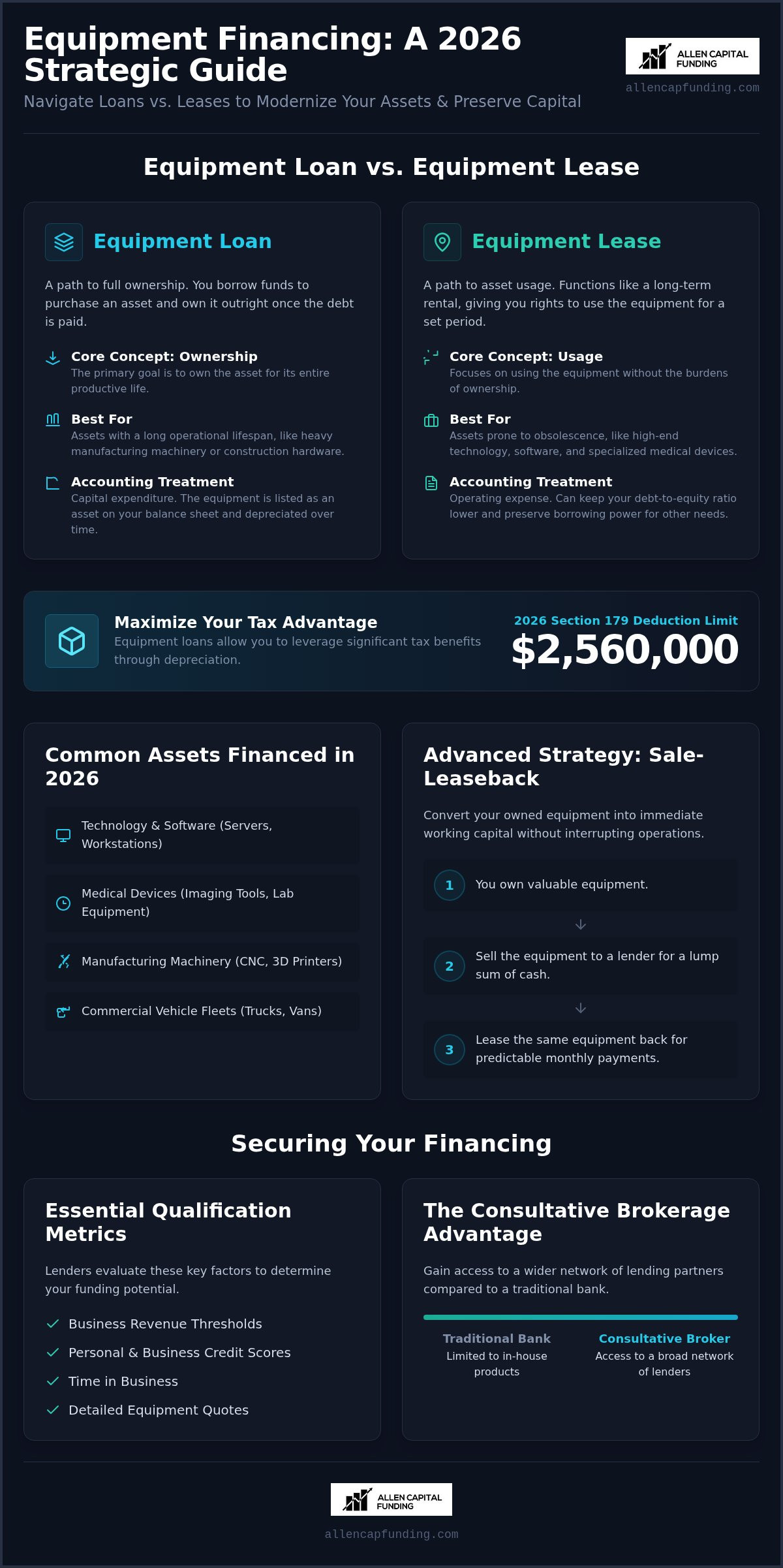
Choosing between a loan and a lease is one of the most critical decisions you'll make when securing equipment financing New York. This choice dictates how the asset appears on your balance sheet and how it impacts your long-term liquidity. An equipment loan is fundamentally an ownership play; you borrow the funds to purchase the asset and own it outright once the debt is retired. In contrast, a lease provides usage rights for a specific period, functioning more like a long-term rental agreement. It's about deciding whether you want to own the tool or simply use the service it provides.
This distinction carries heavy weight for your accounting. Loans are categorized as capital expenditures, allowing you to list the equipment as an asset while depreciating its value over time. Leases are often treated as operating expenses, which can keep your debt-to-equity ratio lower and preserve your borrowing power for other needs. In 2026, most financing structures offer terms ranging from 2 to 7 years. You'll also need to decide between a fixed interest rate for payment predictability or a variable rate that might offer lower initial costs in a shifting market. Each path has distinct advantages depending on your specific industry and growth stage.
When an Equipment Loan Makes Sense
Ownership is the primary goal for assets with a long operational lifespan. If you're investing in heavy manufacturing machinery or construction hardware that will remain productive for a decade or more, a loan is usually the superior path. One of the most significant advantages is the ability to leverage the Section 179 deduction. For the 2026 tax year, the deduction limit is $2,560,000, allowing you to deduct the full purchase price of qualifying equipment in the year it's placed in service. This provides an immediate boost to your cash flow through tax savings.
Beyond tax benefits, you build equity in the equipment with every payment. Many businesses utilize SBA 7(a) loans to fund these purchases because they offer competitive spreads above the prime rate. If you aren't sure which path fits your current trajectory, performing a financial check-up can help clarify your capital needs and long-term equity goals.
When Equipment Leasing is Superior
Leasing is the strategic choice for assets prone to rapid obsolescence. Technology, specialized medical devices, and high-end software suites often have a short peak-performance window. A lease allows you to upgrade to the latest models at the end of the term without the hassle of selling old hardware. Leases typically require less cash out-of-pocket than loans, which helps you maintain a stronger cash position for daily operations.
You generally have two options at the end of a lease term. A Fair Market Value (FMV) lease offers the lowest monthly payments and the option to return the equipment or buy it at its current market price. Alternatively, a $1 buyout lease allows you to take full ownership for a nominal fee once the term ends. This flexibility ensures your business stays modern without the risk of being stuck with outdated, inefficient tools.
Advanced Strategies: Sale-Leasebacks and Liquidity
A sale-leaseback is a sophisticated financial move where you sell equipment you already own to a lender and immediately lease it back. This strategy is particularly effective for businesses that have significant capital tied up in machinery or vehicles but need immediate cash for other opportunities. Instead of waiting years to recoup your investment through depreciation, you get a lump sum of cash while keeping the equipment on-site and fully operational. It's a common tool for companies seeking equipment financing New York to optimize their current asset base without disrupting production.
This dual benefit provides an immediate cash infusion while maintaining full operational use of the asset. It transforms a static asset into a dynamic source of funding. Choosing the right partner to facilitate this transaction is critical. We recommend reviewing our guide on equipment financing companies to understand how to select a provider that specializes in these advanced liquidity structures.
Unlocking Balance Sheet Liquidity
Think of your equipment as a "savings account" you can tap into when you need to fund an expansion or bridge a seasonal gap. This strategy is especially popular in 2026 for logistics and manufacturing fleets where asset equity is high. While many owners look toward business lines of credit for flexible capital, a sale-leaseback can often provide a larger single infusion of cash based specifically on the appraised value of your hardware. This liquidity can even act as the required equity for a larger project under the SBA 504 loan program, which is designed for major fixed assets and real estate. By converting "trapped" equity into liquid working capital, you gain the agility to pivot when the market demands it.
Strategic Financial Check-Ups
Regularly evaluating your equipment equity should be a standard part of your routine financial review. Many business owners overlook the value sitting in their warehouse or on their shop floor. A professional broker plays a vital role here; they act as a guide to identify underutilized assets that are prime candidates for refinancing. An equity draw is the strategic process of extracting cash from an owned asset based on its current market appraisal. This proactive approach ensures your business remains liquid and ready for the next phase of growth.
Essential Qualification Criteria for Equipment Financing
Securing approval for equipment financing New York requires a blend of solid financials and a clear operational vision. Most lenders prioritize three primary pillars: your time in business, consistent annual revenue, and a formal equipment quote from a reputable vendor. While traditional banks often demand a high FICO score, equipment-backed funding is different. The asset itself provides a safety net for the lender. If the machinery holds its value well on the secondary market, you'll likely find more flexibility in the underwriting process than you would with an unsecured loan.
A key factor in securing favorable terms is the "Mission Critical" designation. If your business cannot generate revenue without the asset, lenders view the loan as lower risk because you're highly motivated to keep up with payments. For those in specialized industries, following a strategic roadmap for heavy equipment financing can help you navigate the unique requirements of high-value industrial hardware.
The Broker Advantage in Qualification
Navigating the diverse lender landscape is where a strategic partner becomes invaluable. Brokers like Allen Capital Funding don't just submit applications; they match your specific profile to the appetites of various lending partners. This is especially helpful when seeking equipment financing New York while overcoming obstacles like bad credit equipment financing. We help you build a tailored narrative that explains your financials in the context of future growth, turning a set of numbers into a compelling business case for our partners.
Documentation Checklist for 2026
Preparation is the key to accelerated success. You'll need to gather standard items to streamline the process:
Tax Returns: Usually the most recent two years of business and personal filings.
Bank Statements: The last three to six months of business operating accounts.
Equipment Invoice: A detailed quote from the seller including the make, model, and year.
Growth Projections: A brief plan showing how the new asset will increase your revenue.
Lenders will specifically look at your Debt Service Coverage Ratio (DSCR), which is a financial metric that measures your company’s ability to use its operating income to cover all debt-related payments, including the principal and interest on your new equipment. Ready to see where your business stands? Start your financial check-up today to identify the best funding path for your next acquisition.
Choosing Your Partner for Equipment Financing New York and Beyond
Selecting the right partner for equipment financing New York is a decision that defines your company’s trajectory. Many entrepreneurs default to traditional banks, only to find a cold, transactional experience. These institutions often prioritize rigid checklists over your business's actual potential. A partnership-driven brokerage model offers a more effective alternative. We act as a dedicated facilitator of your accelerated success by focusing on expert guidance and strategic clarity. This consultative approach ensures your financing isn't just a debt; it's a tool for empowerment.
We provide professional confidence through every stage of the process. You need a steady hand to manage the complexities of the 2026 financial market. By acting as a proactive ally, we help you secure the assets required to stay competitive while protecting your cash flow. Our goal is to make you feel capable and well-supported as you scale your operations in the Empire State. We treat your success as our own, providing the reliability you expect from a long-term strategic consultant.
Why a Dedicated Guide Matters
The road to expansion is often blocked by administrative hurdles and opaque lending criteria. Allen Capital Funding simplifies this path by removing the barriers that slow you down. One of the greatest benefits of our model is having a single point of contact for a wide range of capital solutions. Whether your strategy requires an SBA loan, a line of credit, or specialized equipment financing New York, we coordinate the moving parts. This holistic management prevents the common mistake of over-leveraging one area of your business at the expense of another. We ensure your capital structure remains balanced and resilient.
Next Steps for Your Strategic Growth
Moving forward with your acquisition should be a fast-paced and efficient process. We invite you to book an online consultation to explore the tailored options available for your specific industry. Preparing for your first capital strategy session is straightforward. Focus on your primary objectives and have your recent operational data ready for review. We'll work together to turn your equipment needs into a reality that supports your broader vision. Contact Allen Capital Funding for a tailored equipment financing solution today.
Modernize Your Operations with Confidence
Strategic growth in 2026 requires more than just hard work; it demands a sophisticated approach to asset management. By choosing between the long-term equity of an equipment loan and the operational agility of a lease, you position your business to thrive without draining cash reserves. We've explored how advanced tools like sale-leasebacks can unlock trapped capital, providing the liquidity needed for rapid expansion. Managing the landscape of equipment financing New York doesn't have to be a confusing journey when you have the right ally.
Allen Capital Funding acts as your steady guide, offering access to a national network of specialized commercial lenders. Whether you operate in the medical, tech, or logistics sector, we provide tailored funding options that align with your specific growth goals. Our team delivers dedicated expert guidance to ensure your capital strategy is both efficient and sustainable. You're ready to bridge the gap between your current state and your future goals. Book your strategic equipment financing consultation with Allen Capital Funding today. Your next phase of accelerated success is within reach.
Frequently Asked Questions
How does small business equipment financing differ from a standard business loan?
Equipment financing is fundamentally different because the asset you're purchasing serves as the primary collateral. This structure often results in lower interest rates and more flexible qualification requirements compared to unsecured business loans. Since the lender has a direct claim on the equipment, you don't always need to pledge personal assets or real estate to secure the funding.
Is it better to lease or buy equipment for a startup in 2026?
Leasing is frequently the superior choice for startups because it preserves vital working capital during the critical early stages of growth. It prevents you from being tied to technology that might become obsolete in a few years. By choosing a lease, you gain access to the tools you need today with a predictable monthly payment that fits a tighter initial budget.
What credit score is typically required for equipment financing?
Lenders generally look for a credit score of 600 or higher, though options exist for various financial profiles. Because the hardware acts as security, your score isn't the only factor in the decision. Strong business revenue and the specific type of asset you're buying can often outweigh a less-than-perfect personal credit history.
Can I finance used equipment through a broker?
You can absolutely finance used equipment through a strategic broker. Most lenders will approve used assets as long as they're in good working condition and have a verifiable market value. This is a common strategy for businesses looking to reduce their total debt while still upgrading their operational capacity with reliable machinery.
What are the tax benefits of equipment financing under current 2026 laws?
The primary tax benefit is the Section 179 deduction, which allows for a full write-off of up to $2,560,000 in 2026. This incentive encourages businesses to invest in themselves by providing a significant reduction in taxable income. It's a powerful tool for optimizing your cash flow during the very first year of asset ownership.
How long does the approval process take for an equipment loan?
The approval process for equipment financing New York is remarkably efficient, often taking between 24 and 72 hours. Once you submit your basic documentation and the equipment quote, lenders move quickly to issue a commitment. This speed allows you to secure the machinery you need without delaying your production schedule or missing a growth opportunity.
What happens at the end of an equipment lease term?
You have several flexible options at the end of your lease term. You can return the equipment to the lender, upgrade to the latest model, or purchase the asset outright. Many owners choose a $1 buyout option at the start of the lease to ensure they take full ownership once the final payment is made.
Can I finance equipment if I have challenged credit?
Challenged credit doesn't have to be a barrier to securing the tools your business needs through equipment financing New York. Since the financing is asset-based, lenders focus more on the value of the equipment and your company's ability to generate revenue. A larger down payment or a shorter term can often help bridge the gap for borrowers with lower credit scores.


Comments