
SBA Loan for Franchise Purchase: Uses, Terms and Documents
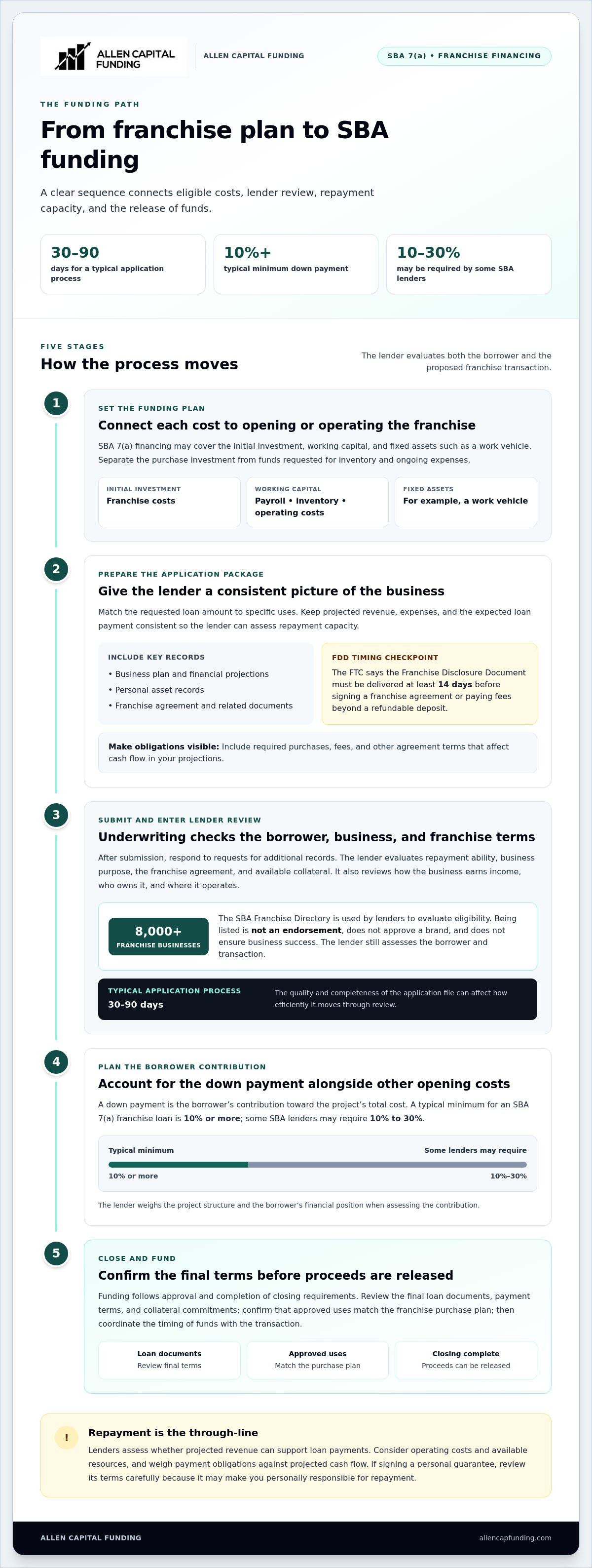
SBA 7(a) funds may cover the initial investment, working capital, and fixed assets such as a work vehicle. Lenders assess franchise eligibility by reviewing the operating agreement and the SBA Franchise Directory, which is not an endorsement of a brand or a promise of business success.
Buying a franchise can make the funding process more structured, but approval still depends on showing how the business will operate and repay its debt. A clear loan package connects the purchase plan with financial projections and supporting records.
This guide explains eligible uses, how franchise SBA financing works, and how 7(a) loans compare with 504 financing. It also outlines the documents to prepare, including SBA loan application Form 1919, so you can organize the details lenders need to assess your request.
Table of Contents
How Can SBA Franchise Loans Be Used?
Eligible uses include franchise costs that support opening or operating the business. An SBA loan for franchise purchase may cover the initial investment, working capital, and fixed assets such as a work vehicle.
The SBA Franchise Directory is a list lenders use to evaluate franchise eligibility. The U.S. Small Business Administration maintains the directory, which is made available to lenders and Certified Development Companies (CDCs). It includes more than 8,000 franchise businesses eligible for SBA financing. Inclusion is not an endorsement or approval of a brand, and it does not ensure the business’s success.
Franchise eligibility is the lender’s assessment of whether the business and franchise arrangement meet SBA requirements. Lenders review the franchise operating agreement and check the directory during evaluation. They consider how the business earns income, who owns it, and where it operates. A franchise brand’s presence in the directory does not replace the lender’s review of the borrower and proposed transaction.
Borrower eligibility is the applicant’s ability to meet SBA program standards and repay the loan. Businesses generally must meet SBA size standards, have a sound business purpose, and demonstrate repayment ability. Lenders assess the full application, including the business plan and financial projections, to understand how revenue will support loan payments. The franchise’s operating costs and the owner’s available resources also help explain the proposed financing plan.
Working capital covers ordinary business expenses, such as payroll, inventory, and operating costs. Fixed assets are longer-term items used to run the franchise, such as a work vehicle. Connect every requested use to the franchise’s opening or operating needs. For example, separate the initial investment from funds requested for inventory and ongoing expenses.
The Franchise Disclosure Document (FDD) is the disclosure document a franchisor provides to a prospective franchisee. According to the Federal Trade Commission, the FDD must be delivered at least 14 days before signing a franchise agreement or paying fees beyond a refundable deposit. Review it alongside the operating agreement so projected costs, obligations, and financing needs align.
Risks include taking on debt the franchise cannot support and having to make repayments if revenue falls short of projections. If you sign a personal guarantee, its terms may make you personally responsible for repayment. Read the guarantee and loan documents carefully, and weigh the payment obligations against the business’s projected cash flow.
How does SBA franchise financing work?
SBA franchise financing involves a lender’s review of the borrower, business plan, and franchise terms. The process moves from preparing an application through underwriting, closing, and funding.
Application Package Preparation
An application package contains the records lenders use to assess the franchise and borrower. Include a business plan, financial projections, and personal asset records to show repayment capacity. Match the requested loan amount to specific uses, such as the initial investment, inventory, equipment, or working capital. Keep figures consistent so the lender can compare projected revenue and expenses with the expected loan payment.
The franchise agreement sets out the franchisee’s duties and the franchisor’s terms. Provide it and related franchise documents with the application. Lenders review the terms and check the SBA Franchise Directory as part of assessing eligibility. Include obligations that affect cash flow, such as required purchases or fees, in your projections. If the agreement changes during review, submit the updated version so the loan file reflects the proposed transaction.
Application Processing and Funding
Application processing is the lender’s review of the loan request before a funding decision. First, submit the package and respond to requests for additional records. The lender evaluates repayment ability, the business purpose, the franchise agreement, and available collateral. A typical application process takes 30 to 90 days, though the quality and completeness of the file can affect how efficiently it moves through review.
Down payment is the borrower’s contribution toward the project’s total cost. A typical minimum for an SBA 7(a) franchise loan is 10% or more, while some SBA lenders may require 10% to 30%. The lender weighs the project structure and borrower’s financial position when assessing the contribution. Plan for the required funds alongside other opening expenses, rather than treating the down payment as the only cash need.
Funding is the release of loan proceeds after approval and closing requirements are completed. Before closing, review the final loan documents, payment terms, and any collateral commitments. Confirm that the approved uses match the franchise purchase plan, then coordinate the timing of funds with the transaction. If you’re organizing financing alongside other business funding needs, review your funding options as part of the planning process.
SBA 7(a) loans for franchise purchases and business acquisitions
Yes, an SBA loan can finance an eligible franchise purchase or business acquisition. The SBA 7(a) program supports varied business purposes, while the right loan depends on the purchase plan and how the funds will be used.
An SBA 7(a) loan is a long-term business loan that can fund franchise purchases, acquisitions, and operating needs. It can also cover expansions, start-ups, inventory, equipment, commercial real estate, debt refinancing, and working capital. For an acquisition, build the funding request around the purchase and related eligible business costs, then show how projected revenue will support repayment.
It can suit a smaller franchise purchase or acquisition when the total financing need falls within that limit. Show how each requested amount serves a business purpose, such as buying inventory or equipment. The lender still evaluates the business plan, repayment ability, and borrower’s credit when making its approval decision.
An SBA 504 loan provides long-term, fixed-rate financing through a Certified Development Company (CDC). It is designed for eligible fixed assets, including commercial real estate purchases, construction or improvements, and long-term equipment. For a franchise project, this can be relevant when the main need involves a location or major equipment rather than general working capital. The typical structure assigns 40% to the CDC, 50% to a third-party lender, and 10% to the franchisee.
An SBA loan guarantee helps lenders provide capital to eligible small businesses. The guarantee is made to the lender, not the borrower, and does not remove the borrower’s repayment obligation. Some SBA-guaranteed loans may offer lower down payments, flexible overhead requirements, or no collateral requirement.
A traditional bank or credit union loan is financing provided without an SBA guarantee. Traditional loans for comparable franchise projects may require down payments of 30-40% or more. Compare the required contribution, repayment structure, eligible uses, and collateral terms against the project’s cash needs. SBA financing may provide a different structure, but the lender’s assessment still depends on the purchase, business plan, and ability to repay.
Comparing loan terms and interest rates
Compare financing by its total repayment cost, not just the advertised rate. The loan program, requested amount, use of proceeds, and ownership structure all affect the terms to consider.
Loan Amounts, Terms, Rates, and Fees
Loan comparison means reviewing the amount, repayment period, interest rate, fees, and borrower contribution together. SBA 7(a) terms can extend from 10 to 25 years, depending on purpose. Real estate purchases related to franchise acquisition may qualify for terms up to 25 years; other purposes can have terms up to 10 years.
For variable-rate 7(a) loans, maximum rates effective January 1, 2025 are based on the prime rate. With a current prime rate of 7.00%, maximum variable rates range from 10.00% to 13.50%. Maximum fixed rates range from 12.00% to 15.00%, based on that prime rate.
SBA-guaranteed loan rates and fees are generally comparable to those of non-guaranteed loans. Compare the payment schedule and total fees as well as the rate, since a longer term can change the total interest paid.
SBA 7(a) Uses and Terms
An SBA 7(a) loan is a loan program for long-term financing across varied business purposes. Eligible uses include franchise purchases, business acquisitions, expansions, start-ups, inventory, equipment, commercial real estate, debt refinancing, and working capital.
For a purchase plan, separate one-time acquisition costs from the funds needed to operate. Compare the amount requested with eligible uses and the cash flow available for repayment. The SBA guarantee supports lender access to capital, but the business owner remains responsible for the loan. A longer repayment term may lower scheduled payments while extending the time interest accrues.
To calculate the total cost of buying a franchise, add the purchase price, franchise fees, opening expenses, and working capital needs. Then include loan interest and fees over the repayment term, based on the proposed rate and payment schedule.
Comparing Lenders and Financing Options
Lender comparison means assessing offers using the same loan amount, project costs, and repayment assumptions. Buyers comparing SBA lenders and franchise financing options in their state should line up rates, fixed or variable structure, terms, fees, down payment, collateral, and payment schedule.
Ask each lender to show how its terms fit the same franchise purchase and planned uses. Compare the total repayment amount, not just the monthly payment. Ownership, the franchise project, and the requested use can affect a lender’s assessment, so keep those details consistent across applications.
Finally, compare SBA 7(a) financing with SBA 504 when the project centers on real estate or long-term equipment. A 504 loan offers fixed-rate financing through a Certified Development Company, with rates tied to market rates for 10-year U.S. Treasury issues and terms up to 25 years. Match the loan program to the asset and repayment plan.
Documents needed for a franchise SBA loan
A loan package is the collection of documents lenders use to assess eligibility, capital needs, and repayment ability. For a franchise application, organize the records around three questions: what you’re buying, how the business will operate, and how it can repay the loan.
Core Application Documents
SBA Form 1919 is the SBA loan application form included in franchise loan documentation. Complete it accurately and keep its borrower and business details consistent with the rest of the package. Use the form as a reference point when organizing supporting records, so the lender can connect the application to the proposed transaction.
A business plan explains how the franchise will operate and earn revenue. Include the franchise concept, planned operations, target customers, and responsibilities involved in running the business. Pair it with financial projections showing expected revenue, operating expenses, and the funds needed to open. Together, these documents help lenders assess the business purpose and whether projected cash flow can support repayment.
Franchise and Purchase Records
The franchise agreement sets out the terms between the franchisor and franchisee. Provide the proposed agreement and related records so lenders can review the arrangement and assess franchise eligibility. Keep the purchase details consistent across the agreement, business plan, and loan request. If the proposed transaction changes, update the relevant documents to reflect the same terms and funding needs.
The Franchise Disclosure Document (FDD) describes key information about the franchise opportunity. Use it alongside the agreement to understand the proposed investment and obligations that may affect operating costs. Bring relevant details into the business plan and projections, rather than leaving lenders to reconcile differing assumptions across records. Clear documentation shows how the requested capital relates to the franchise purchase and its operation.
Financial Support for Repayment
Personal asset information helps lenders assess the borrower’s financial position and repayment capacity. Prepare an organized summary of personal assets and ensure the figures support the information in the loan application. Explain how the owner’s resources fit the project, including the planned contribution and the business’s projected cash flow.
Financial projections estimate the franchise’s future income and expenses. State your assumptions clearly, separating expected sales from costs such as inventory, payroll, and other operating needs. Connect the projections to the requested loan amount and payment obligations. For example, if the plan includes working capital, show how it will support operations while the franchise builds revenue.
Before submission, review the package for consistent names, purchase terms, requested uses, and financial figures. A well-organized set of SBA loan documents makes it easier to follow how the franchise may qualify and repay. Explore SBA loan support as you prepare your franchise financing package.
Allen Capital Funding: Credit Lines
Allen Capital Funding helps business owners explore funding options for franchise purchases and ongoing operating needs. Its SBA Loans can support eligible business financing, while Credit Lines and Working Capital may suit cash-flow needs as the franchise operates. Real Estate financing may be relevant when the purchase plan includes commercial property.
Bring your franchise agreement, purchase details, business plan, and financial projections to a funding discussion. These documents clarify the purpose of the request, expected repayment, and whether an SBA Loan, Credit Line, or another listed option better fits the business need. If the franchise purchase includes property, outline that component separately from working capital needs.
Contact Allen Capital Funding to discuss financing options for your franchise plans.
Move your franchise plan toward a funding decision
Buying a franchise is a business decision as much as a purchase. Before committing, consider how the funding structure fits your ownership goals, operating plans, and financial capacity. A thoughtful plan can help you understand the responsibilities involved and decide how to move forward.
As you plan your next steps, connect the franchise opportunity with the business’s wider needs. An SBA loan for a franchise purchase may be part of the plan, while ongoing cash flow or a property purchase may call for different financing. Allen Capital Funding offers SBA Loans, Credit Lines, and Real Estate financing to support these business needs.
Bring your current plan and financing priorities into the conversation. Contact Allen Capital Funding to discuss your franchise funding needs and identify a practical next step. With a well-organized plan, you can approach the purchase process with greater clarity and confidence.
Frequently Asked Questions
What are the SBA loan options for franchises?
The main options are SBA 7(a) financing for broad business needs and SBA 504 financing for eligible real estate or long-term equipment. A 7(a) request can combine purchase costs with eligible operating needs, while 504 focuses on fixed assets. For example, a franchisee buying a business and funding inventory may consider 7(a); a project centered on a commercial property may fit 504 better.
Which SBA loan programs finance franchise purchases, and what are their limits and terms?
Use 7(a) for broader eligible purposes; consider 504 when the project centers on commercial property or long-term equipment.
Is the franchise on the SBA Franchise Directory, and how does that affect eligibility?
The SBA Franchise Directory helps lenders and Certified Development Companies evaluate whether a franchise business operating under an agreement is eligible for SBA financing. Lenders also review the franchise agreement, so directory placement is one part of their assessment, not a substitute for reviewing the transaction. A listed brand is not endorsed or approved by the SBA, and directory placement does not guarantee the business will succeed.
What down payment is required for an SBA franchise acquisition loan?
A typical minimum down payment for an SBA 7(a) franchise loan is 10% or more, and some lenders may require 10% to 30%. For planning, calculate the contribution against the project’s full eligible cost, then account separately for opening expenses and operating cash needs. The lender assesses the borrower and project structure, so compare the required contribution with the remaining funds available to launch and operate.
What are the SBA loan interest rates, fees, and repayment terms for buying a franchise?
SBA 7(a) maximum variable rates range from 10.00% to 13.50%, and maximum fixed rates range from 12.00% to 15.00%, based on a 7.00% prime rate. The listed rate caps took effect January 1, 2025. Fees and rates are generally comparable to non-guaranteed loans. Repayment can extend up to 10 years, or up to 25 years for related real estate purchases. Compare the payment schedule and total borrowing cost.
What credit score, cash flow, collateral, and business experience do lenders require?
There is no universal credit score threshold in the program criteria. Lenders assess the borrower’s credit profile alongside projected cash flow, available assets, business purpose, and ability to repay. Prepare financial projections showing how sales can cover operating expenses and loan payments. Explain relevant experience through your operating plan and management responsibilities, and document available collateral and personal assets as part of the full application.
What documents are needed to apply for an SBA loan to buy a franchise?
Prepare SBA loan application Form 1919, the franchise agreement, the FDD, a business plan, financial projections, and information about personal assets. Keep purchase terms and requested funding uses consistent across the records. For example, projections should reflect the same operating costs and opening needs described in the plan. Organize documents by borrower, franchise transaction, and repayment so the lender can follow the request efficiently.
What are the steps and typical timeline to get an SBA loan for a franchise purchase?
The process typically takes 30 to 90 days. Start by assembling the business plan, projections, financial records, and franchise documents. Submit the loan application, then respond to lender requests while it reviews eligibility, repayment capacity, the agreement, and collateral. After approval, review and complete closing documents before funds are disbursed. Keep the purchase timeline coordinated with application review and closing requirements to avoid preventable delays.



Comments