
SBA 7(a) Loan Requirements: 2026 Small Business Guide
Did you know that as of 2026, even a perfect credit score no longer guarantees you a seat at the table for the most sought-after small business loan in America? Most entrepreneurs feel buried under mountains of paperwork and the constant fear that one minor oversight could sink their entire application. It's common to feel overwhelmed by the shifting landscape of SBA 7(a) loan requirements, especially with recent updates to citizenship eligibility and the discontinuation of the standardized SBSS score. We understand that securing capital should feel like a strategic breakthrough, not an endless bureaucratic battle.
This guide empowers you to master the complex eligibility standards and documentation needs required to secure the gold standard of small business financing in 2026. You'll gain a clear, actionable roadmap to approval that simplifies the process of bridging gaps in credit or collateral. We will explore the new 1.10:1 debt service coverage ratio, clarify the "Credit Elsewhere" rules, and show you how a dedicated partner can streamline the path from initial application to final funding.
Table of Contents
Understanding SBA 7(a) Eligibility in 2026
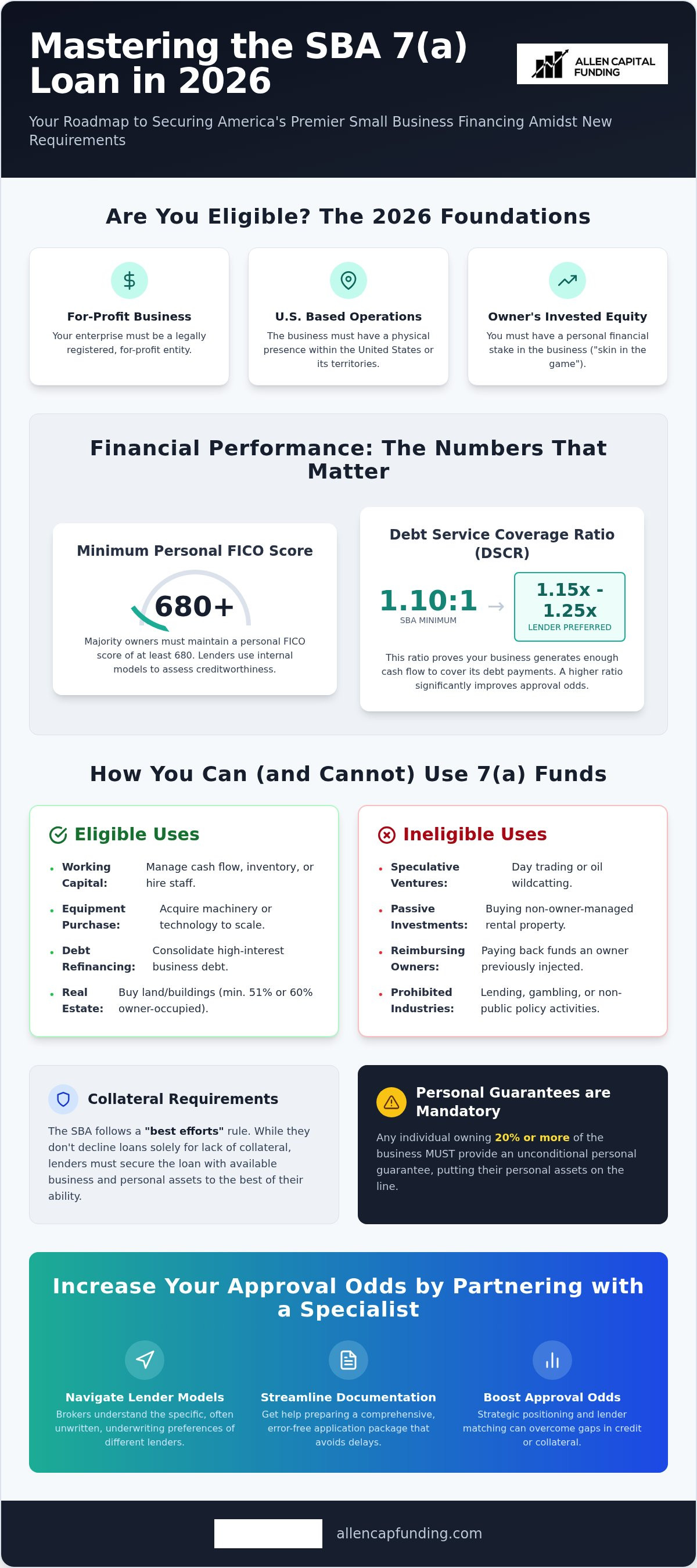
The SBA 7(a) program serves as the federal government's primary mechanism for delivering financial assistance to the American small business sector. It's designed to provide capital to entrepreneurs who might not meet the rigid criteria of traditional commercial lenders. To begin your journey, you must first confirm that your enterprise meets the fundamental SBA 7(a) loan requirements. At its core, the program requires that your business operates for profit and maintains a physical presence within the United States.
Beyond these basics, the SBA enforces an "Invested Equity" rule. This means you can't rely solely on borrowed funds; you must demonstrate a personal financial stake in the venture. This skin in the game ensures that your interests are aligned with the long-term success of the business. Lenders view this commitment as a critical indicator of your dedication to the project's success.
Basic Business Qualifications
Determining if your company is "small" depends on your specific industry. The SBA uses North American Industry Classification System (NAICS) codes to set limits on annual receipts or employee counts. For a detailed SBA 7(a) Loan program overview, you can see how these standards have evolved to support diverse sectors. In 2026, these thresholds reflect recent economic shifts, ensuring that mid-sized firms in high-cost industries aren't unfairly excluded. Your business must also demonstrate a legitimate purpose, showing that the capital will drive growth or operational stability rather than just covering poor management.
Eligible and Ineligible Uses of Funds
The 7(a) program is remarkably versatile, but it isn't a blank check. Lenders prioritize strategic uses that strengthen your balance sheet. Common eligible uses include:
Working capital: Managing seasonal cash flow gaps or hiring essential staff.
Equipment: Purchasing machinery or technology to scale production.
Debt refinancing: Consolidating high-interest business debt to improve monthly cash flow.
Real estate: Acquiring land or buildings, provided the business occupies at least 51% of the space for existing buildings or 60% for new construction.
Conversely, certain activities are strictly prohibited. You cannot use 7(a) funds for speculative ventures, such as wildcatting or day trading. Passive investments, like buying a rental property you don't manage, are also banned. The SBA also excludes businesses involved in lending, gambling, or any activity that doesn't align with public policy. Understanding these SBA 7(a) loan requirements early prevents you from wasting time on a project that the agency simply won't touch.
Credit and Financial Performance Standards
Lenders in 2026 prioritize your business's ability to generate steady cash flow over simple collateral. Meeting the SBA 7(a) loan requirements involves a deep dive into your global financial health. This analysis combines your personal credit history with the business's operational performance to ensure the new debt won't strain your resources. Lenders look for a clear pattern of historical revenue that suggests future stability. They want to see that your business can thrive even after accounting for the new monthly payments.
Your global cash flow analysis is more than just a profit and loss statement. It accounts for your personal living expenses, existing business debts, and the projected impact of the new capital. Lenders look for "excess" cash flow as a buffer against market volatility. This is particularly true for "SBA Express" loans, where digital documentation and speed are prioritized. Ensuring your digital records are clean and accessible is a key part of modern SBA 7(a) loan requirements.
Credit Score Benchmarks for 2026
Expect majority owners to maintain a personal FICO score of at least 680. While the SBA officially discontinued the mandatory FICO SBSS score for small loans in March 2026, many lenders still use similar internal models to aggregate your personal and business data. High scores signal reliability. If your profile has gaps, performing a strategic financial check-up can help identify areas for improvement before you submit formal documents. You can find the latest updates on Official SBA 7(a) loan requirements to see how these benchmarks apply to your specific loan size.
Cash Flow and Liquidity Analysis
The Debt Service Coverage Ratio (DSCR) is the most critical metric for approval. As of March 2026, the minimum DSCR for small loans is 1.10:1, though most lenders prefer a range of 1.15x to 1.25x for larger projects. This ratio proves your business generates enough net operating income to cover all debt obligations plus the new loan payment. Liquidity is equally vital. Lenders want to see that you have working capital reserves to handle unexpected expenses.
Historical Revenue: Three years of consistent growth or stability.
Operating Margins: Healthy margins that indicate operational efficiency.
Debt Obligations: A manageable level of existing business and personal debt.
Having a solid history with a business line of credit often strengthens your case. It demonstrates a track record of responsible borrowing and provides a safety net that reassures underwriters. Consistent, documented revenue remains the foundation of a successful application.
Collateral Requirements and Personal Guarantees
One of the most common misconceptions regarding SBA 7(a) loan requirements is that a lack of hard assets automatically leads to a rejection. In reality, the SBA operates under a "best efforts" collateral rule. This means that while a lender must secure as much collateral as possible to protect the government's interest, they cannot decline a loan solely because your business lacks enough assets to fully cover the loan amount. This policy is vital for the growing number of "asset-light" service businesses in 2026, such as consulting firms and software companies, which often lack significant machinery or real estate.
When you apply, the lender will first look to place liens on all available business assets. If a shortfall remains, they then evaluate personal assets, specifically real estate owned by the principals. Understanding the SBA 7(a) loan application process helps you prepare for these valuation discussions. Lenders prioritize business assets like equipment and inventory, but they will look at personal property if the business's balance sheet doesn't provide sufficient coverage for the debt.
The Reality of Collateralization
Valuing your assets accurately is the first step in a successful application. Lenders typically discount the value of inventory and equipment to reflect what they might fetch in a quick sale. If your business assets are insufficient, the "Personal Residence" rule may apply. If you have 25% or more equity in your home, the lender might require a lien on that property to bridge the collateral gap. Gaining a deeper understanding of asset-based lending for small business can help you better categorize and value your balance sheet before the underwriting process begins. This preparation ensures you aren't surprised by how a lender views your inventory or specialized equipment.
Understanding the Personal Guarantee
While collateral rules offer some flexibility, personal guarantees are non-negotiable. Every individual with a 20% or greater ownership stake in the business must sign an unlimited personal guarantee. This legal commitment makes the owners personally responsible for the debt if the business fails. It acts as a primary trust-builder for the lender, signaling that you are fully invested in the company's success.
Unlimited Guarantees: Required for all owners with 20% or more equity.
Limited Guarantees: Sometimes used for owners with less than 20% stake, capping their liability to a specific dollar amount.
Psychological Commitment: The guarantee ensures that business owners remain proactive in solving financial challenges.
Meeting these SBA 7(a) loan requirements proves your stability and commitment. While the prospect of a personal guarantee feels daunting, it's the trade-off for accessing long-term capital with favorable rates. By securing the loan with a mix of business assets and personal commitment, you create a path toward sustainable growth.
The 'Credit Elsewhere' Test and Document Checklist
Every applicant must pass a specific regulatory hurdle known as the "Credit Elsewhere" test. The Credit Elsewhere test is the SBA's way of ensuring they support businesses that truly need government-backed leverage. Essentially, the lender must certify that your business is unable to obtain a conventional loan on reasonable terms without the SBA's guarantee. This doesn't mean your business is struggling. It often means your project requires the longer repayment terms or lower down payments that only the SBA 7(a) loan requirements allow.
Demonstrating the Need for SBA Support
Proving you cannot find conventional financing requires strategic positioning. Lenders may reject a traditional application because the industry is perceived as high-risk or because the business lacks the specific collateral depth required by internal bank policies. You must articulate why conventional terms, which often feature shorter durations or balloon payments, aren't feasible for your current growth stage. Focus on how the SBA 7(a) structure provides the necessary breathing room to scale operations or preserve cash flow during a transition.
The foundation of your application rests on three years of federal income tax returns for both the business and its owners. These documents provide the historical context lenders need to verify your revenue claims. Alongside these returns, you must provide interim financial statements, including a Profit and Loss statement and a Balance Sheet, that are no older than 90 days. Consistency between your tax filings and your interim data is vital for building trust with underwriters.
The 2026 Digital Document Checklist
Modern lending portals in 2026 demand standardized digital files for rapid processing. Messy scans or disorganized folders can delay your approval by weeks. Pay close attention to SBA Form 1919, which collects borrower information, and Form 413, the Personal Financial Statement. Accuracy on these forms is critical. Even a small discrepancy in reported personal assets can trigger a manual review that slows the entire cycle. Organize your files into a clear, labeled structure to ensure a smooth transition through the lender's automated underwriting systems.
Don't overlook the "human" side of the risk. Detailed management resumes and a concise business profile allow you to sell your expertise and operational history. Lenders aren't just looking at numbers; they're looking for capable leaders who can navigate market shifts. If you're ready to organize your application, a strategic financial check-up is the best way to ensure your file aligns with current SBA 7(a) loan requirements.
Partnering with an SBA Loan Broker for Success
Direct-to-bank applications often fail because entrepreneurs approach lenders without understanding their specific risk appetites. A single denial from a local bank isn't the end of your journey. Instead, it's often a signal that your specific industry profile doesn't align with that particular bank's current lending goals. Professional brokers act as your dedicated advocate, ensuring your profile reaches the right institution. This strategic matching is what turns a potential rejection into a successful funding event.
Professional origination removes the administrative friction that typically stalls the application lifecycle. By cleaning up your financial story before it reaches an underwriter, a broker ensures you meet all SBA 7(a) loan requirements from day one. This proactive approach facilitates an "accelerated success" model, moving you from application to closing with much higher efficiency. You don't have to navigate the bureaucratic barriers alone when you have a partner who understands the nuances of the 2026 lending environment.
The Brokerage Advantage
Lenders frequently shift their criteria based on economic conditions and internal portfolio balance. Working with SBA loan brokers gives you immediate access to a nationwide network of lenders with varying risk appetites. While one bank might avoid your sector, another may be actively seeking to expand its footprint in that exact industry. Your broker advocates for your business during the critical underwriting phase, highlighting your strengths and addressing potential weaknesses before they become deal-breakers.
Expert advice is also essential when deciding between different loan structures. While this guide focuses on the 7(a) program, your business might benefit from a 504 structure for specific real estate projects. A broker helps you weigh these options, ensuring your capital strategy supports long-term growth rather than just short-term needs. They help you navigate the "Credit Elsewhere" documentation discussed earlier, proving to the SBA that your project deserves government-backed leverage.
Next Steps: Your Strategic Consultation
Preparing for your initial consultation is the first step toward securing your business's future. You should have your recent tax returns and interim financial statements ready for review. In the 2026 market, speed is a competitive advantage, but it requires precision. Setting realistic timelines for approval helps you plan your growth phases without the stress of unexpected delays. We focus on streamlining the path to progress, acting as the bridge between your current state and your future goals.
Ready to scale? Book your strategic financial consultation with Allen Capital Funding today. Our team is dedicated to providing the expert guidance and professional origination services you need to secure the gold standard of small business financing. Let's work together to ensure your application meets every SBA 7(a) loan requirements benchmark for a smooth approval.
Accelerate Your Path to Strategic Funding
Mastering the SBA 7(a) loan requirements in 2026 demands a blend of financial precision and operational storytelling. By focusing on critical benchmarks like the 1.10:1 debt service coverage ratio and the "best efforts" collateral rule, you position your business for a successful approval. Remember that the "Credit Elsewhere" test is not a hurdle; it's your opportunity to prove why government-backed leverage is the right tool for your current growth stage. Organizing your digital documentation early ensures you stay ahead of modern lender portals and automated underwriting systems.
You don't have to navigate these complex regulations alone. Our dedicated origination team provides expert guidance through the SBA's intricate SOPs, giving you access to a nationwide lender network focused on your specific industry. We remove the administrative friction that often stalls progress, acting as a reliable bridge to your future goals. Secure your business's future with a tailored SBA 7(a) loan strategy from Allen Capital Funding. Your vision for expansion is within reach when backed by the right capital partner.
Frequently Asked Questions
What is the minimum credit score for an SBA 7(a) loan in 2026?
Lenders typically look for a personal FICO score of 680 or higher for majority owners. Effective March 1, 2026, the SBA discontinued the mandatory use of the FICO SBSS score for small loans, allowing lenders to use their own internal credit analysis procedures. This shift makes your choice of lender critical. A professional origination team can help you identify which institutions have underwriting models that best align with your current credit profile and historical performance.
Do I need to be a US citizen to apply for an SBA 7(a) loan?
Yes, as of March 1, 2026, all direct and indirect owners of a small business applying for an SBA 7(a) loan must be U.S. Citizens or U.S. Nationals. They must also maintain their principal residence within the United States. Lawful permanent residents, including Green Card holders, are no longer eligible to hold an ownership interest in a business seeking this specific type of government-backed financing under the current 2026 eligibility guidelines.
Can I get an SBA 7(a) loan without collateral?
You can obtain a loan without full collateral because the SBA follows a "best efforts" rule. For loans exceeding $50,000, lenders follow their own internal collateral policies but are instructed not to decline an application solely due to a collateral shortfall. Lenders will typically lien all available business assets first. If a gap remains, they may seek a lien on personal real estate to meet the SBA 7(a) loan requirements for security.
What is the 'Credit Elsewhere' test and how do I pass it?
The "Credit Elsewhere" test requires you to demonstrate that your business cannot obtain comparable financing from conventional lenders on reasonable terms. This is a fundamental part of the SBA 7(a) loan requirements. You pass it by showing that traditional bank loans are unavailable due to factors like industry risk, the need for longer repayment terms, or a lack of specific collateral depth. Your lender documents this necessity during the formal underwriting process.
How long does the SBA 7(a) approval process typically take?
The timeline for approval and funding typically ranges from 30 to 90 days. Factors influencing this duration include the complexity of your project, the responsiveness of your documentation, and the specific lender's internal workload. SBA Express loans are generally faster, often providing a response within 36 hours of submission. Working with an experienced broker helps streamline this lifecycle by ensuring your digital file is error-free and standardized for modern lender portals and automated systems.
Are personal guarantees required for all SBA 7(a) loans?
Personal guarantees are mandatory for every individual who owns 20% or more of the small business. This is a non-negotiable requirement that ensures owners are personally invested in the success of the venture. These guarantees are usually unlimited, meaning the owners are responsible for the full amount of the debt if the business defaults. Owners with less than a 20% stake may occasionally be asked for limited guarantees depending on the lender's specific risk assessment.
Can SBA 7(a) funds be used to refinance existing business debt?
You can use SBA 7(a) funds to refinance existing business debt, provided the new loan offers a significant benefit to your cash flow. The SBA requires that the refinancing results in a payment reduction of at least 10% or provides more favorable terms that support the business's long-term stability. This is an excellent strategic move for businesses currently burdened by high-interest credit lines or short-term bridge loans that strain their monthly working capital reserves.
What are the primary differences between SBA 7(a) and 504 loans?
The 7(a) program is highly versatile and used for working capital, equipment, and debt refinancing. In contrast, the 504 loan program is specifically designed for major fixed assets like real estate or long-term machinery. While 7(a) loans have a maximum of $5 million, a business can now have a combined balance of up to $10 million across both programs as of July 2026. This allows for greater flexibility in funding large-scale expansion projects nationwide.


Comments