


PO Financing for Startups: A Strategic Guide to Fulfilling Large Orders in 2026
- anthonyarallen
- 3 days ago
- 11 min read
Did you know that the global purchase order financing market is projected to hit $7.69 billion in 2026? For many founders, this capital is the only thing standing between a missed opportunity and a massive breakthrough. You've likely spent months pitching to land a growth-defining contract, only to realize that the cash flow gap between production and payment is wider than expected. It's a common frustration to have the demand but lack the immediate capital to manufacture the goods.
We understand that turning down a major order feels like a step backward for your brand's momentum. This guide explains how po financing for startups empowers you to fulfill massive orders and protect your hard-earned equity without traditional bank constraints. You'll discover how to leverage your customer's creditworthiness to fund production, build stronger supplier relationships, and scale your operations with confidence. We'll walk through the strategic advantages of this non-dilutive funding and how it provides the accelerated success your business deserves.
Table of Contents
What is PO Financing for Startups? Unlocking Growth Without Equity Dilution
Purchase order financing is a specialized funding solution where a third-party lender pays your supplier directly to produce goods for a confirmed order. This model is revolutionary for early-stage companies. It allows you to accept contracts that might be ten times your current cash flow without needing the cash sitting in your bank account. By facilitating the production of goods you've already sold, po financing for startups bridges the gap between a signed contract and a final invoice.
The Startup Working Capital Dilemma
Many founders eventually encounter the success trap. This happens when you land a massive contract with a blue-chip retailer or government agency, but your bank balance can't cover the necessary manufacturing costs. Traditional banks often decline these requests. They focus on your company's limited credit history or short time-in-business. PO financing shifts this focus. Instead of scrutinizing your startup's financial past, lenders look at the creditworthiness of your customer and the reliability of your supplier. It's about the quality of the deal, not just the age of your company.
Preserving Founder Ownership in 2026
In the current market, preserving ownership is vital for long-term success. Selling a significant percentage of your company just to fund a single production run is an expensive mistake that haunts you during future exit events. While PO financing involves specific fees, it remains a temporary cost that protects your long-term stake. It acts as a strategic bridge to your next valuation milestone. By fulfilling large orders now, you prove your market fit and increase your company's value before you ever talk to an equity investor. Purchase order financing is a critical non-dilutive capital tool for high-growth startups aiming to scale without sacrificing control.
To master this strategy, you must understand the core components of the transaction:
Suppliers: The manufacturers or wholesalers who create or provide the physical goods.
End-Customers: The reputable B2B or government entities that issue the Purchase order.
The Spread: This is the profit remaining for your startup after the lender is repaid and the supplier is covered.
How Purchase Order Funding Works: The Step-by-Step Lifecycle
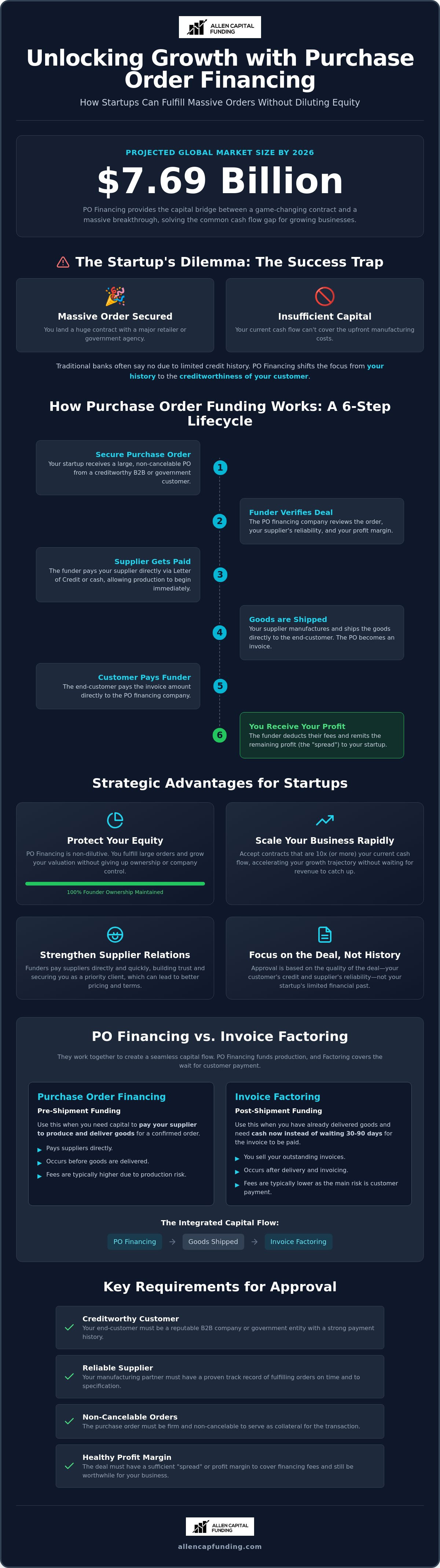
Understanding the mechanics of a transaction helps founders manage expectations and logistics. The cycle begins once you secure a valid purchase order from a creditworthy B2B or government customer. This document serves as the primary collateral for the deal. Unlike a standard bank loan, Purchase order financing relies on the strength of your customer’s credit rather than your startup's limited financial history.
Once the order is verified, the funding partner evaluates your supplier's capacity to fulfill the contract. After approval, the funder issues payment directly to the supplier via a Letter of Credit or cash. This allows production to start without you dipping into your own reserves. When the goods are shipped and the customer pays the funder, the lender deducts their fees and sends you the remaining profit margin. This streamlined flow is why po financing for startups is so effective for rapid scaling.
The Three-Way Partnership: You, Your Supplier, and Your Funder
Think of your funder as a strategic partner who monitors production quality and shipping logistics. Their involvement provides a "seal of approval" for your business. Suppliers feel secure knowing an institution backs the transaction, which often leads to better pricing. Communication is key; you can choose transparent or white-label funding. If you're unsure which path fits your brand, a Financial Check-Up with our team helps clarify your approach.
Transitioning to Invoice Factoring
Once goods reach their destination, the purchase order becomes an invoice. Many companies then transition from PO financing to invoice factoring. This shift is beneficial because factoring typically carries lower fees. This transition lowers your overall cost of capital while waiting for customer payment. It's a core part of Asset-Based Lending for Small Business strategies that ensure po financing for startups keeps working capital fluid.
By moving to a factoring arrangement, you can maintain momentum while waiting 30 to 90 days for a check to clear. This integrated approach ensures you never have to pause growth. You can fulfill the current order and immediately prepare for the next one without a gap in liquidity.
Purchase Order Financing Requirements for Startups in 2026
Securing approval for po financing for startups depends less on your company's credit score and more on the integrity of the specific transaction. Lenders prioritize the creditworthiness of your customer and the reliability of your supplier over your own balance sheet. The primary requirement is a non-cancelable purchase order from a reputable B2B or government entity. If your customer has a history of reliable payments, your startup's young age becomes a secondary concern. This allows you to leverage the financial strength of global corporations to fund your own growth cycles.
Profitability is another critical metric that determines your eligibility. Most purchase order financing companies look for a gross profit margin between 20% and 30%. This margin ensures there's enough room to cover financing fees, which typically range from 1.5% to 6% per 30-day period, while still leaving your startup with a healthy profit. Additionally, lenders typically follow the "Finished Goods" rule. This means the products should be ready for sale without significant additional R&D or complex assembly. This makes the solution an ideal fit for wholesalers and distributors who move tangible inventory rather than custom-engineered prototypes.
Evaluating Your Customer's Creditworthiness
Fortune 500 companies and government agencies are the gold standard for these transactions. Their payment cycles are predictable, and their default risk is extremely low. When preparing for approval, you should check your customer's payment history through credit bureaus or industry reports. If your customer is another small business or a fellow startup, the funding partner might require additional security or a higher margin to mitigate the increased risk. The goal is to ensure the end-payer has the liquid capital to settle the invoice once the goods arrive.
The Role of the Supplier in the Approval Process
Your manufacturer's track record is often more important than your own during the vetting process. The funder will examine your supplier's production capacity, quality control measures, and overall financial stability. They need to ensure the goods will be delivered on time and exactly according to the specifications in the contract. Direct-to-supplier payment is the standard security measure in these deals. You must prepare your supplier for this three-way payment flow. This transparency builds trust and ensures the capital goes exactly where it's needed to start production without delays.
By focusing on these three pillars—the order, the customer, and the supplier—you can position your startup as a low-risk partner. Even if you don't have years of tax returns, a solid deal with a reliable manufacturer can unlock the capital you need to scale.
PO Financing vs. Factoring: Choosing Your Startup Working Capital Solution
Choosing the right financial instrument depends entirely on where you are in the fulfillment cycle. While both solutions provide liquidity, they solve different problems. PO financing covers the pre-shipment phase. It provides the capital needed to get goods manufactured and ready for delivery. In contrast, factoring covers the post-shipment phase. It allows you to access cash tied up in completed invoices while you wait for your customer to pay. For many, po financing for startups is the essential first step that makes the subsequent invoice even possible.
The risk profiles of these two options also differ significantly. PO financing is generally higher risk for the funder because the goods haven't been produced yet. There's always a chance of manufacturing delays or quality issues. Because of this risk, fees are often higher than factoring. While factoring relies on a completed invoice as collateral, po financing for startups relies on the purchase order itself. If your needs are more general, such as covering payroll or marketing, a Business Line of Credit might be a more flexible alternative to these transactional tools.
The Cost of Capital Comparison
Fee structures for these services are typically based on 30-day increments. You might see monthly percentages or flat transaction fees depending on the lender. The biggest factor in your total cost is the speed of your turnover. The faster you can move from production to delivery, the less you pay in financing costs. Increasing the velocity of your production cycle directly boosts the ROI of startup PO funding by minimizing the time capital is deployed. Efficiency isn't just about operations; it's a direct driver of your profit margin.
Hybrid Funding Models for Rapid Scaling
The most successful startups often use a hybrid approach to manage rapid growth. They use PO financing to fund the build and then transition to factoring once the goods are shipped. This creates a continuous cash flow cycle. As soon as the invoice is generated, the factoring advance pays off the PO lender and provides immediate working capital for your next order. This prevents your cash from being trapped in a 60 or 90-day payment cycle. Working with a strategic partner like Allen Capital Funding allows you to manage these layers seamlessly. If you're ready to optimize your cash flow cycle, apply for a financial check-up today to see which strategy fits your current growth trajectory.
Securing Your Startup's Future with Allen Capital Funding
Scaling a business requires more than just a quick cash injection; it demands a sustainable capital strategy. Allen Capital Funding acts as a dedicated guide, helping you move beyond the limitations of traditional banking. We specialize in building custom financial frameworks that evolve alongside your company. Whether you're looking to fund your first $50,000 order or managing $5 million contracts, our team ensures you have the liquidity to succeed. By focusing on po financing for startups, we provide a path to growth that keeps your equity intact and your operations fluid.
Our approach is rooted in the belief that every startup deserves a strategic financial partner. We don't just find a loan. We evaluate your entire business model to ensure the funding structure supports your long-term vision. This involves looking at your supplier relationships, your customer base, and your internal margins. This level of expert guidance ensures your startup is funding-ready before you ever submit an application, significantly increasing your chances of a smooth approval process.
Why Startups Choose a Specialized Broker
Managing multiple lender relationships is a full-time job that most founders can't afford. A specialized broker provides access to a national network of PO and asset-based lenders who understand the unique risks of early-stage companies. This network allows lenders to compete for your business, which often results in more favorable terms and higher advance rates. You save countless hours on paperwork and follow-ups, which lets you stay focused on sales and product development.
Our role is to ensure your current funding doesn't create roadblocks for future goals. We structure po financing for startups so it complements, rather than conflicts with, long-term plans for SBA loans or traditional bank lines of credit. This proactive approach prevents the debt traps that often stall promising brands. We act as a facilitator, removing barriers and simplifying the path to progress for high-growth companies.
Ready to Fulfill Your Next Big Opportunity?
Preparation is the difference between a successful fulfillment and a logistical nightmare. Our Financial Check-Up serves as a diagnostic tool to evaluate your current purchase orders and operational readiness. This process identifies potential gaps in your supply chain or margin structure before they become problems. It's a strategic starting point for any founder who expects to see a surge in demand and needs a reliable hand to manage the financial complexity.
Don't let a lack of capital force you to walk away from a transformative contract. We're here to provide the expert guidance and specialized tools needed to bridge the gap between your current state and your future goals. Schedule your consultation with Allen Capital Funding today to explore how a tailored capital strategy can accelerate your success.
Empower Your Startup to Scale Without Limits
You've built the product and landed the contract; now it's time to ensure your capital keeps pace with your ambition. By leveraging po financing for startups, you can fulfill massive orders without surrendering a single percentage of equity. This strategic approach shifts the focus to your customer's creditworthiness, allowing you to bypass traditional bank constraints and build reliable supplier relationships. Whether you're bridging the gap between production and delivery or transitioning into invoice factoring, these tools provide the liquidity needed for accelerated success.
Allen Capital Funding provides expert guidance on tailored startup funding through a national network of asset-based lending partners. We specialize in bridge capital and non-dilutive growth strategies that protect your long-term vision. Don't let a cash flow gap stand between you and your next major breakthrough. Our team is ready to act as your strategic facilitator, removing financial barriers and simplifying your path to progress. Secure the capital to fulfill your largest orders; consult with Allen Capital Funding today. Your business is ready for the next level, and we're here to help you reach it.
Frequently Asked Questions
What is the difference between PO financing and a startup loan?
PO financing is a transactional tool tied to a specific order, whereas a startup loan is a general debt obligation based on the company's balance sheet. A loan provides cash for any business purpose, but po financing for startups is specifically used to pay suppliers for the production of goods. This makes it a non-dilutive option that doesn't require the same lengthy credit history as a traditional bank loan.
Can a new startup with no revenue qualify for purchase order financing?
Yes, a startup with no revenue can qualify if they have a confirmed purchase order from a creditworthy B2B or government customer. The funder prioritizes the customer's ability to pay the final invoice rather than the startup's historical sales data. This allows new brands to fulfill large contracts that would otherwise be out of reach due to a lack of initial capital.
What are the typical fees for PO financing for startups in 2026?
Typical industry fees for this type of funding range from 1.5% to 6% for every 30 days the capital is deployed. These costs are calculated based on the total value of the supplier's invoice and the duration of the production and payment cycle. Because the risk is higher before goods are shipped, these fees are generally higher than those associated with invoice factoring.
Does PO financing work for service-based startups or only product-based ones?
PO financing is designed for product-based startups that sell finished goods. It doesn't typically apply to service-based businesses or custom R&D projects because there is no tangible inventory to serve as collateral for the funding partner. Wholesalers, distributors, and importers are the most common users of this specific financial solution.
How long does it take to get funded for a first-time purchase order?
First-time funding usually takes between one and two weeks to complete the initial vetting and setup process. This timeline includes verifying your customer's credit and your supplier's production capacity. Once your account is established and your partners are verified, subsequent orders can often be funded in just a few business days.
Will my customer know that I am using a third-party funding company?
Most transactions involve a notice of assignment, which means your customer will be aware of the funding partner's involvement. This is a standard professional practice in business finance and often signals to your customer that you have the institutional backing to fulfill their order. It can actually build trust by showing you have the resources to handle large-scale production.
What happens if my supplier fails to deliver the goods on time?
If a supplier fails to deliver, the funding partner works with you to resolve the issue, but the financial risk often remains with the startup. This is why vetting your manufacturer's track record is a critical requirement for approval in any po financing for startups arrangement. Reliable suppliers are the backbone of a successful funding cycle.
Can I use PO financing for international suppliers or imports?
Yes, you can use this funding for international suppliers and imports through the use of Letters of Credit. This provides a secure payment method that protects all parties involved in cross-border trade. It ensures your global manufacturers receive payment only when shipping documents prove the goods are on their way and meet your specifications.


Comments