
How to Choose a Factoring Company: A Small Business Guide
The fastest factoring offer may not be the right fit for your business. If slow-paying customers are squeezing the cash you need for payroll, supplier bills, or growth, it’s natural to focus on how quickly a factoring company can advance funds. But knowing how to choose a factoring company means looking beyond speed to the full cost, contract commitments, and how customer payments will be handled.
Factoring can turn eligible receivables into working capital, but the right arrangement depends on your invoices, customer payment patterns, and cash-flow goals. Before comparing offers, understand what you’re agreeing to and how the process could affect your customer relationships.
This guide gives you a practical framework to assess whether factoring fits your business, compare offers using consistent questions, and weigh trade-offs such as recourse, fees, contract flexibility, and collections practices. You’ll be better prepared to discuss factoring alongside other capital options and choose an arrangement that suits the way your business operates.
Table of Contents
How to Choose a Factoring Company: Start With Your Receivables and Cash-Flow Need
How Factoring Works: Follow the Invoice, Advance, and Collection Process
Compare Factoring Companies by Fees, Contract Exposure, and Funding Terms
Assess Service and Operations: Will the Factoring Relationship Work Day to Day?
Choose Your Next Step: Match Factoring to a Broader Capital Strategy
How to Choose a Factoring Company: Start With Your Receivables and Cash-Flow Need
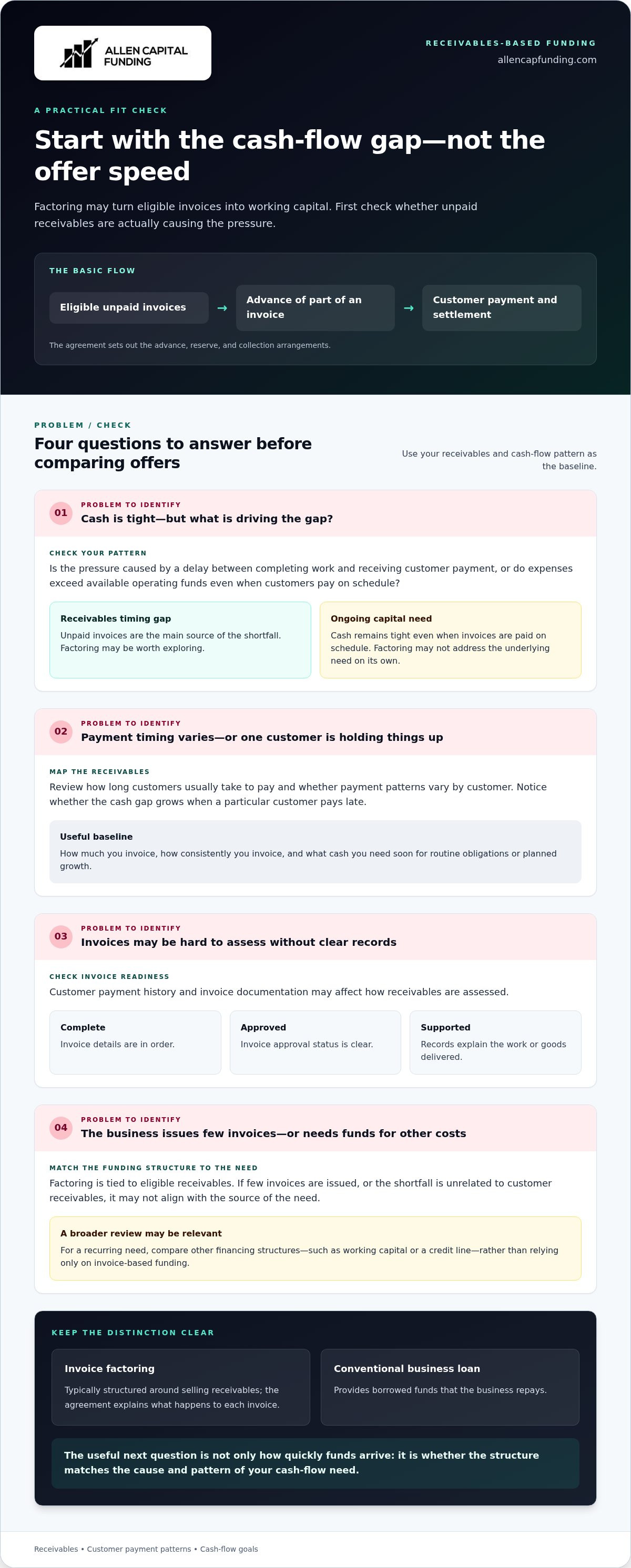
Before comparing offers, identify what is creating the cash-flow pressure. Invoice factoring lets a business use eligible invoices to access funds before customers pay. The factor may advance part of an invoice and later collect payment. The agreement sets out the advance, reserve, and collection arrangements, which can depend on the receivables involved. For a general overview of the concept and its forms, see What is Factoring?
Invoice factoring is typically structured around selling receivables, while a conventional business loan provides borrowed funds that the business repays. The agreement determines how the arrangement works in practice. Look beyond the label and understand what happens to each invoice from submission through settlement.
Next, distinguish a temporary timing gap from an ongoing capital need. A delay between completing work and receiving customer payment can create a short-term pinch, even when the business is otherwise operating steadily. If cash is repeatedly tight because expenses exceed available operating funds, factoring may not address the underlying need on its own. A broader funding review can help you compare structures against your goals and cash-flow pattern.
Which businesses may consider invoice factoring?
Factoring may be worth exploring if your business invoices other companies after delivering goods or completing work, then waits for payment under agreed terms. This can include businesses in staffing, professional services, wholesale, or manufacturing, not only freight. A regular flow of invoices gives you a practical basis for discussing a receivables-based funding approach. Customer payment history and clear invoice documentation may also affect how receivables are assessed. There’s no universal fit, so consider the details of your own invoices.
Map the pattern before starting a funding conversation. Review:
How much you invoice and how consistently you issue invoices.
How long customers usually take to pay, and whether payment patterns vary by customer.
What cash you need soon for routine obligations, planned growth, or both.
Whether invoices are complete, approved, and supported by records explaining the work or goods delivered.
This review helps you see whether the pressure comes from unpaid receivables or another source. It also gives you a baseline for comparing funding arrangements. For instance, note whether the cash gap grows when a particular customer pays late, or whether it remains even when payments arrive on schedule.
When may factoring not match the underlying need?
If your business issues few invoices or needs cash for costs unrelated to customer receivables, factoring may not align with the source of the shortfall. A recurring need may call for comparing other financing structures, such as working capital or a credit line, rather than relying only on invoice-based funding. For another perspective on financing tied to business assets, the Asset-Based Lending for Small Business guide can help frame the comparison.
Focus on fit, not just access to funds. Are unpaid invoices the main cause of the gap? Do customer payment patterns create a recurring timing challenge? Will the cash need continue even if invoices are paid on schedule? Clear answers make it easier to determine how to choose a factoring company and whether factoring belongs in a broader capital plan.
How Factoring Works: Follow the Invoice, Advance, and Collection Process
Factoring follows an invoice from submission through customer payment and final settlement. The steps vary by arrangement, so focus on what the written agreement says about invoice review, funds advanced, collections, and any remaining balance. The World Bank’s overview of Factoring for Small and Medium-Sized Enterprises also explains how factoring connects financing to accounts receivable.
Submit invoices. The business provides invoices for consideration, along with any supporting records required by the process.
Review eligibility. The factor assesses the receivables and related information. The review may consider invoice details, customer payment, or documentation; requirements vary.
Agree to terms. Before proceeding, both parties establish the applicable advance, fees, reserve, recourse terms, and collection responsibilities in the agreement.
Receive funds. If the receivables are accepted and the agreement’s conditions are met, the factor advances funds. The advance is not necessarily the invoice’s full face value.
Reconcile collections. After the customer pays, the payment is applied according to the agreement, and any remaining reserve is settled after applicable deductions.
The advance, reserve, fees, and settlement rules determine the proceeds a business ultimately receives from an invoice. The initial advance and the later reserve settlement are separate parts of the transaction. Track both in your cash-flow forecast rather than treating the advance as the final amount. The signed agreement also determines the factor’s role in collecting payment and your responsibilities for providing records, addressing discrepancies, or handling unpaid invoices.
What happens from invoice submission to settlement?
Follow one invoice through the process before assessing a broader arrangement. Identify what information accompanies it, how the factor communicates its decision, where customer payments go, and how deductions and any reserve are recorded. Then compare the final settlement statement with your bookkeeping. Don’t assume every factor uses the same approval steps or funding timeline. Rely on the process and commitments set out in the agreement.
Recourse and non-recourse factoring: what changes?
In recourse factoring, the business may have an obligation if the customer doesn’t pay. Non-recourse arrangements may shift some nonpayment risk to the factor, but the protection depends on the contract and its exclusions. A customer’s insolvency, an invoice dispute, and a documentation problem may be treated differently. Read the definitions and exceptions closely, and understand what action or repayment obligation could apply in each situation.
As you consider how to choose a factoring company, follow an invoice all the way to settlement, not just to the initial advance. A clear funding discussion should explain the receivables process and how it fits your cash-flow plan. Allen Capital Funding helps businesses explore factoring and other tailored capital options through a business funding conversation.
Compare Factoring Companies by Fees, Contract Exposure, and Funding Terms
Offers are easiest to compare when each one is measured against the same invoices and cash-flow scenario. Don’t choose based only on the headline rate or the speed of the first advance. Faster funding may not outweigh minimum activity, a long commitment, or settlement rules that don’t fit your customers’ payment patterns. The Secured Finance Network (SFNet) offers broader industry context, but your decision should come down to the written terms and how they work for your business.
Build a side-by-side comparison before deciding. Record the terms below for each offer, then note anything that changes the amount you receive or your obligations.
How to understand fees and net proceeds
Separate the fee calculation from the cash you ultimately receive. Review charges such as setup, processing, wire, or minimum fees if they appear in the agreement. Then trace a sample invoice through the proposed advance, reserve, deductions, and final settlement. This shows how the terms work together and gives you a clearer comparison than a single rate alone.
Invoice eligibility, customer concentration, and expected volume can also shape an offer. Compare how each proposal treats invoices from your largest customer and whether your expected invoices meet its stated criteria. An offer based on a different invoice mix or volume may not be directly comparable, so use consistent assumptions.
Which contract terms deserve close attention?
Read the wording on recourse triggers, eligible invoices, minimum activity, exclusivity, term, and termination. Contract language controls, and similar labels can carry different obligations. If a recurring funding need isn’t tied to eligible invoices, a Business Line of Credit may be another structure to consider. The right comparison depends on how you’ll use and repay the funds.
Use the table to identify trade-offs, not to choose a winner based on one feature. To discuss how factoring or another capital option could fit your operating needs, Discuss a funding approach for your business.
Assess Service and Operations: Will the Factoring Relationship Work Day to Day?
A factoring arrangement becomes part of your receivables workflow, not just a source of funds. Before committing, trace an invoice through your business: who approves it, who submits supporting documents, who records the transaction, and who follows up if information is missing? Then compare that workflow with the factor’s stated procedures. A workable arrangement should make responsibilities clear without creating avoidable friction for your team or customers.
Pay attention to routine updates and exceptions. Understand where to find invoice status, how document questions are communicated, and what happens if a customer disputes an invoice or pays late. Clear procedures matter most when an issue interrupts the usual payment flow.
Operational fit means clear responsibilities, predictable communication, and a collections process your team can support. Use that checklist alongside the financial terms as you consider how to choose a factoring company.
How customer communication and collections fit
Customer notification and collections procedures depend on the agreement and the factor’s process. Before submitting invoices, understand whether customers will be notified, who will contact them about payment, and how questions or disputes are routed. Consider what your customers expect from your business, then decide who internally will explain the arrangement or handle related inquiries. Factoring companies may manage collections differently, so focus on the specific process in the agreement.
For example, if your account manager usually handles customer questions about invoices, establish how that role will coordinate with the factor. Decide who checks that a payment has been applied correctly and who follows up when a customer raises a concern. This helps keep the customer experience consistent while organizing receivables responsibilities.
What support should fit your business workflow?
Assess how the factor communicates account information and coordinates documents. Identify the appropriate point of contact, how questions are directed, and how your team can resolve missing or inconsistent invoice details. Match the expected administrative work to your invoice volume, customer mix, and the time your staff can devote to funding tasks. A process that suits a business with a few large customers may not fit one handling frequent invoices for many accounts.
Before submitting invoices, make sure everyone responsible understands the handoffs. Your team should know what records to provide, where to track updates, and who follows up when a payment or document needs attention. These details help you assess the day-to-day workload, not just the offer on paper.
Allen Capital Funding helps small businesses explore tailored funding options, including factoring and other capital structures. Discuss a funding approach for your business that considers both cash-flow needs and the way your receivables process operates.
Choose Your Next Step: Match Factoring to a Broader Capital Strategy
Use a short review to turn your research into a focused next step. The goal isn’t to choose factoring simply because invoices are unpaid. First decide whether invoice-based funding fits the need, contract, and daily workflow, or whether another capital structure deserves consideration.
Summarize the cash need. Note what the funds would support and whether the gap is temporary or recurring.
Review your invoices. Organize examples, expected volume, customer payment patterns, and relevant invoice documentation.
Compare the terms. Look at fees, advances, reserves, recourse, minimums, agreement length, and termination conditions together.
Assess operations. Map document handling, status updates, collections, and customer communications against your team’s capacity.
Discuss fit. Use the information to consider whether factoring aligns with your goals and which other structures may be relevant.
Prepare for a focused factoring discussion
Bring a clear picture of your receivables and cash-flow objectives. Representative invoices, notes on customer payment patterns, and a description of when funds are needed can make the conversation more specific. List contract concerns, such as recourse or minimum activity, along with operational needs, including who will manage invoice records and customer questions.
This preparation helps make the discussion more focused, but it doesn’t determine approval or guarantee particular terms. It gives you a stronger basis for understanding what an arrangement could involve and whether it addresses the need you’ve identified.
When to compare factoring with other financing
Different funding structures address different needs. Factoring is tied to eligible invoices. A credit line may provide revolving access to funds, while asset-based lending generally considers business assets as part of the financing structure. If your cash need continues even when customers pay on time, compare options rather than assuming invoice funding is the whole answer. The Business Line of Credit and Asset-Based Lending for Small Business guides offer related perspectives.
Allen Capital Funding helps small businesses explore factoring alongside credit lines, SBA loans, working capital, equipment financing, and purchase order financing. A broader conversation can connect the funding structure to the business objective, whether that’s addressing receivables timing or planning for a wider capital need. The right fit depends on your goals, cash-flow pattern, and receivables.
Bring your questions and take the next step at your pace. Book an online consultation to explore capital options.
Make Your Next Funding Decision With Confidence
The right financing choice should support the business you’re building, not just relieve today’s pressure. As your customers, sales cycle, and growth plans change, your capital needs may shift too. Keep a simple record of what’s working and where cash-flow pressure returns. That perspective can make future funding decisions more intentional.
Knowing how to choose a factoring company is one part of a larger capital conversation. Allen Capital Funding includes factoring among its business financing solutions and helps businesses consider tailored options across multiple capital categories. Bring your priorities, questions, and plans for the funds. A clear discussion can help you identify a sensible direction without rushing the decision.
Explore capital options with Allen Capital Funding and take a thoughtful next step toward funding that fits your business goals.
Frequently Asked Questions
What should I look for when choosing a factoring company?
Look for terms and processes you can understand, then compare them against your actual receivables. Use the same example invoice and expected payment scenario for each offer. Check how the arrangement treats a disputed invoice, a late-paying customer, or a change in your invoice volume. A suitable fit should make sense for your cash-flow needs and administrative capacity, not just look attractive at first glance.
Is invoice factoring a loan?
Invoice factoring is generally structured as a sale of receivables, not a conventional loan: the business transfers eligible invoices in exchange for funds under an agreement. That distinction doesn’t mean the arrangement has no obligations or costs. Review what happens if an invoice is disputed, altered, or unpaid, and understand any responsibilities that remain with your business. The agreement determines how the transaction is handled and recorded.
Can a small business use factoring if its customers pay slowly?
It may be an option if the business has invoices a factor will consider, but slow customer payment alone doesn’t ensure an invoice can be factored. A long payment cycle may create a recurring cash gap, while a disputed or incomplete invoice may be treated differently under the agreement. Review customer payment patterns and receivables records to assess whether factoring could address the timing issue.
What is the difference between recourse and non-recourse factoring?
With recourse factoring, the business may have to address an invoice the customer doesn’t pay. Non-recourse factoring may shift specified nonpayment risk to the factor, but the scope depends on the contract. It may not cover disputes about delivered goods or services, for example. Read the definitions, exclusions, and steps required if payment fails. The labels alone don’t explain which party bears every risk.
How much does a factoring company charge?
Costs depend on the offer and the invoices involved, so there isn’t one price that applies to every business. Review how the fee is calculated, when it applies, and whether the agreement includes other deductions, such as setup, processing, transfer, or minimum charges. Then estimate the net proceeds and settlement for a representative invoice. Use the written terms to compare the full cost structure.
Will my customers know that I use a factoring company?
They may be notified, depending on the arrangement and how payments are directed. Before signing, understand what customers will be told, who will contact them about remittance, and where they should send payment questions. Consider how this fits your existing customer communications. If your team manages account relationships, decide who will explain the change and how staff should route questions to avoid conflicting instructions.
Can I factor only some of my invoices?
The agreement determines which invoices can be submitted and whether there are volume, customer, or exclusivity requirements. A business might want to factor invoices from one customer while handling other receivables internally, but the contract may set limits. Identify the invoices you expect to submit and understand how the agreement treats invoices outside that group, including any minimum activity obligations.
What documents might a business need to discuss factoring?
Useful starting materials may include sample invoices, customer contracts or purchase orders, proof of delivery or completed work, and an accounts receivable aging report. Payment history by customer can help explain typical timing, while basic business financial information may provide wider context. Organize the records you have and note any gaps. This can make an initial discussion more specific without guaranteeing approval or particular terms.



Comments