


How Does Purchase Order Financing Work? A Strategic Guide for 2026
- anthonyarallen
- Jul 10
- 12 min read
You just landed a contract that could double your annual revenue, but your bank account says you can't afford the raw materials or inventory to fulfill it. It's a frustrating paradox where rapid growth feels like a threat to your survival. You're likely worried about turning down a lucrative deal or facing supplier delays that could damage your reputation. Many entrepreneurs feel trapped when their capital is tied up, leaving them unable to seize the very opportunities they worked so hard to create.
We believe your ambition shouldn't be limited by your current cash on hand. By learning exactly how does po financing work, you can use your customer's creditworthiness to pay your suppliers and fulfill every order without depleting your reserves. With the global purchase order financing market projected to reach $7.69 billion in 2026, this strategy is becoming a standard for high-growth companies. This guide will walk you through the step-by-step funding flow, explain the latest 2026 regulations, and show you how to maintain a healthy balance sheet while your business reaches new heights.
Table of Contents
What is Purchase Order Financing and Why is it Essential in 2026?
Purchase order financing is a short-term funding solution used to pay suppliers for goods required to fulfill a specific customer order. It acts as a bridge, allowing you to secure inventory without waiting for your own capital to catch up. Many business owners ask, how does po financing work in a volatile economy? The answer lies in its ability to unlock growth by focusing on the strength of your purchase orders rather than your current bank balance. This What is Purchase Order Financing? resource provides a foundational look at how these documents trigger the funding process.
The fundamental shift in 2026 is clear. Relying solely on cash-on-hand is no longer the standard for high-growth wholesalers. With the global PO financing platform market projected to reach $7.69 billion this year, companies are increasingly using these strategic tools to maintain agility. This method allows you to accept contracts that far exceed your current borrowing limits or credit lines. It's not a general-purpose loan; it's an advance against a specific, verified transaction.
Traditional debt often clutters your balance sheet and requires monthly interest payments regardless of your sales volume. PO financing is different. It's a self-liquidating form of capital. Once your customer pays for the goods, the funding source is reimbursed, and you keep the profit. This makes it a powerful ally for businesses that don't want to take on long-term liabilities to solve short-term inventory needs.
The Core Mechanism: How It Solves the Working Capital Gap
The "funding gap" is the dangerous period between receiving a massive order and getting paid by your customer. This delay can paralyze a growing company. By utilizing this solution, you preserve asset-based lending for small business liquidity, keeping your other assets free for operational expenses. The process involves three primary parties:
The Business: You hold the purchase order but lack the cash to pay the supplier.
The Supplier: They need payment or a guarantee to start production or ship goods.
The Funding Source: They pay the supplier directly to ensure the order is fulfilled.
Who Benefits Most from PO Financing?
Wholesalers and distributors often face seasonal surges where demand outstrips available capital. This tool allows them to scale instantly. Government contractors also benefit because they must mobilize quickly for federal projects that require significant upfront costs. Manufacturers use it when they need raw materials to begin production for a confirmed buyer. If you have a creditworthy customer and a reliable supplier—relationships often fostered through professional groups like Network In Action—you can achieve accelerated success without waiting for a traditional bank's approval. Understanding how does po financing work is the first step toward never saying "no" to a lucrative contract again.
The 6-Step Purchase Order Financing Process
The transition from a signed contract to a delivered product requires a precise sequence of events. Understanding how does po financing work in a practical, day-to-day sense helps you manage expectations with both your customers and your manufacturing partners. The process is designed to move at the speed of modern commerce, ensuring that capital never slows down your logistics. The 6-Step Purchase Order Financing Process typically begins the moment you secure a significant opportunity.
First, you must receive a valid purchase order from a creditworthy customer. This document is the collateral that drives the entire transaction. Once you have the PO, you apply for funding by providing detailed supplier cost estimates and production timelines. After the funding partner approves the deal, they pay your supplier directly. This is usually handled via a wire transfer or a Letter of Credit, which provides the supplier with the financial guarantee they need to start production. Finally, the supplier produces the goods and ships them directly to your customer or a designated third-party warehouse.
This streamlined flow removes the burden of upfront costs from your shoulders. It allows you to focus on sales and relationship management while the financier handles the heavy lifting of supplier payments. If you're ready to see how these steps apply to your specific industry, consider exploring our funding solutions to find a path that fits your growth trajectory.
Verification and Quality Control
In 2026, the financing process is more transparent than ever. Funding partners now utilize digital tracking platforms to provide real-time visibility into the production cycle. Third-party inspections are a standard part of the flow, ensuring that goods meet your customer's exact specifications before the final payment is released to the supplier. Letters of Credit serve as a primary tool for securing international supplier trust by guaranteeing payment upon proof of shipment. These safeguards protect all parties and ensure that the final delivery matches the original purchase order perfectly.
Invoicing and Final Settlement
Once the goods are delivered and accepted, the transaction shifts from the purchase order phase to the invoicing phase. You'll issue an invoice to your customer, but the payment instructions will direct them to pay the funding company. When the customer settles the invoice, the financier deducts their pre-agreed fee and the initial advance. The remaining balance, which represents your profit margin, is then wired to your business account. This final settlement closes the loop, leaving your balance sheet clean and your cash reserves intact for the next big contract.
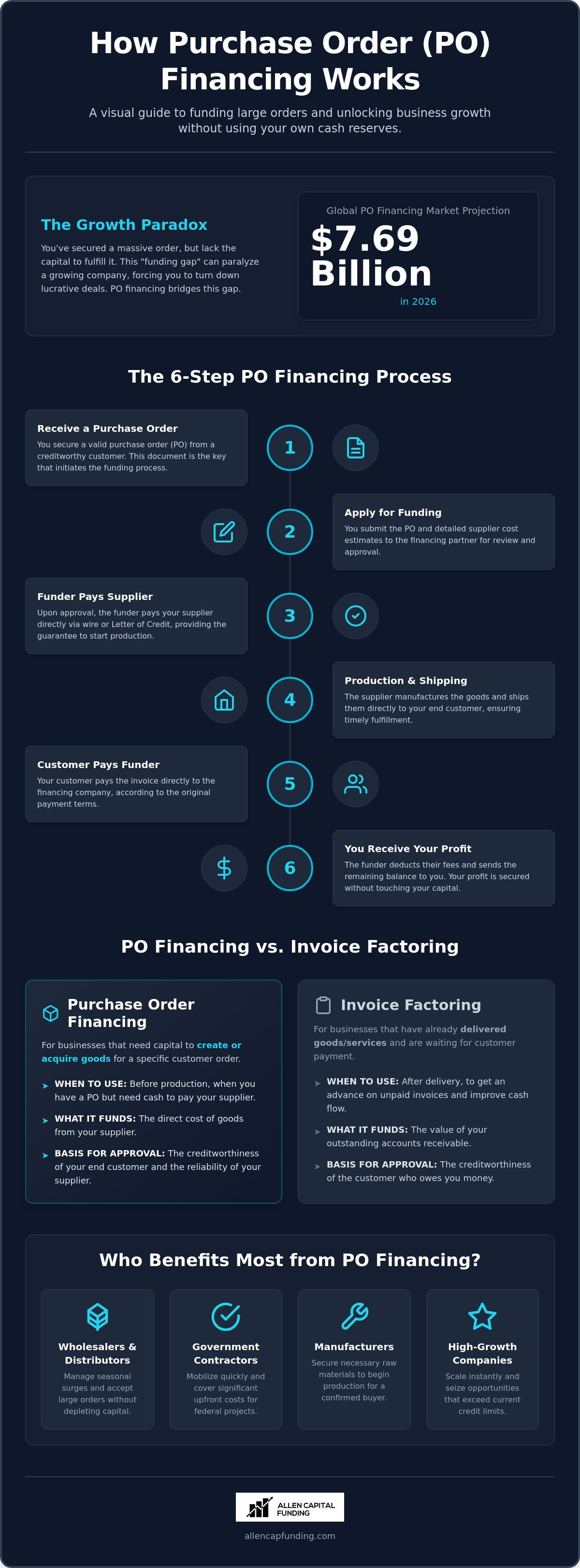
PO Financing vs. Invoice Factoring: Choosing the Right Tool
Understanding the nuances of trade finance starts with timing. While many founders confuse the two, the distinction is clear: PO financing happens before production begins. Factoring occurs only after you deliver the goods and generate an invoice. If you're wondering how does po financing work in relation to your overall cash flow, think of it as the catalyst for manufacturing. Factoring is the bridge to your next payroll. Because the financier takes on performance risk by paying suppliers before goods exist, PO financing typically carries higher fees than factoring.
Many successful firms don't choose just one. They use both to manage the entire lifecycle of a large contract. You use PO funding to pay the supplier, then transition to factoring once the invoice is generated to lower your ongoing costs. Maintaining a business line of credit provides a flexible backup for overhead that specific transaction funding won't cover. It's helpful to review what purchase order financing is to see how it integrates with these other strategic tools.
The synergy between these products creates a seamless funding loop. By using PO financing to fulfill the order and factoring to liquidate the resulting invoice, you can keep your cash moving. This approach is especially effective in 2026 as supply chains require more upfront capital to secure priority production slots with manufacturers.
When PO Financing is the Superior Choice
Use PO financing when you can't even start production without external help. It's ideal for high-margin transactions, specifically those with a profit margin of 20% to 30% as required by most 2026 lenders. This buffer ensures the financing fees don't erase your gains. This path is perfect for businesses with limited credit history that have secured a contract with a highly creditworthy customer, such as a government agency or a major retailer.
When Factoring or a Line of Credit Wins
Factoring wins when you've already delivered the product but can't wait 60 or 90 days for payment. It relies on the value of an existing invoice rather than a future order. If you need capital for general expenses like rent or a new marketing campaign, a line of credit is the more flexible option. It provides a revolving pool of funds that isn't tied to a specific customer's purchase order, allowing you to manage daily operations without restriction. Understanding how does po financing work helps you realize it's a precision tool for growth, while lines of credit are for stability.
Approval for PO financing doesn't rely on your personal credit score as much as a traditional bank loan does. Instead, financiers look at the strength of the individual deal. If you're wondering how does po financing work during the underwriting phase, it's essentially a risk assessment of your entire supply chain. The most critical factor is the creditworthiness of your customer. Lenders strongly prefer purchase orders from Fortune 500 companies, major retailers, or government entities. These organizations have a proven history of paying their bills; this gives the funding source confidence that the advance will be repaid without delay.
Supplier reliability is the second pillar of the approval process. Since the lender pays your supplier directly, they need to know the goods will be produced on time and to the correct specifications. You'll need to demonstrate that your supplier has a solid track record of high-quality delivery. The nature of the goods also plays a major role in the decision. Finished goods are much easier to finance than raw materials or complex services. This is because finished products have immediate resale value if the end customer cancels the order. If you're dealing in components or raw materials, the lender faces more risk because those items are harder to liquidate.
Finally, your profit margins must be healthy enough to sustain the cost of capital. Most lenders require a minimum gross margin of 15% to 25% to ensure the deal is viable. This buffer ensures that after the financing fees are deducted, your business still realizes a significant gain. If you have a solid contract but lack the capital to execute it, you don't have to walk away from the opportunity. You can request a financial check-up with our team to see if your current deal meets these qualifying standards.
The Documentation Checklist for 2026
To move quickly, you need your paperwork in order. You'll need a copy of the actual purchase order from your end customer to initiate the process. Detailed supplier quotes and specific production timelines are also mandatory to prove the deal is ready for execution. While historical financial statements are less critical than the transaction itself, providing them helps establish your business's legitimacy and operational capacity. Having these documents organized prevents delays in the funding cycle.
Common Red Flags That Stall Funding
Certain clauses in a contract can immediately stall your funding. For example, "right to return" or consignment-style agreements introduce too much uncertainty for most financiers. They want to see a final, non-contingent sale. Orders from customers with a history of late payments or high bankruptcy risk will also trigger a rejection. If your margins are too thin, the cost of capital might outweigh the benefit, making the deal unviable for both you and the lender. Avoid these pitfalls by vetting your customers as thoroughly as the lender will.
Maximizing Your Growth with Allen Capital Funding
Execution is the final hurdle between a large contract and a successful delivery. While understanding how does po financing work provides the foundation, choosing the right partner determines how quickly you can scale. Allen Capital Funding acts as a strategic consultant rather than just a lender. We don't simply provide a one-size-fits-all product; we act as a dedicated guide to help you structure deals that protect your margins and empower your growth. This partnership approach ensures that every transaction strengthens your position in the market.
One of the primary advantages of working with us is our access to a national network of specialized funding partners. Many direct lenders are constrained by their own internal balance sheets or limited industry experience. Because we operate as a strategic bridge, we can match your specific transaction with the funding source best suited for your sector. This breadth of options allows us to facilitate deals that traditional banks or smaller direct lenders might turn down due to complexity or size.
We prioritize speed because we know that supply chain opportunities wait for no one. Our process is designed for efficiency, often moving from the initial consultation to active funding in days, not weeks. To ensure that this capital tool fits your broader business strategy, we offer a "Financial Check-Up" service. This proactive assessment helps determine if PO financing is the most effective choice for your current goals or if a combination of our other solutions, like factoring or a line of credit, would better serve your long-term success.
Customized Solutions for Every Industry
Different sectors face unique supply chain pressures. Tech companies may deal with rapid obsolescence, while apparel wholesalers manage tight seasonal windows and construction firms handle complex material logistics. We tailor PO facilities to match these specific requirements. Allen Capital Funding simplifies capital access for growth-stage businesses by removing the traditional barriers often found at commercial banks. This customization ensures that your funding is as agile as your business model.
How to Start Your Consultation Today
The path to accelerated success begins with a proactive strategy. We encourage you to gather your current purchase orders and supplier cost estimates to prepare for a productive discussion. Our team is ready to analyze your specific deal and provide a tailored quote that reflects your business's potential. You can easily schedule a session through our online booking system to discuss your capital needs with an expert. Secure the capital you need to scale—book your consultation with Allen Capital Funding today!
Empowering Your Next Phase of Growth
Mastering how does po financing work is a strategic turning point for any high-growth business. You've learned that you can fulfill massive orders by leveraging your customer's credit instead of your own cash. You now understand the critical distinction between paying suppliers upfront and factoring invoices later. This knowledge allows you to accept larger contracts with confidence, knowing that your working capital remains protected.
We are here to act as your proactive ally in this journey. Through our access to national lending networks and tailored solutions for high-growth wholesalers, we provide the expert guidance needed to navigate the entire funding lifecycle. Our goal is to remove the barriers to your progress and simplify your path to success. Bridge your funding gap with expert PO financing solutions from Allen Capital Funding. Your biggest opportunities are within reach; it's time to capture them.
Frequently Asked Questions
Is purchase order financing considered a loan?
Purchase order financing isn't a traditional loan; it's a short-term asset-based advance. It focuses on the value of the purchase order itself rather than your business's debt to income ratio. This distinction keeps your balance sheet flexible for other growth needs because it's a transaction specific tool that doesn't require a long term commitment.
How much does purchase order financing typically cost in 2026?
Industry averages in 2026 typically range from 1.5% to 6% per 30 day period on the advanced amount. These rates depend on the transaction's complexity and the credit profile of your end customer. Understanding how does po financing work in terms of costs helps you price your contracts correctly to maintain healthy margins.
Can a startup with no credit history qualify for PO financing?
Startups can certainly qualify even without a long credit history or extensive financial records. Financiers prioritize the creditworthiness of the entity issuing the purchase order and the reliability of your manufacturer. If you have a solid contract from a Fortune 500 company or a government agency, your business's age is less relevant to the approval process.
What is the difference between PO financing and a business line of credit?
A line of credit provides a revolving pool of funds for general use, while PO financing is strictly tied to a specific order. You can use a line of credit for rent or marketing, but PO capital is reserved for inventory or production costs. Using both creates a robust financial safety net that covers both operations and growth.
Will my customer know that I am using a financing company?
Yes, your customer will usually be notified because they must send payment to the financing company. This is a standard industry practice known as a Notice of Assignment. Most large retailers and government agencies are familiar with this process and view it as a sign of a well capitalized and professional partner.
What happens if my customer fails to pay the invoice?
If a customer fails to pay, your business is generally responsible for the debt unless you have a non recourse agreement. Most facilities are recourse, meaning the financier can seek repayment from you if the customer defaults. Vetting your customers' payment history is a vital step in the process to avoid these situations.
How long does the approval process take for a new PO facility?
Setting up a new facility usually takes between five to ten business days. Once the initial facility is in place, individual transactions can often be funded within 24 to 48 hours. This speed is essential for businesses that need to move quickly on unexpected opportunities without waiting for traditional bank cycles.
Does PO financing cover the cost of shipping and logistics?
Yes, PO financing often covers the full cost of goods, including shipping, logistics, and international duties. This ensures you don't have to dip into your cash reserves for incidental costs like freight or customs fees. Learning how does po financing work across the entire logistics chain helps you manage total project costs more effectively.


Comments