
Factoring vs. Purchase Order Financing: A Strategic Comparison for 2026
Updated: Sep 19
Imagine you just landed the contract that could redefine your company's future, but your suppliers demand upfront payment and your cash is tied up in outstanding invoices. It's a common growth trap where success creates a liquidity crisis that traditional banks are often too slow to solve. You are not alone in feeling that frustration; many business owners find that their biggest opportunities are the ones they are least prepared to fund.
Deciding between factoring vs purchase order financing is the most critical strategic choice you will make to bridge these gaps in 2026. This article provides a clear framework to help you determine which tool aligns with your specific transaction cycle. You will discover how to secure immediate working capital without the burden of traditional bank debt, allowing you to fulfill large orders and scale with confidence. We will examine the mechanics of funding production versus leveraging receivables, ensuring you have a steady, reliable hand guiding your financial strategy. By matching the right capital to the right stage of your business cycle, you can transform cash flow from a barrier into a competitive advantage.
Table of Contents
The Working Capital Dilemma: Identifying Your Cash Flow Gap
Rapid business scaling often leads to a funding vacuum. This occurs when the capital required to fulfill new contracts exceeds the cash you have on hand. It's a sign of success, but it creates a dangerous liquidity bottleneck that can stall your momentum. Understanding the strategic application of factoring vs purchase order financing is the first step toward reclaiming control over your cash flow.
Traditional bank loans often fail to address these immediate, transaction-based needs. Banks typically focus on historical financial statements and personal credit scores, which don't reflect the potential of a massive new contract. Asset-based financing serves as a flexible alternative to traditional debt. It allows you to leverage your current business activities to secure the capital you need today. By treating your orders and invoices as collateral, you bridge the gap between signing a deal and receiving payment. This approach focuses on the strength of your customers rather than just your balance sheet.
The Pre-Delivery Bottleneck: The Cost of Fulfillment
The first major hurdle in the transaction cycle is the cost of fulfillment. When you land a large order, you must secure raw materials or finished goods before production can even begin. This stage requires significant upfront capital that many growing firms don't have readily available. Overextending your supplier credit lines to cover these costs is a risky strategy. It can damage your vendor relationships and leave you with no safety net if a delivery is delayed. A lack of upfront capital can lead to growth paralysis.
The Post-Delivery Bottleneck: The Waiting Game
The challenge doesn't end once you ship the product. Most corporate and government clients operate on Net-30, Net-60, or even Net-90 payment terms. This creates a waiting game where your capital is trapped in accounts receivable. While you wait for the customer to pay, you still have to cover payroll, rent, and other overhead costs. This is where Invoice Factoring becomes an essential tool for liquidity. It allows you to sell your outstanding invoices to a funding partner for an immediate cash advance. When choosing between factoring vs purchase order financing, this post-delivery stage is the most common point of friction for service-based and manufacturing businesses alike.
Purchase Order Financing: Capitalizing on Growth Before Production
Purchase Order (PO) financing is a targeted liquidity tool designed to fund the cost of goods before they reach your customer. In 2026, it serves as a critical lifeline for companies that have outgrown their cash reserves but possess a strong pipeline of orders. Unlike a general line of credit, the workflow is transaction-specific. Once you secure a purchase order from a creditworthy customer, the financing partner steps in to pay your supplier directly. This ensures production moves forward without you needing to tap into limited operational cash. When comparing factoring vs purchase order financing, the timing is the differentiator: PO funding solves the problem before the product exists.
A major advantage of this model is that the lender prioritizes your customer's credit profile over your own balance sheet. If you're a young company with a contract from a Fortune 500 entity or a government agency, you can access substantial capital that a traditional bank would likely deny. This financing is strictly for tangible products. It covers finished goods or the components required for assembly, rather than general overhead or service-based labor costs.
When PO Financing Makes Strategic Sense
Wholesalers and distributors often face irregular, massive orders that dwarf their monthly revenue. Using this tool allows you to accept game-changing contracts that would otherwise cause growth paralysis. It's particularly effective for managing seasonal demand surges, such as holiday inventory builds, where cash needs peak months before revenue arrives. Because this is a form of asset-based funding, you can scale your operations without the need for equity dilution or giving up control of your firm.
Critical Requirements for PO Funding
Lenders require a non-cancelable purchase order from a verified, creditworthy entity. Because the lender takes on the risk of the transaction, they must be certain the end customer has the capacity and intent to pay. Most partners focus on finished goods that can be easily resold if the transaction fails. Custom or highly specialized work is significantly harder to fund because it lacks a secondary market. The financing company typically pays your supplier directly via a Letter of Credit or wire transfer. This direct intervention ensures the funds are used solely for fulfilling the specific order. If you aren't sure if your current contract qualifies, you can perform a financial check-up to evaluate your options and determine the best path forward.
Invoice Factoring: Unlocking Value from Your Accounts Receivable
Invoice factoring is the strategic sale of your accounts receivable to a third party for immediate cash. It's important to understand that this is not a loan; it's the sale of an asset. This distinction is vital for business owners who want to avoid traditional debt. When you sell an invoice, the capital arrives in two installments. First, you receive an advance, typically 80% to 95% of the invoice's value. Once your customer pays the invoice in full, the remaining balance, known as the rebate, is released to you minus a small service fee. This process is a foundational element of Asset-Based Lending for Small Business, where your balance sheet provides the liquidity you need to thrive.
Unlike other tools, factoring is widely applicable across almost every industry. While purchase order financing is limited to tangible goods, factoring supports service providers, staffing agencies, and IT firms with equal efficiency. When weighing factoring vs purchase order financing, consider that factoring specifically solves the post-delivery waiting game. It turns your "trapped" capital into active working capital within hours rather than months.
The Operational Benefits of Factoring
The most immediate benefit is the influx of cash for payroll, marketing, and expansion. You don't have to wait for a slow-paying client to fund your next project. Additionally, many factoring partners provide an outsourced accounts receivable benefit, often utilizing advanced systems like smartAR to manage the ledger. They assist with credit checks on new customers and handle the collections process, which frees up your internal team for higher-value tasks. Perhaps most importantly, your funding limit grows automatically as your sales grow. There is no need to renegotiate a loan every time you land a larger contract.
Businesses must choose between two primary structures. In recourse factoring, your business remains liable if the customer fails to pay the invoice. This is often the more cost-effective option for companies with highly reliable clients. Non-recourse factoring is different because the factor assumes the credit risk of the customer. If the customer goes bankrupt or fails to pay due to financial insolvency, the factor absorbs the loss. Non-recourse factoring acts as a form of credit insurance that protects your cash flow from unexpected customer defaults. Understanding these nuances is key to a successful factoring vs purchase order financing strategy for 2026.
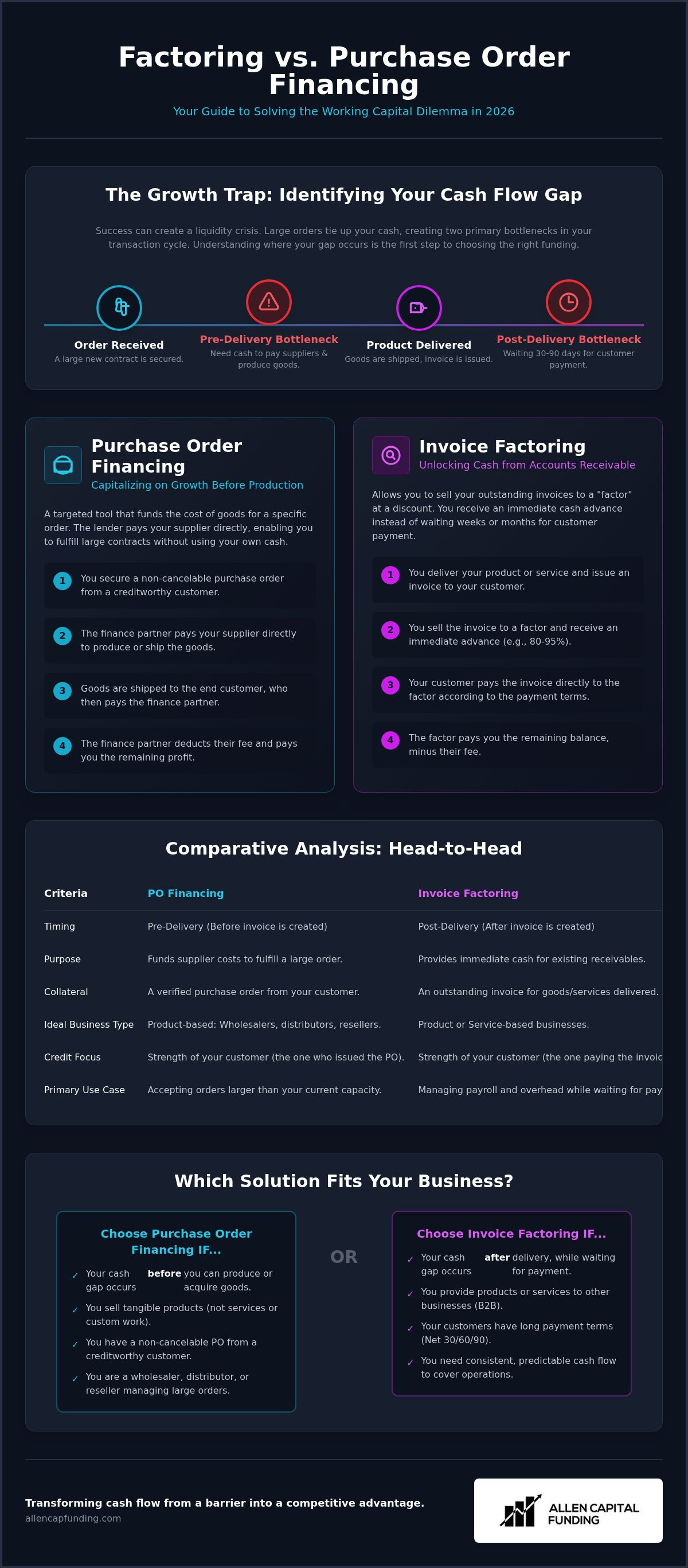
Comparative Analysis: Factoring vs. Purchase Order Financing
Directly comparing factoring vs purchase order financing requires looking at the timing of your capital needs and the structure of the associated costs. Factoring costs are typically structured as factor rates or discount fees that accrue based on how long an invoice remains unpaid. Purchase order financing usually involves transaction fees applied to the total order value for a specific period. While factoring is a post-delivery tool suitable for both service and product based firms, PO financing is strictly a pre-delivery tool for those selling tangible goods.
The level of external interaction also differs between these two methods. A PO lender works closely with your suppliers to guarantee payment for raw materials or finished inventory. A factor, however, interacts with your customers to manage the collection of outstanding receivables. If you need a more general pool of funds for various business expenses rather than a transaction-specific tool, a Business Line of Credit might serve as a better alternative for ongoing operational flexibility.
The Lifecycle Decision Matrix
Choosing the right tool depends on where you sit in the transaction cycle. If you have the product ready to ship but don't have the cash to wait for payment, factoring is your solution. If you have a confirmed order but don't have the product to ship, you need PO financing. Keep in mind that PO financing usually requires higher gross profit margins. Because the lender takes on the risk of production and delivery, the fees are often higher than factoring. In the digital environment of 2026, both options offer rapid funding, but your margins must be robust enough to absorb the cost of capital without erasing your profit.
The Hybrid Strategy: Using Both Tools Simultaneously
Many successful businesses don't view these as mutually exclusive choices. A hybrid strategy allows for a seamless hand-off between the two. For example, a wholesaler might use PO financing to pay a manufacturer for a large retail contract. Once those goods are delivered and an invoice is generated, a factoring company can buy that invoice. The proceeds from the factoring advance are used to pay off the PO lender, and the wholesaler keeps the remaining cash for operations. This combination covers the entire cash flow cycle from the initial order to the final customer payment. It ensures you never run out of liquidity while scaling to meet massive demand. If you're ready to build a scalable funding partnership, you can apply for working capital today to fuel your next growth phase.
Implementing a Tailored Capital Solution for Your Business
Deciding on the correct path between factoring vs purchase order financing is a vital first step, but implementation requires a partner who can navigate the nuances of the 2026 lending market. Allen Capital Funding serves as a dedicated guide, helping you identify the most efficient route to liquidity. The primary advantage of our brokerage model is the breadth of access we provide. Instead of being limited by the rigid criteria of a single institutional lender, you gain access to a national network of specialized partners. We act as a facilitator, matching your specific transaction needs with lenders who specialize in your industry. This tailored approach ensures that your funding is not just capital, but a strategic asset designed for accelerated success.
Preparing Your Business for Funding
Efficiency in funding depends on your readiness to provide clear, actionable data. Lenders in 2026 prioritize transparency and the quality of the underlying transaction. To move from application to funding quickly, you should assemble a comprehensive documentation package. This includes your current accounts receivable aging reports, copies of non-cancelable purchase orders, and a verified list of your major clients.
Engaging in a Strategic Financial Check-Up is another essential step. This proactive review prepares you for large capital draws by highlighting where your balance sheet is strongest. Because these tools rely on the creditworthiness of your customers rather than your personal credit score, maintaining a portfolio of high-quality clients is your best leverage for securing favorable terms. Our team helps you evaluate these relationships to ensure your funding plan is both scalable and secure.
Next Steps: Securing Your Growth Capital
Many business owners wait until they face growth paralysis before seeking liquidity. Moving from a reactive to a proactive financial stance allows you to bid on larger contracts with the certainty that you can fulfill them. We invite you to explore how a tailored combination of PO and factoring options can bridge your cash flow gaps. Our process is designed to respect your time, delivering essential information without distraction. By building a scalable funding partnership today, you ensure that your business is ready for every opportunity the future holds.
Strategic Liquidity for Your Next Growth Milestone
Evaluating the choice between factoring vs purchase order financing is about matching capital to your specific transaction lifecycle. Whether you need to pay suppliers upfront to fulfill a massive order or bridge the gap while waiting for a long-term invoice to clear, these specialized tools remove the barriers to your progress. By leveraging asset-based solutions, you avoid the constraints of traditional debt and maintain the momentum your business deserves.
Allen Capital Funding acts as your dedicated guide in this process. We provide access to a national network of diverse lending partners and offer deep expertise in managing complex transaction cycles. You don't have to handle these financial decisions alone. Secure your business growth with a tailored funding strategy from Allen Capital Funding today. We offer no-obligation financial consultations to help you build a scalable path toward your future goals. Your success is our priority, and we're ready to help you unlock your firm's full potential.
Frequently Asked Questions
Can I use purchase order financing and invoice factoring at the same time?
Yes, you can use both tools simultaneously to cover your entire transaction lifecycle. This hybrid approach is common for wholesalers who need purchase order financing to pay for inventory and then use factoring to bridge the gap while waiting for the final customer payment. Using these tools together ensures that your cash flow remains steady from the moment you receive an order until the day you collect the funds.
Is purchase order financing more expensive than invoice factoring?
Purchase order financing is typically more expensive because the lender takes on higher risk before goods are delivered. Factoring involves an already completed transaction, making it a lower-risk asset for the funding partner. While costs vary based on your transaction volume and customer credit, the strategic advantage of securing inventory often justifies the expense. Choosing between factoring vs purchase order financing depends on whether your bottleneck is production or collection.
What industries benefit most from factoring vs. PO financing?
Wholesalers, distributors, and manufacturers benefit most from purchase order financing because they deal with tangible goods and significant upfront costs. Service-based industries like staffing, IT consulting, and transportation find more value in factoring. These businesses often have high payroll costs and wait 30 to 90 days for payment. Both tools provide a scalable way to manage growth without the burden of traditional bank debt or equity dilution.
Does my personal credit score matter for these types of financing?
Your personal credit score is not the primary factor for approval in these asset-based models. Lenders prioritize the creditworthiness of your customers and the reliability of your suppliers. While some partners perform a background check, the strength of your purchase orders and invoices carries the most weight. This focus makes these solutions accessible to younger companies or those with seasonal fluctuations that might not qualify for conventional commercial bank loans.
How quickly can I receive funding through these methods?
Funding speed is one of the primary benefits of these alternative methods. Once your initial account is established, you can often receive capital within 24 to 72 hours of submitting a request. This pace is significantly faster than traditional bank financing, which can take weeks or months. Digital underwriting and automated accounting integrations in 2026 have further streamlined the approval process for businesses that need immediate liquidity to scale.
Will my customers know that I am using a financing company?
Yes, your customers will generally be aware of the arrangement because they send payments directly to the financing company. This is a standard practice in B2B commerce and is often seen as a sign of financial sophistication. Most large corporations and government agencies are familiar with these workflows. Maintaining transparent communication with your clients helps ensure a smooth transition and builds trust throughout the payment process as your business grows.
Are there minimum monthly volume requirements for factoring?
Minimum volume requirements depend on the specific lender and the nature of your business. Some factoring partners look for a steady stream of invoices, while others offer spot factoring for one-time transactions. Discussing your typical monthly sales with a broker helps you find a partner that aligns with your current scale. A flexible arrangement allows you to increase your funding limits as your contract volume expands over time.
What happens if my customer cancels the purchase order after it is funded?
If a customer cancels a funded order, you remain responsible for the capital advanced by the lender. To mitigate this risk, most lenders only approve non-cancelable purchase orders from highly creditworthy entities. They may also require a minimum gross margin of 20% to 30% on the order to ensure the transaction is viable. Understanding the terms of your agreement is essential for managing the risks associated with factoring vs purchase order financing.



Comments