
Cost of Purchase Order Financing: A Strategic Guide for 2026
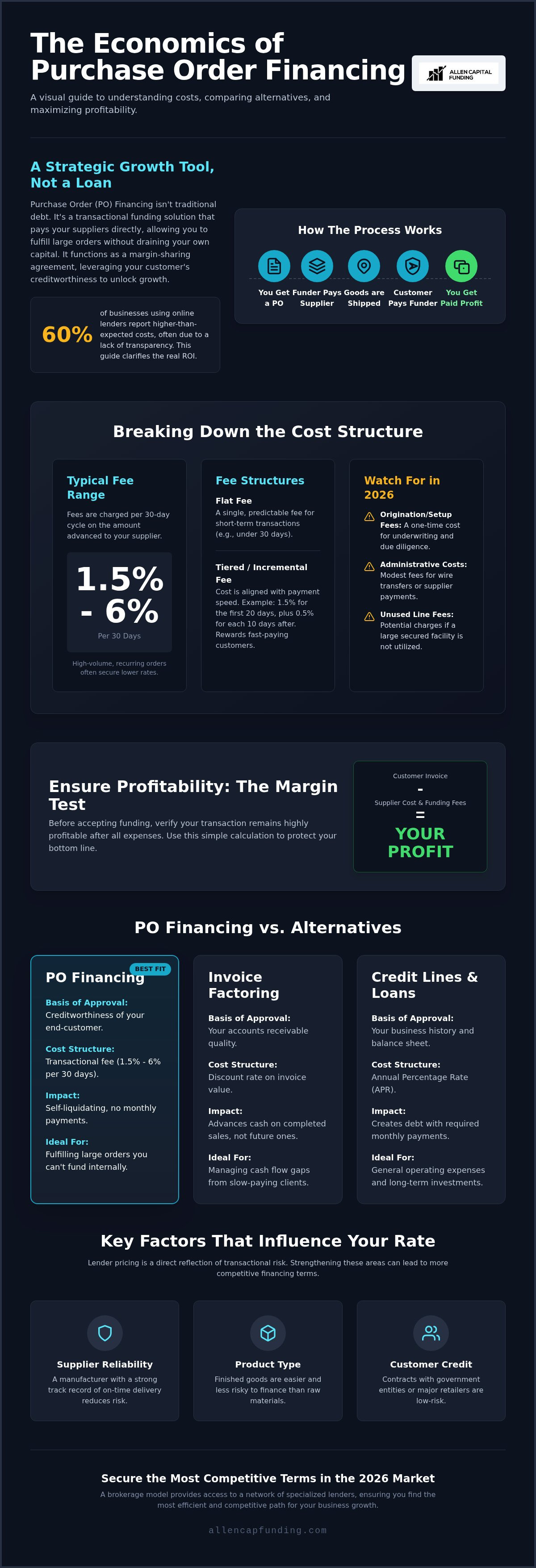
Turning down a game-changing contract because you lack the capital to pay your suppliers is a choice you shouldn't have to make. While a 2025 Federal Reserve survey found that 60% of businesses using online lenders reported higher-than-expected costs, this frustration often stems from a lack of transparency and poor ROI calculation. You might feel anxious about how the cost of purchase order financing will impact your bottom line, but when structured correctly, it's a strategic margin-sharing agreement rather than a simple debt expense.
We understand the pressure of protecting your profit margins while trying to scale. This guide provides a clear framework to help you navigate complex fee structures and calculate the total cost of funding for your specific transactions. You'll gain the confidence to accept larger orders, knowing exactly how to maintain your profitability throughout the fulfillment process. We'll examine the differences between PO financing and factoring costs, explore market trends for 2026, and show you how a strategic financial check-up ensures you're choosing the most efficient path for your business growth.
Table of Contents
Understanding the Economics of Purchase Order Financing
Purchase order financing is a specialized transactional tool designed to bridge the gap between receiving a large order and having the capital to fulfill it. It isn't a loan in the traditional sense. Instead, it's a form of funding where a lender pays your supplier directly so they can produce and ship goods. This arrangement relies on the strength of a confirmed purchase order from a creditworthy customer. Because this is a deal-specific solution, the cost of purchase order financing is structured as a fee based on the transaction volume and duration rather than a standard annual interest rate.
When evaluating this funding, you have to weigh the cost of capital against the cost of missed opportunity. Many businesses focus solely on the percentage fee, but the real expense is the profit lost by turning down a contract you can't afford to fulfill. The cost equation involves three main parties: your business, your supplier, and your end-customer. By leveraging the credit of your customer, you unlock the ability to grow without taking on long-term debt or diluting your equity.
How PO Financing Differs from Traditional Business Loans
Traditional loans require monthly principal and interest payments that can strain your cash flow. PO financing is self-liquidating. The lender is repaid directly when your customer pays for the goods, which removes the burden of monthly installments. Additionally, while banks look at your historical balance sheet, PO lenders prioritize the creditworthiness of your customer. This shift in focus allows you to access funding amounts that often exceed your existing credit limits, providing a scalable path for rapid expansion.
The Role of Transactional Risk in Pricing
Pricing is not arbitrary; it's a direct reflection of transactional risk. Lenders look at several variables to determine the cost of purchase order financing for a specific deal:
Supplier Reliability: A manufacturer with a long track record of on-time delivery reduces risk and can lead to better rates.
Product Type: Finished goods are easier to finance than raw materials because they require no further processing before sale.
Customer Credit: Contracts with government entities or big-box retailers are considered low-risk, which often results in more competitive fee structures.
By understanding these economic drivers, you can position your business to secure the best possible terms while protecting your margins. This clarity transforms financing from a simple expense into a strategic advantage for scaling operations.
Breaking Down the Fees: How PO Financing Rates are Calculated
Calculating the cost of purchase order financing requires a close look at how lenders charge for the time your capital is in use. While traditional loans use annual percentages, PO financing typically operates on a 30-day cycle. Most lenders in 2026 charge a fee ranging from 1% to 6% per 30-day period. This rate is applied to the total amount paid to your supplier, not the total value of the invoice. You'll also likely encounter a one-time setup or origination fee at the start of the relationship to cover the lender's initial underwriting and due diligence.
Transaction volume plays a significant role in the rate you receive. High-volume, recurring orders often qualify for lower percentage fees because the lender's operational costs are spread across a larger capital base. According to insights from Forbes on Purchase Order Financing, businesses that demonstrate consistent growth can often negotiate more favorable terms as their funding needs increase.
Flat Fees vs. Tiered Fee Structures
Flat fees provide a predictable cost structure for short-term transactions, usually lasting 30 days or less. This is ideal if you know your customer will pay promptly upon delivery. However, many modern lenders prefer incremental or tiered fee structures. For example, you might pay 1.5% for the first 20 days and 0.5% for every 10 days thereafter. Fee tiers serve as the primary mechanism for aligning cost with payment speed. This structure benefits businesses with fast-paying customers, as you only pay for the exact window of time the funds are outstanding.
Hidden Costs to Watch For in 2026
Beyond the headline rate, administrative expenses can impact your total ROI. You should expect modest wire transfer fees and administrative costs for each supplier payment. Some lenders also charge "unused line fees" if you secure a large facility but don't utilize it. It's also important to verify application and due diligence fees upfront; while some costs are necessary for complex international deals, they shouldn't be excessive. Working with a consultant at Allen Capital Funding helps you identify these line items early so you can build them into your pricing strategy.
Purchase Order Financing vs. Alternative Funding Costs
Choosing the right capital product requires comparing the cost of purchase order financing against other specialized tools. While it often carries a higher headline rate than a traditional bank loan, its value lies in its accessibility and speed. For many, it serves as the Secret Weapon of Small Businesses because it doesn't require the same level of collateral or personal credit history as conventional debt. It's designed to solve a specific, transactional problem that other products might not address as efficiently.
PO Financing vs. Invoice Factoring: A Cost Analysis
The primary difference between these two lies in the stage of the transaction. Invoice factoring typically costs less because the lender's risk is lower; the goods have already been delivered and accepted by the customer. In contrast, PO financing covers the manufacturing phase, where production delays or quality issues could still occur. Despite the higher price, you can create a "bridge" to lower your total expenses. Once you ship the goods and generate an invoice, you can use factoring to pay off the PO funding, effectively transitioning to a lower interest rate for the remainder of the payment cycle.
When a Line of Credit is More Cost-Effective
A revolving business line of credit is often more cost-effective for managing day-to-day operations or smaller, predictable inventory needs. These lines usually carry lower APRs and offer greater flexibility for general expenses. However, securing one typically requires a strong credit score and several years of profitable tax returns. Fast-growth startups or businesses landing their first "whale" contract often find the cost of purchase order financing more manageable than the restrictive covenants or lengthy approval times of a traditional line.
SBA loans are another alternative for long-term working capital. In fiscal year 2025, the SBA guaranteed $37 billion in 7(a) loans, providing businesses with some of the lowest rates available. While these are excellent for stability, they're rarely fast enough to catch a sudden, large-scale purchase order. PO financing remains the "first money in" for rapid scaling because it scales directly with your sales volume, not just your balance sheet. This allows you to accept opportunities that would otherwise be out of reach due to capital constraints.
Measuring ROI: When the Cost of PO Financing Makes Strategic Sense
Deciding to move forward with a high-value contract requires more than just looking at the fee percentage. You must apply a rigorous "Margin Test" to ensure the transaction strengthens your business health. This framework involves subtracting the total financing fees from your gross profit to determine the net gain. If the cost of purchase order financing leaves you with a healthy net margin, the deal is a strategic win. While most lenders look for a minimum gross margin of 15% to 20%, aiming for 25% or higher provides a safer buffer against unexpected shipping or administrative costs.
You also have to consider the cost of doing nothing, or the opportunity cost. Turning down a major retailer doesn't just mean losing a single sale; it often means losing a permanent spot on their vendor list. When you say "yes" to a large order, you're investing in customer acquisition and long-term brand equity. This strategic growth often leads to economies of scale. By placing a larger order with your supplier, you may negotiate a lower per-unit cost, which can partially or fully offset the financing fees.
The Profit Margin Threshold
Determining your minimum margin threshold is the first step in protecting your bottom line. Use your financing approval as leverage to negotiate better terms with your manufacturers. Since the lender pays them upfront, suppliers often offer early payment discounts that reduce your total production costs. The "Break-Even Point" for a financed transaction occurs when the financing fees exactly equal the additional profit generated by the increased order volume. Any margin above this point represents pure growth that wouldn't have been possible without external capital.
Strategic Scalability and Customer Retention
Fulfilling a significant order today builds the track record you'll need for lower-cost capital in the future. Lenders view successful past performance as a major risk mitigator. For example, consider a scenario where you fulfill a $1,000,000 order with a 30% gross margin. Even with a 4% financing fee ($40,000), you still capture $260,000 in profit. Without funding, your profit on that missed opportunity is zero. This successful fulfillment proves your operational capacity to future partners and prepares your business for more traditional tools like SBA loans.
If you're unsure how a specific contract will impact your long-term profitability, our team can help you run the numbers. You can schedule a financial check-up to analyze your margins and ensure your next big deal is a sustainable step toward scaling your operations.
Securing Competitive Rates through Allen Capital Funding
The brokerage model offers a distinct advantage in the 2026 lending environment. While direct lenders are limited to their own internal criteria, we act as a strategic bridge to a wide network of funding partners. This access allows us to find the most efficient cost of purchase order financing by matching your specific transaction with a lender that specializes in your industry. Whether you're dealing with international manufacturing or domestic distribution, we foster competition among lenders to secure the most favorable terms for your bottom line.
Speed is a critical factor in the total cost equation. A delay in funding can lead to missed production windows or strained supplier relationships. We prioritize a streamlined application process that minimizes "time-to-capital" costs. Before you commit to any structure, we conduct a comprehensive Financial Check-Up. This assessment ensures that PO financing is the right strategic move and that your margins are robust enough to support the funding without compromising your business health.
The Broker Advantage: Access to Multiple Lenders
Lenders have different appetites for risk based on product types and customer profiles. By leveraging our established relationships, we identify partners who view your specific deal as low-risk, which results in more competitive fee increments. We don't just accept the first offer; we negotiate the length of fee tiers and setup costs on your behalf. This advocacy ensures that the financing structure aligns perfectly with your customer's payment cycle, preventing you from paying for capital you no longer need. Our goal is to act as your dedicated guide, removing barriers and simplifying the path to progress.
Preparing Your Business for the Lowest Possible Rates
Securing the best rates requires more than just a large purchase order. You need to present a clear picture of reliability to potential funding partners. Lenders look for specific documentation, including a history of successful supplier deliveries and a clean balance sheet that demonstrates operational stability. While PO financing focuses heavily on your customer's credit, your own internal organization signals that you can manage the fulfillment process effectively. Proactive preparation often leads to faster approvals and more flexible terms.
Your journey toward scalable growth starts with a clear understanding of your options. To see how we can optimize your funding strategy, book a consultation today. We'll analyze your current purchase orders and build a capital solution that protects your profit margins and accelerates your success.
Mastering Your Margins for Future Success
Mastering your business economics means viewing the cost of purchase order financing as a strategic investment in your scalability. By applying the "Margin Test" and selecting fee structures that align with your payment cycles, you transform a transactional expense into a powerful engine for growth. You don't have to navigate these complex capital landscapes alone or settle for rigid, one-size-fits-all terms. Success in 2026 requires a steady hand and a clear framework for protecting your profitability during periods of rapid expansion.
Allen Capital Funding provides more than just access to capital; we offer a dedicated partnership to help you unlock your business's full potential. Our brokerage model provides access to a national network of specialized lenders, while our proactive financial check-ups ensure your funding mix remains optimized for health. Whether you're landing a first big-box retail deal or expanding a government contract, we're here to facilitate your progress through expert guidance on asset-based and working capital solutions.
Secure your next large contract with a custom purchase order financing strategy from Allen Capital Funding. You have the vision to land major contracts, and we have the expertise to help you fulfill them with absolute confidence.
Frequently Asked Questions
How much does purchase order financing typically cost in 2026?
The standard fee for this funding typically ranges from 1.5% to 6% of the financed amount for each 30-day period. This rate depends on several variables, including the transaction risk, the total order volume, and the creditworthiness of your end customer. While these rates are higher than traditional bank loans, they provide the immediate capital needed to fulfill large contracts without depleting your internal cash reserves or taking on long-term debt.
Is purchase order financing more expensive than invoice factoring?
Yes, this funding is generally more expensive than invoice factoring because it involves higher risk for the lender. Since the goods haven't been produced or delivered yet, there is a chance of manufacturing delays or quality issues. Factoring involves completed work or delivered goods, which lowers the risk. Many businesses use both tools in a sequence to lower the total cost of purchase order financing by transitioning to factoring once the goods ship.
Can I use purchase order financing if I have bad credit?
You can often qualify for this funding even with a limited or poor credit history because the lender prioritizes your customer's creditworthiness over your own. The transaction relies on the ability of your end customer, such as a major retailer or government entity, to pay the final invoice. This makes it an ideal solution for startups or businesses undergoing a turnaround. We focus on the strength of the purchase order rather than just your personal credit score.
What are the most common hidden fees in PO financing agreements?
Common additional costs include application fees, due diligence charges, and administrative fees for wire transfers or letters of credit. Some lenders may also include "unused line fees" if you don't utilize the full amount of a secured facility. It's essential to review the full fee schedule upfront to avoid surprises. We recommend a strategic financial check-up to identify these line items and ensure they don't erode your projected profit margins during the fulfillment process.
How do I calculate the ROI of a financed purchase order?
To calculate your ROI, subtract the total cost of purchase order financing from the gross profit of the specific contract. If a $100,000 order has a 30% margin ($30,000) and the financing fees are 4% ($4,000), your net gain is $26,000. Without the funding, your profit would be zero because you couldn't fulfill the order. This calculation helps you determine if the margin can comfortably absorb the transactional fees while supporting your business growth.
Does the cost of PO financing decrease as my business grows?
The cost often decreases as your transaction volume and track record improve. Lenders offer more competitive rates to businesses that demonstrate a history of successful fulfillment and consistent order flow. High-volume accounts allow lenders to spread their operational costs over larger capital amounts, which can lead to lower percentage fees. As your business scales, you gain more leverage to negotiate better terms and more favorable fee increments with our network of specialized funding partners.
What happens to the financing cost if my customer pays late?
If your customer pays late, the financing cost will increase based on the agreed-upon fee increments, which are often structured in 10-day or 30-day blocks. For example, if your initial fee covers 30 days and the payment arrives on day 40, you'll likely be charged an additional pro-rated fee for the next block of time. It's important to understand these "tail" costs and build a buffer into your pricing to protect your profit margins from unexpected payment delays.
Are there industries where PO financing is cheaper?
Financing is often more cost-effective in industries dealing with finished goods and highly reputable end-customers. Sectors like consumer electronics, apparel, and government contracting frequently see lower rates because the products are easily sellable and the buyers have excellent credit. Conversely, transactions involving raw materials or highly customized components may carry higher fees due to the increased manufacturing risk. Specialized lenders often offer better terms for industries where they have deep experience and established supplier relationships.



Comments