
Commercial Real Estate Financing: A Strategic Explainer for Business Growth in 2026
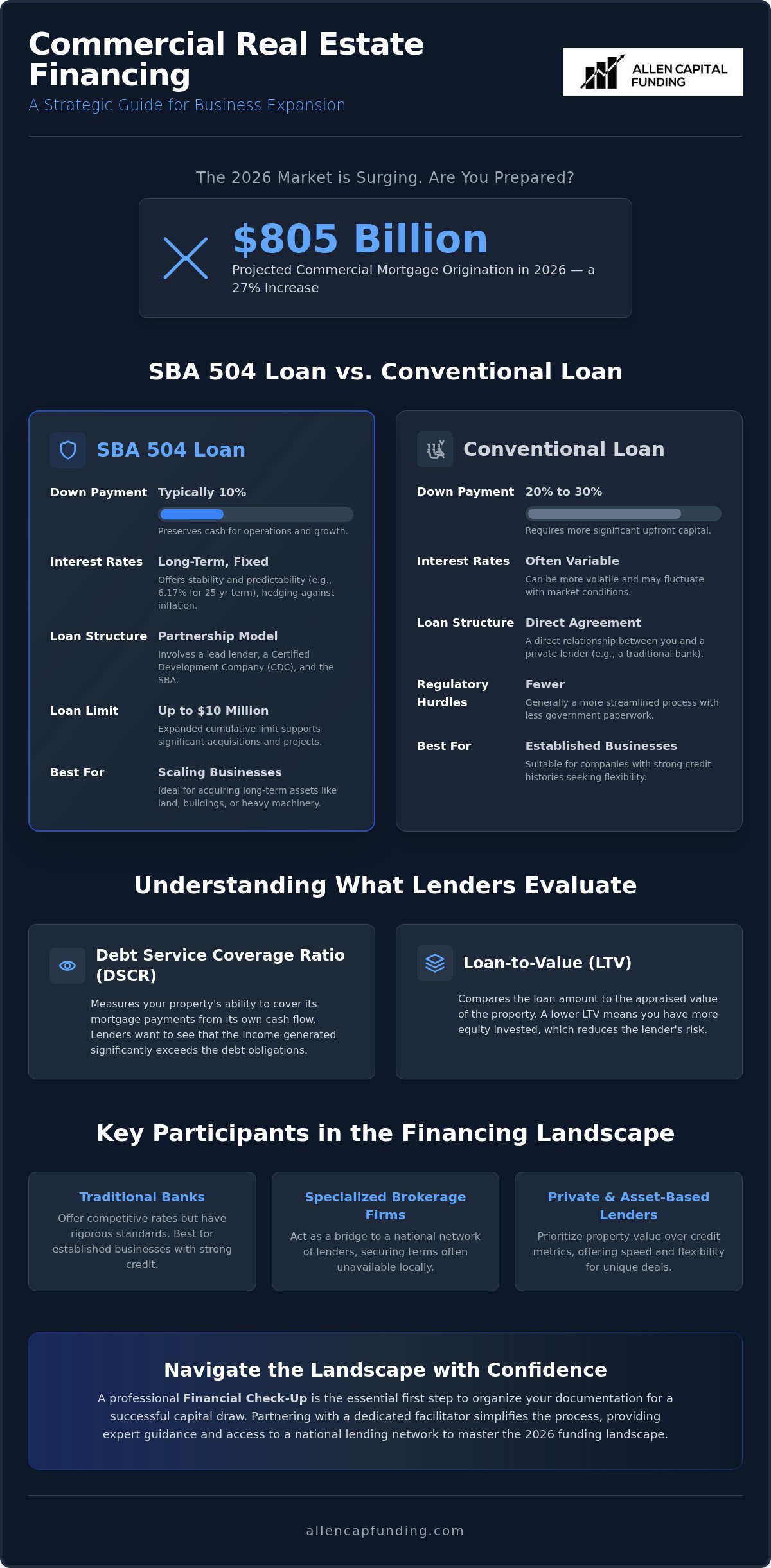
Did you know that total commercial mortgage origination is projected to surge by 27% to over $805 billion in 2026? This massive wave of capital confirms that now is a pivotal time to secure your company's physical footprint through commercial real estate financing. You probably feel the pressure of choosing between complex SBA requirements and conventional bank terms while watching interest rate cycles closely. It's natural to worry about over-leveraging your assets when the financial landscape feels like it's shifting under your feet.
This guide will help you master the fundamentals of funding so you can secure the property your business needs to scale this year. We've designed this roadmap to give you professional confidence in your borrowing decisions. You'll learn how to navigate the latest rate trends, understand the impact of the expanded $10 million SBA loan limit, and see how a strategic financial check-up prepares you for long term ownership. We'll explore the specific pathways to move your business from its current state to its future goals with clarity and speed.
Table of Contents
What is Commercial Real Estate Financing?
At its core, commercial real estate financing is a specialized form of debt-based funding used by businesses to acquire, develop, or refinance property. Unlike a residential loan that focuses primarily on your personal credit score, a Commercial mortgage is secured by the property itself and the revenue it generates. This structure allows you to secure the physical space your business needs while building long-term equity instead of paying rent to a landlord.
The 2026 market has expanded the scope of these products. It's no longer just about buying an existing storefront or office. Today's commercial real estate financing solutions cover everything from ground-up construction to massive facility expansions. The strategic shift from leasing to owning allows you to control your operational costs and create a tangible asset on your balance sheet. This transition is a major milestone in a company's lifecycle, signaling a move from temporary operations to permanent scaling.
Key Participants in the Financing Landscape
Understanding who provides the capital is the first step toward securing a deal that fits your growth profile. The landscape is diverse, offering various paths based on your specific business health.
Traditional Banks: These institutional lenders offer some of the most competitive interest rates but maintain rigorous underwriting standards. They're ideal for established businesses with strong credit histories.
Specialized Brokerage Firms: Facilitators like Allen Capital Funding act as a bridge. We help small businesses access a national network of lending partners, often securing terms that aren't available through a local branch.
Private and Asset-Based Lenders: These sources prioritize the value of the property over traditional credit metrics. They offer speed and flexibility, which is vital for time-sensitive acquisitions or unique property types.
The 2026 Market Context for Property Owners
The national market is seeing a significant rise in liquidity this year. The Mortgage Bankers Association (MBA) forecasts a 27% increase in total commercial mortgage volume, reaching over $805 billion in 2026. This surge means more lenders are competing for your business, creating a favorable environment for borrowers. However, strategic timing remains critical. You need to align your property acquisition with your overall growth strategy to avoid over-leveraging your existing assets.
Maintaining operational stability during a large capital draw is often the biggest challenge for growing companies. Many successful owners utilize a Business Line of Credit to manage daily expenses while their real estate deal moves through underwriting. This ensures that your expansion doesn't come at the cost of your short-term liquidity. Before you commit to a purchase, starting with a professional Financial Check-Up helps you identify exactly how much capital you can safely deploy without straining your cash flow.
SBA 504 vs. Conventional Commercial Loans
Choosing between an SBA 504 loan and a conventional mortgage is one of the most consequential decisions for a business owner. Both serve as vehicles for commercial real estate financing, but they cater to different operational needs and financial profiles. The primary distinction lies in how the debt is structured and the amount of capital you must commit upfront. While conventional loans are agreements between you and a private lender, the SBA 504 program involves a partnership between a lead lender, a Certified Development Company (CDC), and the Small Business Administration.
The SBA 504 program focuses strictly on long-term fixed assets. It's designed to help businesses buy land, build new facilities, or purchase heavy machinery. In July 2026, interest rates for 25-year SBA 504 terms are at 6.17%, offering a predictable cost of capital for decades. Conventional Commercial real estate loans often have more volatile rate structures, though they offer fewer regulatory hurdles. The most visible difference is the down payment. SBA loans typically require only 10% down, whereas conventional lenders usually expect 20% to 30% equity. This gap in required capital can be the difference between expanding now or waiting another year to save.
The SBA Advantage for Expanding Businesses
For firms looking to scale without draining their cash reserves, the SBA 504 program offers a lower barrier to entry. This program provides long-term rate stability that acts as a hedge against inflation. Effective July 4, 2026, the SBA doubled the cumulative loan limit to $10 million, allowing you to access up to $5 million through the 504 program alone. This change significantly increases your purchasing power for larger industrial or retail spaces. Partnering with an SBA loan specialist is essential to manage the specific occupancy rules, as your business must typically occupy at least 51% of an existing building to qualify.
When to Choose Conventional Financing
Conventional financing is often the better choice when speed is your top priority. These loans don't require federal approval, which typically results in a faster closing process and less paperwork. They also offer greater flexibility. If you plan to lease out more than 49% of the property or have a unique property use case that doesn't fit SBA guidelines, a conventional loan is your primary path. If you have a strong balance sheet and high existing equity, you might even leverage those assets to secure more competitive rates than government-backed options. If you're ready to see which structure fits your current growth stage, you can explore our tailored funding solutions to find your best path forward.
Strategic Evaluation: DSCR, LTV, and Your Balance Sheet
Lenders in 2026 aren't just looking at the property value; they're looking at your operational resilience. Before you apply for commercial real estate financing, you need to view your business through their lens. This means analyzing your balance sheet to ensure it can support a significant capital draw without compromising your daily operations. Lenders prioritize stability, and they use specific mathematical benchmarks to determine how much risk they are willing to take on your behalf. Understanding these figures before you start the application process puts you in a position of strength during negotiations.
Loan-to-Value (LTV) is the first metric that dictates your initial cash outlay. For conventional bank and CMBS loans, you'll typically see LTV ratios between 65% and 75%. This means you'll need to provide a 25% to 35% down payment. In contrast, the SBA 504 loan program allows for LTVs as high as 90%, which significantly lowers the barrier for growing firms. Your credit profile also plays a vital role. While business credit determines your company's history, personal credit scores still influence the terms and interest rates you'll receive in the 2026 lending cycle. A professional Financial Check-Up is the best way to evaluate these factors before you approach a lender.
Understanding the DSCR Calculation
The Debt Service Coverage Ratio (DSCR) is the most critical figure in your application. Lenders use it to verify that your business generates enough profit to pay the new mortgage. The formula is straightforward: Net Operating Income divided by Total Debt Service. Debt Service Coverage Ratio (DSCR) is the measure of a business's ability to cover its debt payments from cash flow. For most conventional lenders in 2026, a ratio of 1.25x is the standard safe benchmark. This means for every dollar of debt, your business should produce $1.25 in income. If your ratio is lower, you may need to increase your down payment to reduce the loan amount.
Leveraging Assets for Better Terms
If your cash reserves are tight, you can look beyond your bank account. Utilizing asset-based lending for small business allows you to unlock liquidity from your existing balance sheet. You can use high-value equipment or accounts receivable to strengthen your financial profile or fund your down payment. Additionally, balancing your new property debt with existing Credit Lines ensures you have a safety net for operational costs. This multi-layered approach to capital ensures that your property acquisition supports your growth rather than straining your resources.
Preparing Your Business for a Large Capital Draw
Securing commercial real estate financing requires more than just a good idea. It demands a rigorous organizational phase. You're asking a lender to take a multi-million dollar risk on your vision, so you must demonstrate that your business is a well-oiled machine. This preparation begins with a comprehensive Financial Check-Up. This internal audit identifies gaps in your reporting or liquidity before a bank sees them. It's the difference between a swift approval and a frustrating rejection. By the time you sit down with a lender, you should have a clear picture of your borrowing capacity.
Once you've identified your baseline, organize three years of federal tax returns and your most recent year-to-date profit and loss (P&L) statements. Lenders look for consistency and growth trends over time. Next, draft a business plan that focuses specifically on the return on investment (ROI) of the property. Explain how owning this space reduces costs, increases production, or opens new revenue streams. Don't forget to inventory your collateral. Your existing equipment and inventory can serve as secondary security, significantly strengthening your application. Finally, secure a pre-qualification through a strategic facilitator to ensure you're targeting the right lenders from the start.
The Documentation Checklist
Accuracy is your best ally during the underwriting process. Your interim financial statements and balance sheet must be current, typically within the last 90 days. You'll also need a detailed debt schedule of all current liabilities, including existing credit lines and equipment leases. For any owner with a stake of 20% or more, personal financial statements are mandatory. This transparency builds the trust necessary for a partnership-driven lending experience. If you're ready to start this process, schedule your professional Financial Check-Up today to ensure your documentation is lender-ready.
Addressing Challenged Credit Profiles
Not every business has a perfect financial history. If your credit profile is challenged, take proactive steps to improve your scores at least six months before the draw. If there are variances in your history, such as a one-time loss due to a specific market event, prepare a written explanation to provide context to potential lenders. For businesses in transition, alternative financing options can bridge the gap until your profile qualifies for traditional real estate terms. Being honest and proactive about your financial narrative is always better than letting a lender discover a red flag on their own. We act as your advocate, helping you frame your financial story in the best possible light.
The Facilitator Advantage: Navigating the 2026 Landscape
Many entrepreneurs assume that calling their local branch is the most direct path to commercial real estate financing. However, this DIY approach often leads to a cycle of repetitive paperwork and multiple credit inquiries that can negatively impact your profile. A specialized brokerage firm like Allen Capital Funding serves as a strategic bridge. We don't just offer one product; we provide access to a national network of lending partners. This allows us to match your specific business health with the lender most likely to approve your terms at the best possible rate.
The primary advantage of a facilitator is the shift from a one-size-fits-all model to tailored funding options. Traditional banks have strict, narrow boxes. If you don't fit perfectly, you're out. We remove those barriers by providing expert guidance and underwriting support before your application ever reaches a lender's desk. We ensure your narrative is framed correctly, highlighting your strengths and addressing potential weaknesses proactively. This supportive empowerment allows you to focus on running your business while we handle the complexities of the capital market.
Expert Guidance vs. Direct Banking
Direct banking limits you to a single institution's appetite for risk. If that bank has already reached its lending cap for your specific industry in 2026, you'll face a rejection regardless of your credit score. A facilitator advocates for your business to multiple lenders simultaneously. We streamline the complex SBA application process, ensuring every document meets federal standards the first time. This collaborative approach ensures your capital solution isn't just a loan, but a long-term tool for growth that respects your operational cash flow.
Securing Your 2026 Growth Strategy
In a shifting market where the Mortgage Bankers Association forecasts over $800 billion in volume, you need a proactive ally. The 2026 landscape is moving fast, and interest rate cycles require precise timing. Strategic assessment is no longer optional; it's a requirement for scaling safely. Your next step is to move beyond research and into action. Booking a consultation for a strategic assessment allows us to evaluate your balance sheet and identify the most efficient path to property ownership. Unlock your business's potential with strategic capital and turn your 2026 growth goals into a physical reality today.
Secure Your Future with Strategic Property Ownership
Securing the right commercial real estate financing is the catalyst for moving your business from a tenant to a property owner. By now, you understand the nuances of SBA 504 loan limits and how metrics like DSCR define your borrowing power. You've seen that the 2026 market offers significant liquidity, provided you approach lenders with organized documentation and a clear ROI strategy. Transitioning to ownership builds equity and stabilizes your long term operational costs. It's a strategic move that sets the stage for years of accelerated success.
Success in this landscape requires a proactive ally who understands the shifting cycles of the national market. We provide the expert guidance you need to navigate these complexities while matching your goals with our national network of funding partners. Every journey begins with a comprehensive Financial Check-Up to ensure your balance sheet is optimized for a successful capital draw. Book a Strategic Consultation with Allen Capital Funding today to assess your readiness and unlock your company's full potential. You've built the vision; now it's time to secure the foundation that supports its growth.
Frequently Asked Questions
What is the typical down payment for a commercial real estate loan in 2026?
The down payment depends on the loan structure you select. For the SBA 504 program, you typically only need a 10% down payment. Conventional commercial real estate financing usually requires a higher equity stake, with most lenders expecting between 25% and 35% of the purchase price upfront.
Can I get commercial real estate financing with challenged credit?
Yes, you can still secure funding even if your credit profile isn't perfect. We focus on asset-based lending and alternative structures that prioritize the property's value and your business's cash flow. A strategic facilitator helps you frame your financial story to highlight your operational strengths and mitigate lender concerns.
How long does the SBA 504 loan approval process usually take?
The entire process typically takes 60 to 90 days from the initial application to closing. This timeline accounts for the dual approval required from both your lead lender and the Certified Development Company (CDC). Organizing your documentation through a Financial Check-Up before applying can significantly reduce delays during the underwriting phase.
What is the difference between owner-occupied and investment property financing?
Owner-occupied financing requires your business to occupy at least 51% of the property, which is a strict requirement for SBA programs. Investment property financing is designed for owners who intend to lease out the majority of the space to third parties. Investment loans often carry higher interest rates and require larger down payments because they rely on tenant income.
Do I need a business plan to apply for commercial real estate funding?
Yes, a clear business plan is essential for most 2026 lenders. Your plan should go beyond basic operations to focus on the return on investment the property provides. Lenders want to see exactly how owning the space will increase your production, reduce costs, or support your long term scaling goals.
How does a Financial Check-Up help me get a better interest rate?
A Financial Check-Up identifies and corrects balance sheet weaknesses that lenders view as high risk. By optimizing your Debt Service Coverage Ratio and cleaning up interim statements, you present a more stable profile. Lower perceived risk directly translates to more competitive interest rates and better loan terms from institutional partners.
What are the common closing costs for commercial property loans?
Closing costs typically include appraisals, environmental reports, legal fees, and loan origination charges. For SBA 504 loans, you'll also encounter specific fees like the 1.5% CDC processing fee and a 0.25% SBA funding fee. It's vital to budget for these costs separately from your down payment to maintain your operational liquidity.
Is it better to lease or buy commercial space for a small business in 2026?
Buying is often the superior choice for established businesses looking to build equity and lock in fixed costs. With the SBA doubling cumulative loan limits to $10 million in July 2026, property ownership has become more accessible for growing firms. Ownership protects you from rising rents and creates a tangible asset that strengthens your company's overall valuation.



Comments