
Business Loans for Women Entrepreneurs: A 2026 Guide
The best business loan for a woman entrepreneur may not be labeled specifically for women. The right fit depends on what your company needs the capital for and whether repayment works with its cash flow. If you’re comparing business loans for women entrepreneurs, you may be wondering whether women-owned businesses have access to different programs and how a loan compares with a credit line or other financing.
This guide covers funding options, including SBA loans, credit lines, working capital, equipment financing, factoring, and purchase order financing. Learn how to match financing to a business need, what lenders commonly review, and which records can help you prepare a focused application.
You’ll also find practical ways to compare repayment structures and organize your business’s financial picture before applying. Allen Capital Funding helps business owners explore tailored capital options, so you can approach the funding conversation with clearer priorities and a better understanding of your next steps.
Table of Contents
Business loans for women entrepreneurs: start with the funding need
Begin with the next step you need to fund: covering a cash-flow gap, purchasing equipment, expanding operations, acquiring property, or fulfilling a large order. A business loan is borrowed capital that the business repays under agreed terms. Approval, repayment structure, and suitability depend on the financing option, the lender’s review, and the company’s circumstances.
That distinction matters when searching for business loans for women entrepreneurs. A women-focused resource may explain business ownership designations or offer guidance, but it doesn’t determine which financing structure fits your company. The goal is to connect a specific business need with a repayment approach your cash flow can support.
Does being a woman entrepreneur mean you need a special loan?
Not necessarily. Women-owned status alone doesn’t identify the right type of financing or mean a separate loan category is required. Business owners can consider financing based on the company’s purpose, financial position, and ability to repay. Lenders assess applications using their own criteria, so ownership status should not be treated as a promise of approval or special terms.
The SBA offers resources for women entrepreneurs that can provide guidance and support as you plan. Those resources are different from a loan guarantee for an individual business. For background on how the term is used, see Understanding Woman-Owned Business Designations. Keep the financing decision focused on your company’s needs and the lender’s requirements.
Grants are another possible source of business funding, but they aren’t loans: grants generally don’t require repayment, while borrowed capital does. Since this guide focuses on repayable financing, compare loan structures based on how the funds will be used and repaid.
Define the business goal before comparing loans
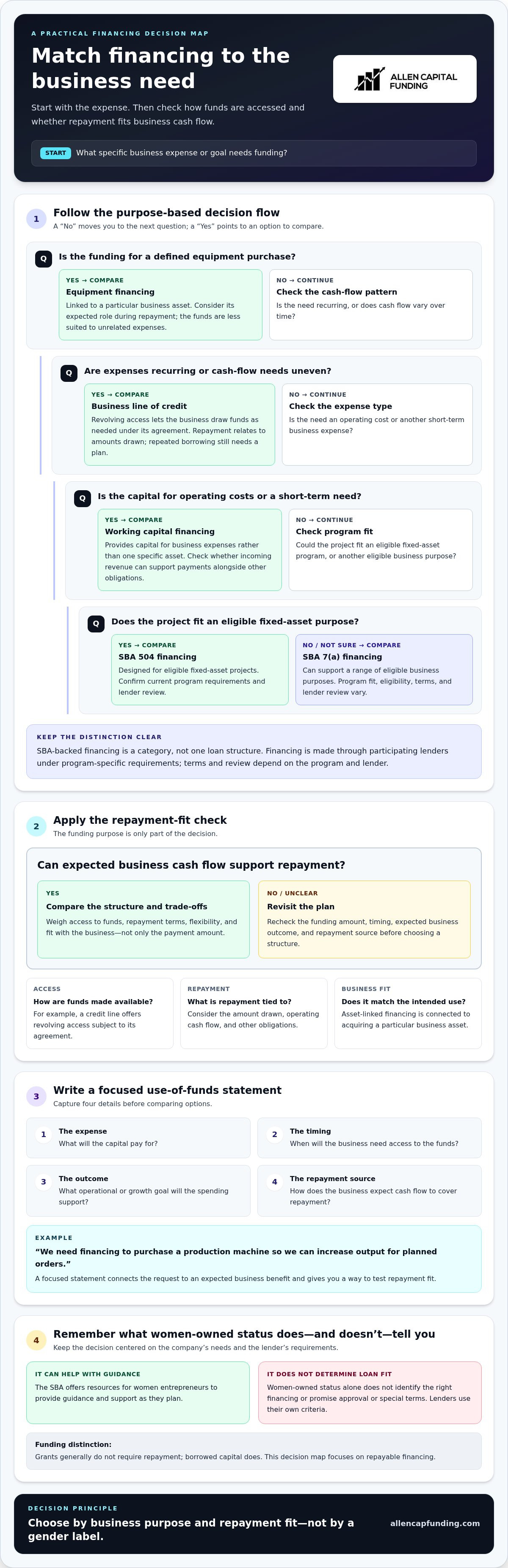
Identify the expense and the result you expect it to support. Day-to-day operating costs may call for working capital; a new machine points toward equipment financing. An expansion may involve several funding needs, while a property purchase or a large customer order may call for another approach. Naming the purpose makes comparisons more relevant.
Write a short use-of-funds statement before reviewing options. Include:
The expense: What will the capital pay for?
The timing: When will the business need access to the funds?
The outcome: What operational or growth goal will the spending support?
The repayment source: How does the business expect cash flow to cover repayment?
For example, “We need financing to purchase a production machine so we can increase output for planned orders” is clearer than “We need money to grow.” A focused statement helps explain the request and test whether the expected business benefit aligns with repayment.
Choose financing by business purpose and repayment fit, not by a gender label. With that foundation, you can compare options against a defined goal instead of sorting through loan names without a decision framework.
Compare business loan options by purpose and repayment structure
Once you’ve defined the goal, compare how each option provides access to funds and how repayment works. Business loans for women entrepreneurs aren’t one uniform category: an SBA loan, a revolving credit line, and financing tied to equipment can support very different plans. Consider both the intended use and the effect of repayment on business cash flow.
When an SBA loan may fit a longer-term business plan
SBA-backed financing is a category, not a single loan structure. Eligibility, lender review, and terms vary by program. Broadly, 7(a) financing can support a range of eligible business purposes, while 504 financing is designed for eligible fixed-asset projects. For program context, explore this SBA loan funding guide. Review current program details and requirements as you compare options. The SBA also provides resources for women-owned businesses, including guidance beyond financing.
When flexible or asset-linked financing may fit better
A credit line may suit recurring needs or cash flow that rises and falls, because funds can be drawn as needed. Equipment financing connects the request to a specific asset. For unpaid invoices, factoring may turn receivables into a source of cash; purchase order financing may help address costs tied to fulfilling customer orders. Both are transaction-linked, so they aren’t universal substitutes for a loan or credit line. Compare the transaction, timing, and repayment source together.
Comparing these paths against your business goals and cash flow can clarify the trade-offs. Explore tailored business funding options with Allen Capital Funding as you narrow your choices.
Compare options using total repayment, flexibility, and business fit
A payment that looks manageable on paper may still strain cash flow if it’s due before customer revenue arrives. Compare the full repayment picture, not just one payment amount. Review payment frequency, repayment duration, whether collateral is involved, and how much flexibility you have to draw or repay funds under the written terms.
Financing fit depends on both the business purpose and the company’s capacity to repay. A seasonal company may have strong sales during part of the year but tighter cash flow during slower months. A business with recurring operating expenses may value access to funds as needs arise. For planned growth, forecast how new costs and expected revenue could affect the money available for repayment.
Which questions reveal whether a loan fits?
Start with the milestone the capital is meant to support and when you expect to use the funds. Then test repayment against realistic cash flow, not only an optimistic forecast. Include existing obligations and ordinary operating expenses. If revenue fluctuates, consider whether payment timing leaves enough room in slower periods. A fixed, one-time purchase may call for a different structure than an ongoing need that changes month to month.
Purpose: What business milestone or expense will the financing support?
Timing: When will funds be needed, and when should the business benefit from them?
Repayment: Can projected cash flow support payments alongside existing obligations?
Flexibility: Does the business need repeated access to capital, or a defined amount for a specific purchase?
Collateral: What assets, if any, may be part of the financing arrangement?
Peer and advocacy organizations can provide another perspective as you develop your plan. For example, NAWBO’s advocacy and support for women entrepreneurs can complement your financing research, but it doesn’t replace a lender’s review of an application or the terms of a specific offer.
How to avoid comparing unlike financing offers
Compare offers on equal footing: use the same requested amount, business purpose, and repayment period, and review disclosed fees alongside the repayment schedule. A revolving credit limit is not the same as a lump-sum loan. The amount available to draw may differ from the amount actually borrowed, and repayment depends on how funds are used and on the agreement’s terms.
Consider payment frequency and duration together. More frequent payments can affect day-to-day cash management, while a longer repayment period changes the overall repayment picture. Collateral requirements and access to funds may differ too. Read the written terms carefully, including how payments are calculated and what conditions apply. Treat an illustrative example as an explanation of a possible structure, not as a personalized offer.
Prepare a stronger business loan application
A focused application connects the financing request to the business need and shows how the company plans to manage repayment. For business loans for women entrepreneurs, preparation follows a practical sequence: clarify the request, organize relevant records, test repayment capacity, and match the financing structure to the use of funds. Requirements vary by program, lender, business profile, and request, so use document lists as preparation aids, not universal checklists.
Build a clear funding case and document set
State the amount you’re seeking, how the business will use it, when funds are needed, and what operational benefit you expect. Then gather records that explain the company’s financial position and the request. Clear, consistent documentation makes it easier to present the business case and address questions during lender review.
Define the use: Describe the expense and the business outcome it supports, such as adding capacity, managing operating needs, or purchasing an asset.
Organize records: Depending on the request, a lender may ask for current financial statements, business tax records, revenue documentation, and details about the business. Keep relevant files together and check that figures align across documents.
Explain the business: Prepare a concise overview of what the company does, how it earns revenue, and what the funding will support. Note material changes in revenue or operations to give the request useful context.
Match the financing: Connect the use of funds to a suitable structure. If the need involves recurring or uneven expenses, revolving capital may be worth comparing; this business line of credit guide explains how that approach works.
Keep the explanation direct. For equipment financing, identify the asset’s role and how it supports operations. For working capital, explain the operating need and how the business expects cash flow to support repayment.
Review readiness before submitting an application
Before beginning lender review, compare cash-flow projections with existing debt and expected repayment obligations. Use realistic assumptions, including slower periods or revenue changes that could affect available cash. Preparation can make your request clearer, but it can’t guarantee approval or a particular offer.
Check consistency: Look for gaps, outdated figures, or differences between financial statements, tax records, and revenue documentation.
Test repayment: Consider whether the business can meet payments while covering payroll, suppliers, and other operating costs.
Keep support ready: Be prepared to explain unusual changes or provide context for figures that may prompt follow-up questions.
Tailor your document set to the financing under consideration, rather than relying on a generic loan application. Allen Capital Funding helps business owners compare capital paths against company goals and cash flow. Discuss a tailored business funding path with the team.
Explore a tailored funding path with Allen Capital Funding
After comparing financing structures, connect your business goal with options that fit its financial context. Allen Capital Funding helps small businesses explore SBA loans, credit lines, working capital, equipment financing, factoring, and purchase order financing. A consultation can help organize the decision around what the company needs, how it earns revenue, and how repayment may fit its cash flow. It’s guidance for exploring potential funding paths, not a promise of approval, rates, or timing.
The aim isn’t to select a product by label. Explain the project clearly, then compare relevant forms of capital against the business’s priorities and repayment capacity.
What to bring to a funding conversation
A concise overview helps make the discussion more productive. Prepare a picture of the company’s history, ownership, revenue patterns, and current financing obligations. Add the project details: the amount sought, intended use, and target timing. Organized records can ground the conversation in the business’s financial position.
Business context: Summarize what the company does, how long it has operated, and any recent changes in revenue or operations.
Funding request: Describe the planned expense, the business outcome it supports, and when the funds are needed.
Financial picture: Bring available financial statements, tax records, revenue documentation, and information about existing obligations.
Questions: Note what you want to understand about repayment structure, access to funds, collateral, and written disclosures.
You don’t need to have every answer ready. Clear records and specific questions create a strong starting point for discussing how financing could align with the business plan.
Choose a next step based on your business goal
Different goals point toward different conversations. A longer-term growth plan or eligible property project may make SBA or real estate financing relevant to explore. Recurring expenses or uneven cash flow may lead you to consider a credit line or working capital. Equipment purchases, unpaid invoices, and customer orders can call for a closer look at equipment financing, factoring, or purchase order financing.
Bring the goal and cash-flow context into the discussion. Allen Capital Funding helps compare potential paths across these business financing categories and consider how each relates to the project. Start with what your company is trying to accomplish and how it expects to manage repayment.
Schedule an online consultation to discuss tailored funding options for your business.
Take the next step toward your business’s growth
Your next funding decision can be a deliberate step toward a business milestone, not just a response to an immediate need. Approach business loans for women entrepreneurs with a clear view of what you want the capital to make possible and what repayment needs to leave room for. A focused conversation can help turn that goal into a practical direction.
Allen Capital Funding helps business owners explore SBA loans, credit lines, working capital, and asset-based financing. An online consultation gives you a chance to discuss your business’s financial context and goals with the team, then explore potential funding paths without assuming one structure fits every company.
Schedule an online consultation to explore business funding options. Bring your priorities and questions to discuss a practical path forward.
Frequently Asked Questions
Are there business loans specifically for women entrepreneurs?
Some organizations provide women-focused business resources, but women-owned status alone doesn’t point to a separate loan structure or guarantee access to financing. Business loans for women entrepreneurs may come through common business financing categories, with fit depending on the company, its funding purpose, and lender criteria. Use ownership-focused programs for guidance, then compare financing based on the business’s needs and ability to manage repayment.
Can women entrepreneurs apply for SBA loans?
Yes. Women business owners can apply for SBA-backed financing if the business and request meet the relevant program and lender requirements. The SBA doesn’t approve every application automatically; lenders review the business’s qualifications and proposed use of funds. Before applying, identify which program may suit the project and review current SBA guidance, since eligibility criteria and application requirements can change.
What types of business loans can women-owned businesses consider?
Options include SBA loans, term financing, business lines of credit, working capital, and equipment financing. The business’s transactions may also make factoring or purchase order financing relevant. For example, a company waiting on customer invoice payments might explore factoring, while a business preparing to fulfill a large order could examine purchase order financing. These structures work differently, so compare their terms and how repayment or access to funds relates to the need.
How do lenders evaluate a woman-owned business loan application?
Lenders commonly consider the company’s cash flow, credit profile, operating history, existing obligations, and the purpose of the request. They may also assess whether the business can support repayment and whether the proposed financing fits the use of funds. Explaining an unusual revenue dip or a recent change in operations can add useful context, but each lender sets its own review criteria.
Can a startup owned by a woman qualify for a business loan?
A startup may be able to seek business financing, but limited operating history can make the review different from that of an established company. A lender may look closely at the owner’s relevant experience, business plan, startup budget, projected revenue, and available financial resources. Prepare realistic assumptions and explain how the venture expects to generate cash flow. Eligibility and potential terms depend on the financing program and lender review.
Should I choose a business loan or a grant?
Choose based on the project, timing, and repayment implications. A grant generally doesn’t require repayment, but it may have specific eligibility rules or limits on how funds can be used. A business loan is borrowed capital that must be repaid under agreed terms, offering another route for financing a planned expense. Compare the funding purpose and obligations before deciding which path fits the business.
What documents should women entrepreneurs prepare before applying?
Requirements vary, but useful records may include recent business financial statements, business tax returns, bank statements, and a concise company overview. For a specific purchase, gather supporting details such as an equipment estimate or project budget if available. Keep ownership and business information consistent across documents, and note unusual transactions or changes in revenue. An organized file can make follow-up questions easier to address.



Comments