
Business Loan Broker vs. Direct Lender: Choosing the Best Path for Capital in 2026
Updated: Sep 19
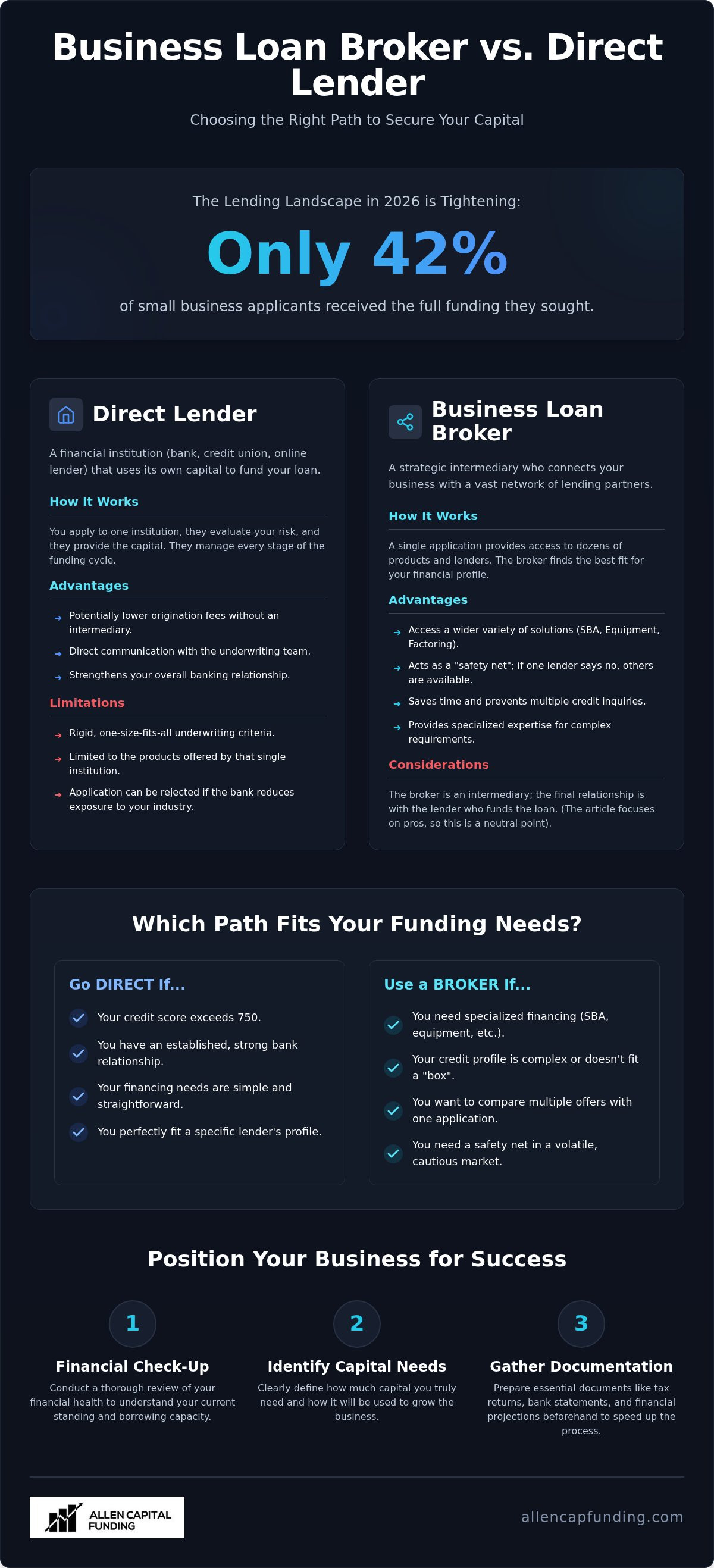
Only 42% of small business financing applicants received the full amount of funding they sought in 2026. This statistic reflects a tightening market where traditional institutions often maintain conservative underwriting standards. You've likely spent hours worrying about complex SBA 7(a) requirements or equipment financing terms, only to fear your application might hit a dead end. It's exhausting to navigate these financial hurdles when your primary goal is simply to scale your operations and secure your legacy.
Understanding the trade-offs of a business loan broker vs direct lender is the first step toward reclaiming your time and securing strategic capital. This guide provides a clear framework for choosing the path that offers the fastest access to working capital and the most competitive rates. We'll explore how to leverage recent SBA policy changes and navigate new state disclosure laws effectively. You'll discover why the most expensive capital is often the loan you cannot get, and how to position your business for accelerated success in a cautious lending environment.
Table of Contents
Defining the Players: Business Loan Brokers vs. Direct Lenders
The choice between a business loan broker vs direct lender determines how you access capital and what kind of relationship you'll have with your funding source. A direct lender is a financial institution that uses its own balance sheet to fund your loan. This category includes traditional big banks, local credit unions, and modern online alternative lenders. You apply to them, they evaluate your risk, and they provide the capital directly.
In contrast, a business loan broker acts as a strategic intermediary. They don't lend their own money; instead, they connect you with a vast network of lending partners. This single point of entry allows you to access dozens of different products and underwriting styles without submitting separate applications to every institution. This distinction is critical for businesses that require more than a standard bank loan.
The Mechanics of Direct Lending
Direct lenders manage every stage of the funding cycle. From the initial application to the final wire transfer, you deal with one entity. This structure can be efficient if you fit the lender's specific "box." However, every Commercial lender is restricted by its own internal risk appetite and balance sheet constraints.
If a bank decides to reduce its exposure to your specific industry, your application might be rejected regardless of your credit score. Direct lending works best for businesses with high credit scores and straightforward financing needs. You get a direct line of communication, but you're limited to the specific products that one institution offers. If you need a specialized solution like purchase order financing, a traditional direct lender might not have the infrastructure to support it.
How a Strategic Broker Operates
A broker provides a broader perspective. Instead of pushing one specific product, they analyze your financial profile to find the best fit. At Allen Capital Funding, we serve as consultants rather than just facilitators. We manage the paperwork fatigue by using a single documentation package to approach multiple potential partners simultaneously. This saves you from the frustration of repeating the same process for every bank.
Brokers remove barriers by identifying which lenders are currently active in your sector. This proactive approach saves time and prevents unnecessary credit inquiries that could lower your score. You gain access to a wider variety of solutions, including:
SBA 7(a) and 504 loans
Specialized equipment financing
Working capital and credit lines
Factoring and purchase order financing
Working with a broker ensures you aren't stuck if one lender says no. It provides a safety net that direct lenders simply cannot offer. This flexibility is vital when market conditions shift and traditional banks tighten their requirements.
The Direct Lender Route: When to Go Straight to the Source
In certain markets, specialized non-bank portals like Online Pôžičky offer a pôžička pre živnostníkov, providing a tailored path for self-employed entrepreneurs who may not meet the strict criteria of traditional direct lenders.
Many entrepreneurs start their search for capital at their local branch. It's a natural instinct. If you have an established relationship with a depository institution, you might expect a smoother path to funding. When evaluating a business loan broker vs direct lender, the direct route often appeals to those with high credit scores and robust financial histories. These institutions use their own funds. This can lead to lower interest rates if you fit their specific borrower profile perfectly. However, the lending environment in 2026 remains cautious. Even loyal customers find that banks are tightening their belts and maintaining conservative underwriting standards.
Advantages of the Direct Approach
Working directly with a bank can reduce certain upfront costs. Without an intermediary, you might find lower origination fees in some cases. Some smaller community banks also offer direct access to their underwriting teams. This allows for a personal touch where you can explain the story behind your numbers. Over time, maintaining your loans and deposits in one place can strengthen your overall banking relationship. You may also find specialized SBA lender programs that are managed entirely in-house by preferred lenders, which can simplify the communication chain during the approval process.
The Limitations of One-Size-Fits-All Lending
The direct route has significant drawbacks for businesses that don't meet strict, traditional criteria. Rigid underwriting is the biggest hurdle. Large banks often rely on automated scoring systems that can't account for the nuances of rapid growth or seasonal fluctuations. If a direct lender says "no," your search effectively ends there. You're left to start from scratch with another institution. This leads to "application fatigue" and multiple hard inquiries that can lower your credit score. In a market where only 42% of applicants receive their full requested amount, a single rejection can be a major setback for your timeline.
Product availability is another concern. A bank may offer a standard business line of credit but lack the infrastructure for specialized tools like invoice factoring. This limited menu can force you into a loan structure that doesn't actually solve your cash flow problems. If your capital needs are complex, relying on a single bank's limited offerings can stifle your long-term growth. It's essential to ensure your funding source can scale with you. Before committing to a single source, you can explore customized funding options that match your specific industry requirements and growth trajectory.
The Broker Advantage: Why Options Matter in 2026
In a volatile 2026 market, the biggest risk to your business isn't necessarily a high interest rate. It's the opportunity cost of a failed application. While direct lenders focus on their own rigid criteria, a broker provides a safety net of multiple capital sources. This approach is essential when only 42% of small business financing applicants receive the full amount of funding they seek. By understanding the core difference between a lender and a broker, you can avoid the "No" problem that stalls growth.
Choosing a business loan broker vs direct lender also opens doors to a "hidden market" of private lenders and institutional funds that don't market directly to the public. These partners often have higher risk appetites or specialized industry focuses. A broker saves dozens of hours by filtering out lenders that won't approve your specific industry or credit profile. This efficiency ensures your application only lands on the desks of those ready to fund, protecting your credit score from unnecessary inquiries.
Access to Specialized Capital Products
A strategic broker doesn't force your business into a pre-set product. They can pivot between asset-based lending, bridge loans, and technical SBA loan brokerage effortlessly. If your goal is acquiring heavy machinery, they bring deep expertise in commercial equipment loans for niche sectors like medical or logistics. This flexibility ensures the capital matches your specific goal rather than just filling a temporary gap. You gain access to a tailored suite of tools, from factoring to purchase order financing, that a single bank rarely offers under one roof.
Underwriting Advocacy and Negotiation
Successful funding often depends on how your story is told to the decision-makers. A broker knows how to package your financial profile to highlight strengths, such as strong cash flow, while mitigating weaknesses like seasonal fluctuations. They create competition among multiple lenders, which often leads to better terms and lower rates than a single bank would offer. As your dedicated advocate, a broker speaks the language of credit committees to ensure your application is viewed through a lens of potential rather than just risk. This proactive representation bridges the gap between your current financial state and your future growth goals.
Key Evaluation Criteria: Which Path Fits Your Funding Needs?
Choosing between a business loan broker vs direct lender requires an honest assessment of your current financial standing and growth goals. Your credit profile serves as the primary filter. Businesses with credit scores exceeding 750 often find favorable terms at direct banks. However, if your score falls between 600 and 700, a broker's touch is usually necessary to find a lender willing to look past the number. Speed is another critical factor. If you need capital within 48 hours to secure a time-sensitive opportunity, an alternative direct lender or a broker is essential to bypass traditional banking delays. For those considering individual financing to bridge these gaps, Personal Loans offers a way to locate suitable options quickly.
Determining your path depends on the complexity of your industry and your specific needs. Use a broker if your sector is classified as "high risk" by traditional institutions. This includes industries like logistics or medical, where specialized knowledge is required. A broker is also the right choice if you require a mix of products, such as a credit line combined with equipment financing. Conversely, a direct lender may suffice if you have a decade of history with your bank and only need a small, standard term loan. Consider the following scenarios:
High complexity: SBA loans and large-scale equipment acquisitions almost always benefit from a broker's technical expertise.
Urgent timeline: Brokers can access alternative channels that fund faster than traditional banks.
Strategic growth: When you need capital that scales with your revenue, a broker's network provides more options.
Calculating the Real Cost of Capital
Look beyond the headline interest rate to understand the true expense of your loan. You must factor in origination fees, closing costs, and potential prepayment penalties. While a broker may charge a fee, this cost is often offset by the lower interest rate they negotiate through competitive bidding. The most significant expense to analyze is the cost of "doing nothing." If a direct lender rejects your application after weeks of waiting, the lost revenue from that missed growth opportunity far outweighs a marginal fee. Securing access to capital is often more valuable than chasing the absolute lowest rate at the risk of rejection. To get started on the right path, you can schedule a financial check-up to evaluate your current funding readiness.
Securing capital is a strategic move that acts as a bridge between your current state and your future goals. When you evaluate the business loan broker vs direct lender choice, prioritize the certainty of funding. A slightly higher fee is a worthwhile investment if it guarantees the capital necessary for your next phase of growth. This proactive approach leads to accelerated success by removing the barriers that a single, rigid institution might impose.
Securing Your Capital: How to Partner for Strategic Growth
Choosing between a business loan broker vs direct lender is a pivotal decision that requires more than just a quick application. It demands a strategic look at your company's internal health. The first step is a comprehensive financial check-up to identify your true capital needs. This process moves beyond surface-level numbers to uncover the most effective way to fuel your expansion. Allen Capital Funding provides the expert guidance needed to navigate this choice with confidence, acting as a steady hand in a complex financial landscape.
Preparation is the key to speed. You should prepare your documentation early to avoid delays that can stall your momentum. Tax returns, P&L statements, and balance sheets are universal requirements that every lender will scrutinize. Transparency is equally vital. Don't hide past credit challenges. Being honest with your broker about historical issues allows them to advocate for you effectively. They can find the right fit among their network immediately rather than wasting time on lenders with rigid, automated disqualifiers.
The Consultative Approach to Lending
A consultation beats an automated application every time. While big banks often rely on cold algorithms, our consultative approach focuses on supportive empowerment. We look at the story behind your balance sheet. Allen Capital Funding tailors solutions to your specific growth trajectory, ensuring your capital is a strategic advantage rather than just a temporary fix. It's essential to have a dedicated team that understands national lending trends to navigate the shifting regulations of 2026. This expertise ensures you aren't just getting a loan; you're gaining a facilitator for your accelerated success.
Next Steps for Your Business
Your path to capital starts with clarity. Determine your immediate capital gap and evaluate your long-term asset needs, such as equipment or real estate. Gather your financial data for a preliminary review to ensure your application is airtight. This proactive stance separates successful firms from those that struggle with rejection. By organizing your records now, you remove barriers and simplify the path to progress. When you're ready to secure the best possible terms for long-term growth, schedule a consultation with Allen Capital Funding today. We're ready to help you bridge the gap between your current state and your future goals.
Accelerating Your Path to Strategic Capital
The choice between a business loan broker vs direct lender ultimately determines how effectively you can navigate the shifting financial landscape of 2026. While direct banks serve a specific purpose for standard needs, brokers provide a strategic safety net by opening doors to a national network of diverse lending partners. This breadth of options ensures you aren't limited by one institution's rigid underwriting or narrow product range. Accessing multiple channels is often the difference between a stalled application and a funded project.
Strategic growth requires more than just a wire transfer; it needs deep expertise in SBA loans, specialized equipment financing, and working capital solutions. By adopting a consultative approach, you position your firm for accelerated success rather than just temporary liquidity. This proactive preparation removes traditional barriers and clarifies your path toward long-term goals. You deserve a partner who understands the story behind your numbers and can advocate for your success.
Your business's future depends on the strength of your financial foundation and the speed of your execution. Secure your business future with a strategic funding consultation today. We're here to provide the steady hand and expert guidance your vision deserves.
Frequently Asked Questions
What is the main difference between a business loan broker and a direct lender?
The primary difference between a business loan broker vs direct lender involves the capital source and product variety. A direct lender uses its own funds and balance sheet, meaning you're limited to their specific internal products and risk appetite. A broker acts as a strategic intermediary with a national network of partners. This allows them to compare multiple offers simultaneously, ensuring you secure the most competitive terms and a solution tailored to your growth.
Do business loan brokers charge a fee to the borrower?
Brokers earn revenue through facilitation fees or commissions from lending partners after a successful closing. While some might charge a direct fee for processing, these costs are typically offset by the lower interest rates they negotiate through competitive bidding. A reputable firm discusses its fee structure during an initial financial check-up. This ensures you understand the total cost of capital before committing to a specific funding path or lending partner.
Is it harder to get approved by a direct lender like a big bank?
Securing approval from a direct lender is often harder because they rely on narrow, automated underwriting criteria. Many banks in 2026 require near-perfect credit and extensive collateral, which excludes many growing firms. A broker removes these barriers by advocating for your business to multiple alternative sources. They look beyond standard metrics to highlight your cash flow and strategic potential, connecting you with lenders who have a higher risk appetite.
Can a broker help me get an SBA loan faster than a bank?
A broker can expedite an SBA loan by ensuring your application package meets all technical requirements before submission. They identify which lenders in their national network are currently active and responsive to SBA 7(a) or 504 requests. This targeted approach prevents your file from sitting in a bank's backlog. While they don't control federal processing times, their expertise eliminates common documentation errors that lead to lengthy delays or outright rejections.
Will working with a broker affect my credit score more than a direct lender?
Working with a broker is generally better for your credit score than applying to several direct lenders yourself. Each bank application typically triggers a hard inquiry, which can lower your score. A broker performs a preliminary review and only submits your documentation to lenders likely to offer an approval. This strategic filtering protects your credit profile from unnecessary hard pulls while increasing your chances of securing the working capital or credit lines you need.
What industries benefit most from using a business loan broker?
Capital-intensive sectors like logistics, medical, and construction benefit significantly from a broker's expertise. These industries often require specialized equipment financing or purchase order funding that traditional banks don't offer. Businesses with seasonal revenue or those in high-risk categories also find brokers essential for navigating conservative lending standards. A broker identifies partners who understand these industry-specific challenges and can provide flexible solutions like factoring or asset-based lending to support growth.
How do I know if a business loan broker is reputable?
A reputable broker prioritizes expert guidance and a consultative approach over high-pressure sales tactics. You can verify their standing by looking for transparency regarding fees and a willingness to perform a thorough financial check-up before suggesting products. They should demonstrate deep technical knowledge of diverse funding tools and maintain a national network of reputable lending partners. A trustworthy facilitator acts as a steady hand, simplifying the funding process and acting as your advocate.
Can I use a broker for specialized equipment financing?
Brokers are excellent resources for specialized equipment financing because they match niche assets with lenders who understand their specific value. Whether you need medical technology or heavy machinery, a broker identifies the most suitable capital solution for that asset's lifespan. They can pivot between various lending structures to ensure the terms align with your long-term growth trajectory. This customization is rarely available through a single direct lender with a limited product menu.



Comments