


Best Invoice Factoring Companies for Small Business: A 2026 Selection Guide
- anthonyarallen
- Jul 11
- 13 min read
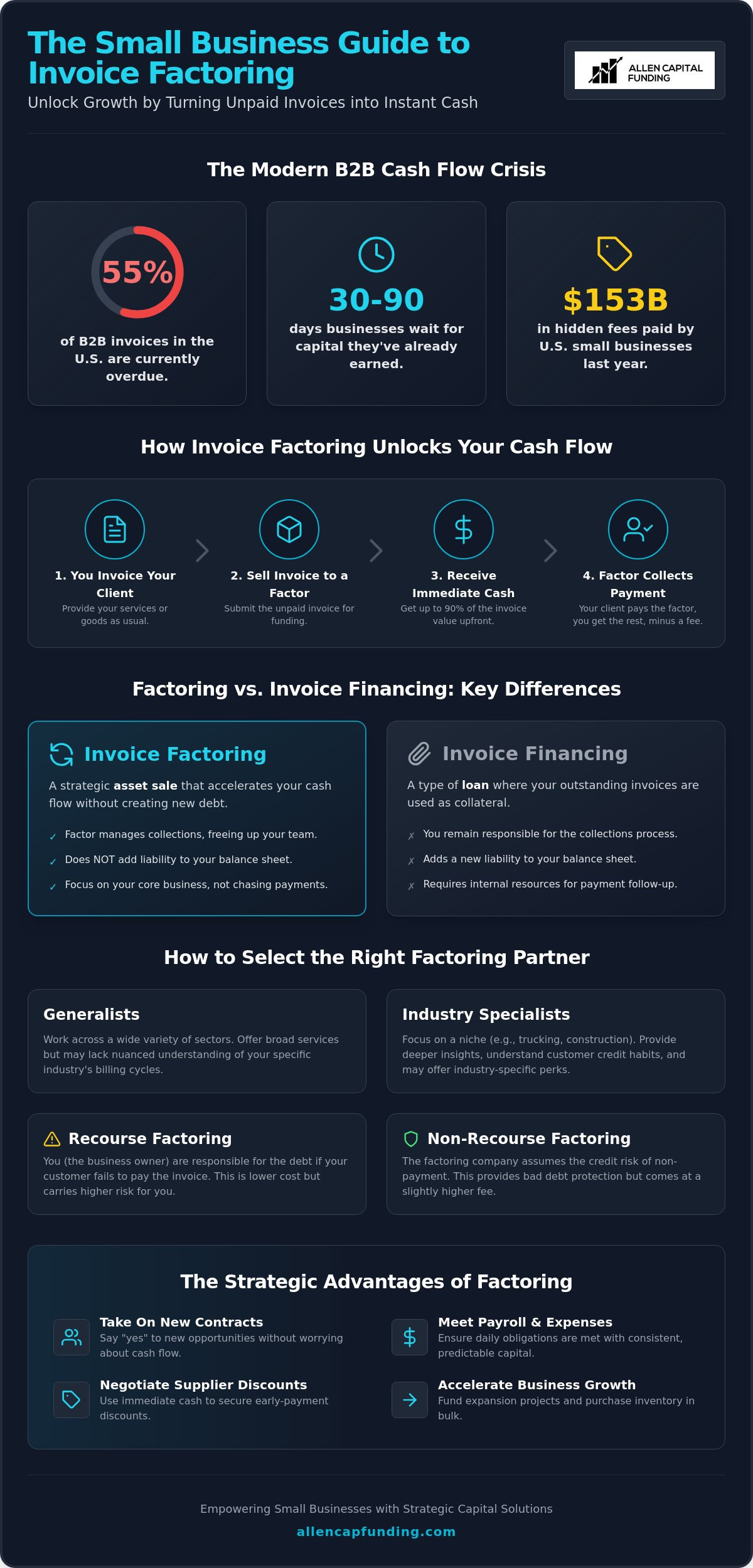
Did you know that 55% of B2B invoices in the United States are currently overdue? It's a staggering reality that forces many entrepreneurs to stall their growth while waiting 30 to 90 days for capital they've already earned. You shouldn't have to choose between taking on a new contract and meeting your daily obligations because your cash is trapped in accounts receivable. Finding the right invoice factoring companies for small business can bridge that gap and provide the immediate liquidity you need to scale with confidence.
We understand that the search for a financial partner often feels overwhelming, especially when U.S. small businesses paid an estimated $153 billion in hidden fees just last year. Our goal is to simplify this process and empower you with clear, actionable insights. In this 2026 selection guide, we'll evaluate the top providers based on their fee structures, funding speed, and industry expertise. You'll learn how to identify a partner that offers a simple application process and handles your collections with the professional touch your clients expect, ensuring your business stays on the path to accelerated success.
Table of Contents
The Role of Invoice Factoring Companies in Small Business Liquidity
Types of Invoice Factoring Partners: Generalists vs. Industry Specialists
Evaluating the Best Invoice Factoring Companies: Key Selection Criteria
Understanding Costs and Risk: Recourse vs. Non-Recourse Factoring
Securing the Right Factoring Solution with Allen Capital Funding
The Role of Invoice Factoring Companies in Small Business Liquidity
Invoice factoring is more than just a financial transaction. It's a strategic asset-based tool that empowers B2B companies to control their financial destiny. At its core, Factoring (finance) is the process of selling your accounts receivable to a third party at a discount. This conversion provides an immediate influx of working capital, turning paper profits into usable cash. It's a proactive way to manage cash flow without the constraints of traditional lending.
For many entrepreneurs, the search for invoice factoring companies for small business begins when bank credit tightens. With banks restricting credit for 13 consecutive quarters as of 2026, factoring has emerged as a reliable alternative. Unlike traditional loans, factoring doesn't add new liabilities to your balance sheet. You aren't borrowing money; you're simply accelerating the arrival of funds you've already earned. This makes it an ideal solution for businesses with creditworthy customers who simply take too long to pay.
How Factoring Accelerates Business Growth
Growth requires fuel. When your capital is locked in unpaid invoices for 60 or 90 days, you miss opportunities. Factoring unlocks that cash instantly, allowing you to meet payroll, purchase bulk inventory, or fund a new expansion project without hesitation. You don't have to wait for a client's check to clear before you can say "yes" to a new contract.
The benefits extend beyond simple survival. With immediate liquidity, you can negotiate early-payment discounts with your own suppliers, often offsetting the cost of the factoring itself. There is also a significant psychological shift that occurs. You move from being a "debtor" constantly checking the mailbox to a "cash-rich" operator ready to act on strategic advantages. This proactive stance is the bridge to accelerated success, transforming how you view your balance sheet.
Factoring vs. Invoice Financing: Key Differences
It's easy to confuse factoring with invoice financing, but the distinction is critical for your operations. Invoice financing is essentially a loan where your invoices serve as collateral. You remain responsible for the debt and the collections process. It stays on your books as a liability that must be repaid.
Factoring is a fundamentally different approach. Factoring is an asset sale that transfers the responsibility of collecting payments from your customers to the factor. This frees your team from the administrative burden of chasing payments. While financing keeps the transaction "in-house," factoring introduces a professional partner who handles the back-office collections with the same care you would. This allows you to focus entirely on your core business goals while your partner manages the ledger.
Types of Invoice Factoring Partners: Generalists vs. Industry Specialists
Selecting the right financial partner isn't just about finding the lowest rate. It's about finding a team that understands how your specific industry operates. As you evaluate invoice factoring companies for small business, you'll notice two primary categories: generalists and industry specialists. Generalists work across a wide variety of sectors, offering a broad range of services that appeal to a diverse client base. While they provide stability, they may lack the nuanced understanding of your specific billing cycles or customer behaviors.
Specialist factors focus on a single niche. They understand that a construction company faces different payment hurdles than a medical practice or a local manufacturer. Because they specialize, these firms often have deeper insights into the credit habits of your specific customers. They know which debtors pay on time and which ones require more persistent follow-up. This expertise helps you get working capital for your business with fewer administrative headaches. You also need to consider the difference between bank-owned factors and independent firms. Bank-owned options might offer slightly lower rates, but they often come with the same rigid requirements and slow approval times found in traditional lending. Independent firms typically offer more speed and flexibility, which is often vital for growing companies.
Industry-Specific Factoring Benefits
Specialized invoice factoring companies for small business provide tools that go beyond simple cash advances. In the trucking industry, for example, factors often provide fuel cards and specialized freight bill processing to keep drivers on the road. For staffing agencies, a specialist might offer integrated payroll services to manage high-volume weekly payments efficiently. Manufacturing businesses benefit from partners who understand progress billings and the complexities of long supply chains. These specialized services act as an extension of your own back office, helping you maintain momentum without adding to your internal workload.
Small Business vs. Enterprise Factoring Companies
Scale matters when choosing a partner. Large enterprise-level factoring companies often require high minimum monthly volumes that don't fit the needs of a startup or a boutique firm. These larger entities rely heavily on automated portals and rigid algorithms. For a small business, this can feel cold and unresponsive. Boutique factors often provide a more personalized service, offering a dedicated account manager who actually knows your business by name. This human interaction is invaluable when you have a unique situation or a complex invoice that requires a manual review. If you're unsure which model fits your current growth stage, a Financial Check-Up can help clarify your path forward. Choosing a partner that offers flexible contract terms allows your financing to grow alongside your revenue, ensuring you aren't trapped in an agreement that no longer serves your needs.
Evaluating the Best Invoice Factoring Companies: Key Selection Criteria
Finding the right partner requires looking beyond the headline discount rate. While a rate of 1% to 5% per 30 days is standard in 2026, the total cost of capital often involves several layers of administrative charges. High-performing invoice factoring companies for small business distinguish themselves through transparency rather than just low initial quotes. You need a framework that accounts for the speed of the advance and the quality of the team representing your brand to your customers. Growth demands clarity. Don't settle for vague terms. A steady partner ensures your strategic success.
When evaluating the speed of funding, distinguish between the initial account setup and the daily processing of new invoices. Most reputable providers deliver funds within 24 to 48 hours of invoice submission. Some even offer same-day funding for established clients. However, the initial due diligence process can take longer. Ask potential partners about their average "time to first advance" to ensure their pace matches your urgent liquidity needs. A proactive ally will streamline this process to get you moving as quickly as possible.
The "All-In" Cost of Factoring
To truly compare offers, calculate the effective Annual Percentage Rate (APR). While factoring is a sale of assets rather than a loan, the APR equivalent typically ranges from 18% to 45%. This figure helps you compare factoring against other Working Capital options. Watch for tiered pricing models where your rates decrease as your monthly volume increases. This structure rewards your growth and keeps your costs manageable as you scale. Be wary of "miscellaneous" or "maintenance" fees that aren't tied to specific actions. With U.S. small businesses paying $153 billion in hidden fees in 2024, verifying every line item for service, ACH, and due diligence is essential for protecting your margins. The best invoice factoring companies for small business provide a clear schedule of costs up front, including origination fees that commonly range from $150 to $500.
Customer Service and Brand Protection
Your factor acts as your outsourced accounts receivable department. This means their staff will be the ones calling your clients to verify invoices or follow up on late payments. Professional courtesy is non-negotiable. A partner who uses aggressive collection tactics can damage your long-term client relationships. You want a guide that acts as a bridge between your current state and your future goals, not a barrier to customer satisfaction. Look for providers that offer real-time online portals. These platforms provide 24/7 transparency, allowing you to track collections and fund status without needing to wait for a return call. This level of accessibility builds the trust necessary for a long-term strategic partnership.
Understanding Costs and Risk: Recourse vs. Non-Recourse Factoring
The most common question entrepreneurs ask when evaluating invoice factoring companies for small business is straightforward: "What happens if my customer doesn't pay?" The answer depends entirely on whether your agreement is structured as recourse or non-recourse. This choice defines who carries the ultimate financial burden of a default. Approximately 80% of the factoring volume in the United States is currently recourse factoring. It's the industry standard for a reason, but it requires a clear understanding of your customers' credit reliability. Understanding these risk profiles is essential for maintaining a secure and predictable cash flow.
Recourse factoring requires your business to buy back the invoice if the client fails to remit payment within a set period, which is typically 60 or 90 days. This means you retain the credit risk. Non-recourse factoring offers a higher level of protection because the factor assumes the risk if your customer becomes insolvent or files for bankruptcy. However, this safety net isn't absolute. Non-recourse agreements usually only cover specific credit events, not general disputes over service quality or simple late payments. Choosing between these models involves a direct trade-off between higher fees and lower operational risk.
When to Choose Recourse Factoring
Recourse factoring is often the most cost-effective path for businesses with a portfolio of highly reliable, long-term clients. Because you're retaining the risk, invoice factoring companies for small business can offer lower discount rates. In 2026, recourse fees typically range from 1.0% to 2.5% for invoices paid within 30 days. You'll also benefit from higher advance rates, which frequently reach 80% to 95% of the invoice value. This structure is a natural fit for broader Asset-Based Lending for Small Business strategies, where you use your entire balance sheet to maximize liquidity. If you're confident in your debtors' ability to pay, recourse factoring provides the maximum amount of capital at the lowest possible cost.
The Safety Net of Non-Recourse Factoring
Non-recourse factoring acts as a form of credit insurance for your accounts receivable. It's particularly valuable for startups and high-growth firms entering new markets where they don't have deep history with their debtors. By paying a premium, usually 0.5% to 1.5% over standard recourse rates, you protect your business against "bad debt" that could otherwise cripple your cash flow. This security allows you to scale aggressively without the fear that a single client's insolvency will halt your progress. It's a proactive way to insulate your working capital from external economic shocks. If you want to determine which risk model aligns best with your growth goals, you can request a Financial Check-Up to analyze your current receivables and identify the most secure path forward.
Securing the Right Factoring Solution with Allen Capital Funding
Finding the right fit among the many invoice factoring companies for small business shouldn't be a trial-and-error process. Allen Capital Funding acts as your strategic bridge, connecting your unique operational needs with the most compatible lenders in the market. Instead of submitting dozens of separate applications, our brokerage model allows you to access a broad network of vetted partners through a single, streamlined process. This efficiency saves you time and ensures you receive competitive offers that align with your specific growth goals. We provide the professional confidence you need to make informed decisions about your company's future.
Our role is to serve as an authoritative expert and dedicated guide. We provide the expert guidance necessary to help you avoid unfavorable contract terms or hidden fee structures that could stall your progress. Factoring is often just one piece of a larger puzzle. We help you integrate this tool into a comprehensive financial strategy; this might also include a Business Line of Credit to provide maximum flexibility as your capital needs evolve. By looking at the complete picture, we ensure your liquidity solutions support long-term stability rather than just short-term needs.
A Tailored Approach to Capital
We don't believe in one-size-fits-all finance. Our team takes a proactive, solution-focused approach to match your industry and monthly volume to the right factoring partner. Before you commit to any funding source, we recommend a Financial Check-Up. This strategic consultation helps determine if factoring is truly the best move for your current situation or if another working capital solution would serve you better. While we have a national reach across the United States, our experience remains boutique and consultant-led. You'll work with a dedicated ally who is deeply invested in your accelerated success, acting as a bridge between your current state and your future goals. To ensure your long-term success includes a robust tax and wealth strategy, visit Timothy Roberts & Associates, LLC.
How to Get Started
Securing immediate liquidity is a straightforward process when you have the right facilitator. Our consultation process is designed for speed and clarity. You can book an appointment online to explore your options and receive a clear overview of the market. To move quickly, you'll typically need to provide a few essential documents. These include your current accounts receivable aging reports and a list of your primary B2B clients. This information allows our team to identify which invoice factoring companies for small business will offer the best advance rates for your specific portfolio. Don't let unpaid invoices hold your business back from its potential. Consult with an Allen Capital Funding expert today to unlock the capital you've already earned.
Accelerate Your Growth with Strategic Liquidity
Invoice factoring is a powerful tool to bridge the gap between completed work and received payments. By selecting the right invoice factoring companies for small business, you transform your accounts receivable into a dynamic engine for growth. You've learned that the best partner isn't just about the lowest rate. It's about industry expertise and transparent fee structures that protect your bottom line and your client relationships.
Whether you opt for the cost-efficiency of recourse factoring or the security of non-recourse protection, your choice should align with your specific risk tolerance. Our team at Allen Capital Funding acts as your proactive ally in this decision. We provide national access to specialized asset-based lending partners and expert guidance from dedicated funding specialists. This ensures you secure the most favorable terms for your unique situation while maintaining focus on your core operations.
Secure your business liquidity—book a consultation with Allen Capital Funding. Our fast-paced, efficient funding process is designed to help you reach your future goals without delay. You have the vision for your business; we have the capital solutions to help you achieve it.
Frequently Asked Questions
How much do invoice factoring companies typically charge small businesses?
Most invoice factoring companies for small business charge a discount rate based on your monthly volume and the creditworthiness of your customers. These fees are typically calculated as a percentage of the total invoice value for each 30-day period. You should also look for transparency regarding setup fees or administrative charges to understand your total cost. Calculating the effective cost of capital helps you compare this solution against other funding options. This clarity ensures your financing supports strategic growth.
Is invoice factoring better than a small business bank loan?
Factoring is often more accessible than a bank loan because it relies on your customers' credit rather than your own. While bank loans usually offer lower interest rates, they involve rigid requirements and lengthy approval cycles. Factoring provides immediate liquidity without adding new debt to your balance sheet. This makes it a superior choice for growing firms that need fast capital to fulfill new contracts or manage seasonal spikes without waiting for extensive bank underwriting.
What is the difference between recourse and non-recourse factoring?
The primary difference lies in who carries the risk of non-payment. In a recourse agreement, your business must buy back the invoice if your customer fails to pay. Non-recourse factoring protects you against customer insolvency or bankruptcy. While non-recourse offers more security, it usually involves higher discount rates to cover the added risk. Most U.S. factoring volume is recourse because it offers a more cost-effective solution for businesses with reliable clients who pay invoices on time.
Will my customers know I am using a factoring company?
Yes, your customers will typically be aware because the factoring company handles the collections process. This transparency is standard in B2B industries and is generally viewed as a sign of professional financial management. The factor will send a Notice of Assignment to your clients, directing them to pay the factor directly. High-quality invoice factoring companies for small business manage these interactions with professional courtesy to protect your long-term relationships and brand reputation.
Can I factor invoices for customers with bad credit?
It's unlikely that a factor will accept invoices for customers with poor credit or a history of delinquency. Since the factoring company is essentially purchasing the asset, they prioritize the creditworthiness of your debtors over your own business credit. If a specific customer represents a high risk of default, the factor will likely exclude those invoices from the funding agreement. This protects both parties from the high opportunity cost of uncollectible debt and maintains cash flow stability.
What industries benefit most from invoice factoring services?
Industries with long payment cycles and high upfront costs benefit the most. This includes trucking, where fuel and maintenance costs are immediate, and staffing agencies that must meet weekly payroll before client payments arrive. Manufacturing and construction firms also use factoring to manage supply chain expenses and progress billings. Any B2B company facing a gap between service delivery and payment can use this tool to maintain steady growth and professional stability.
How quickly can I get funded after signing a factoring agreement?
Industry standards for funding speeds typically range from 24 to 48 hours once your account is fully established and invoices are verified. Some specialized providers even offer same-day funding for recurring clients. The initial setup and due diligence process may take several days as the factor reviews your client list and aging reports. After this initial phase, the funding rhythm becomes highly efficient. This allows you to react quickly to new opportunities without traditional bank processing delays.
Does invoice factoring affect my business credit score?
Invoice factoring doesn't directly impact your business credit score because it isn't a loan. It doesn't appear as a liability on your credit report, which can actually help your score by improving your debt-to-income ratio. By providing immediate cash, factoring allows you to pay your own suppliers and creditors on time. This consistent payment history is one of the most effective ways to build and maintain a strong business credit profile for future strategic needs.


Comments