


Asset-Based Lending for Small Business: Unlocking Balance Sheet Liquidity in 2026
What if the inventory sitting in your warehouse and the unpaid invoices on your desk were actually more valuable than the cash in your bank account? You likely know the frustration of watching high-growth opportunities slip away because your capital is locked in your balance sheet. It's a common struggle for entrepreneurs who find traditional bank loans out of reach due to seasonal cash flow volatility or the strict ownership regulations that took effect in early 2026. Many business owners feel stuck when traditional lenders tighten their standards, but your physical assets hold the key to your next phase of growth.
This article explains how asset-based lending for small business transforms those stagnant assets into a flexible, revolving line of credit. You'll learn how to weaponize your balance sheet to access immediate working capital without the high costs of unsecured debt. We will also explore why non-bank lenders now manage nearly 49% of this market, offering the speed and flexibility you need to stay competitive. By the end of this guide, you'll know exactly how to secure funding that scales automatically as your company expands, ensuring you never miss a market opportunity again.
Table of Contents
What is Asset-Based Lending for Small Business?
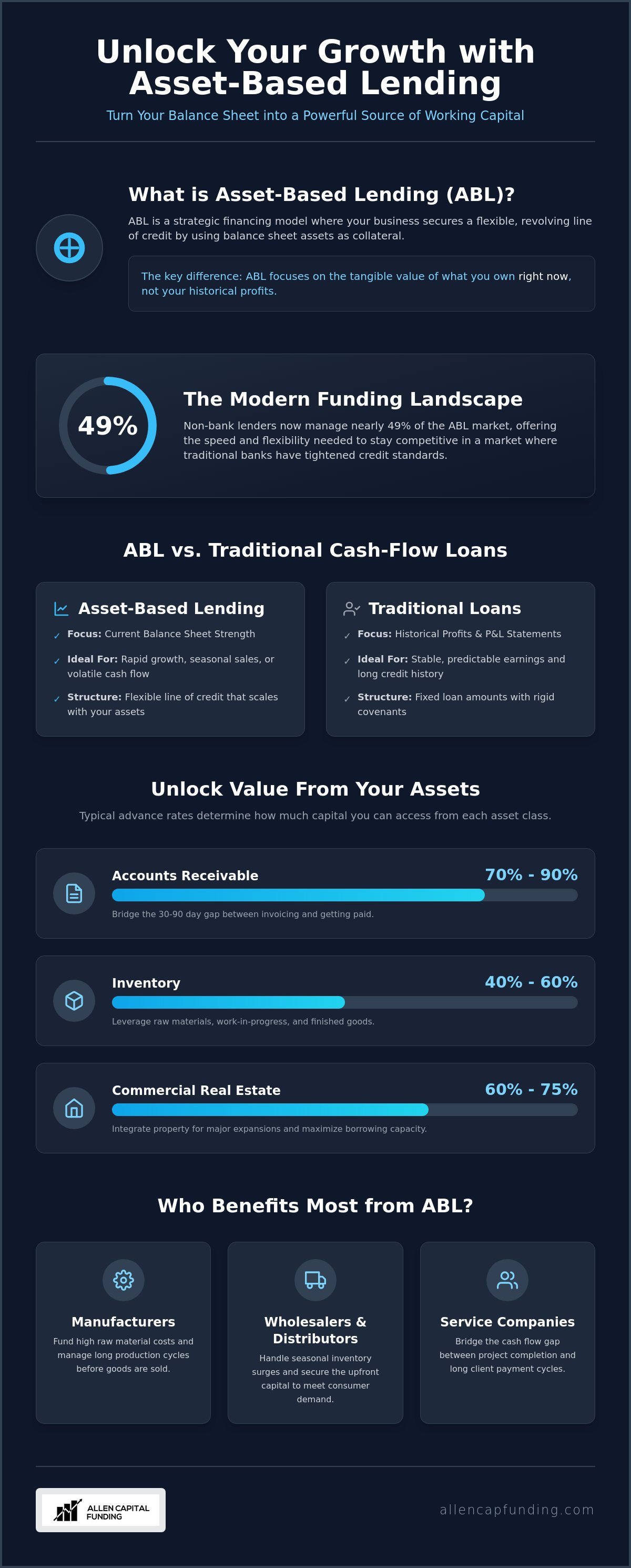
Asset-based lending is a strategic financing model where a business secures a loan or revolving line of credit by using specific balance sheet assets as collateral. Unlike traditional cash-flow lending, which prioritizes your historical profits and P&L statements, asset-based lending for small business focuses on the tangible value of what you own right now. This shift in perspective allows companies with fluctuating earnings or rapid growth cycles to access capital that conventional banks might deny. It's a proactive way to convert your company's strength into immediate liquidity.
In 2026, market conditions have made ABL a preferred choice for inventory-heavy sectors. Traditional banks have tightened credit standards following stricter risk-weighting frameworks and persistent economic uncertainty. With SBA lending volume in the 7(a) program seeing an 18% decline in early 2026, many entrepreneurs are turning to non-bank lenders who now control over 48% of the ABL market. Sophisticated firms view this as a tool for accelerated success rather than a safety net. It provides a reliable bridge between your current state and your future goals without the rigid requirements of unsecured debt.
The Core Mechanism: How Assets Become Capital
Lenders use Loan-to-Value (LTV) ratios to determine how much you can borrow against each asset class. For instance, eligible accounts receivable often see advance rates between 70% and 90%, while inventory typically ranges from 40% to 60% of its appraised value. Lenders generally prefer liquid assets like AR over specialized machinery because unpaid invoices are much easier to convert into cash. This structure ensures that your funding grows automatically as your business activity increases. The borrowing base is a dynamic limit that fluctuates in real-time based on the current value of your eligible assets.
Who Benefits Most from ABL?
This financing structure is particularly effective for businesses where cash is constantly tied up in physical or financial assets. It removes the barriers created by long payment cycles and heavy production costs. The following sectors often find the most success with this model:
Manufacturers: Companies dealing with high raw material costs use ABL to fund production cycles before finished goods are sold.
Wholesalers and Distributors: These businesses often face seasonal inventory surges that require massive upfront capital to meet consumer demand.
Service Companies: Firms with long payment cycles or high AR balances can bridge the gap between project completion and client payment.
By leveraging asset-based lending for small business, these organizations ensure that their growth isn't throttled by the timing of their customers' payments. For transport-based businesses, this liquidity allows them to explore Truck Repair and upfitting services from specialists like Tim Halpin Equipment Corp to keep their fleet operational. This flexibility allows you to say yes to new contracts without worrying about your bank balance. Instead of waiting for a check to clear, you can use your existing assets to fuel your next big move immediately.
Types of Collateral Used in Asset-Based Financing
Your balance sheet contains several categories of value that can be unlocked to drive growth. The most common form of collateral is accounts receivable. This allows you to bridge the 30 to 90 day gap between delivering a product and receiving payment. Lenders typically advance 70% to 90% of eligible invoices, providing a steady stream of working capital. According to insights on Asset-based financing for small businesses, this method is highly effective for companies with high-quality customers but slow payment cycles. It ensures your cash isn't trapped in the mail while you're trying to fund new projects.
Inventory serves as another powerful lever for asset-based lending for small business. Lenders evaluate raw materials, work-in-progress, and finished goods to provide a line of credit, usually advancing 40% to 60% of the appraised value. For larger draws, advanced collateral options like commercial real estate or intellectual property can be integrated into the deal. Real estate typically commands advance rates of 60% to 75% of the appraised value, which provides the capital needed to explore Iron and Sulfur Filtration Systems or other property upgrades. By combining these different asset classes, you can maximize your total borrowing capacity and secure the liquidity needed for major expansions.
Asset-Based Lending vs. Invoice Factoring
Many business owners confuse ABL with invoice factoring, but they function very differently. Factoring is an asset sale where you sell your invoices to a third party at a discount. In contrast, ABL is a debt-based line of credit where you retain ownership of the assets. ABL is often more cost-effective for established firms with strong internal controls. It also offers greater confidentiality because the financing remains behind the scenes. Your customers don't need to know you're using a credit line, which helps you maintain a direct and professional relationship with your clients.
Maximizing the Value of Your Equipment
You don't always need to buy new machinery to access capital. Refinancing existing equipment is a common strategy in asset-based lending for small business. Lenders typically advance 50% to 80% of the orderly liquidation value of your heavy machinery or vehicles. This process requires a professional appraisal to determine what the assets would fetch in a controlled sale. If you're looking to acquire new tools or leverage what you already own, specialized Equipment Financing structures provide the capital without disrupting your daily operations. If you're ready to see how your balance sheet stacks up, a quick Working Capital assessment can help identify your most valuable untapped assets.
Asset-Based Lending vs. Cash-Flow Loans: A Strategic Comparison
Traditional lenders often focus on where your business has been, while asset-based lending for small business focuses on where you're going. Cash-flow loans are essentially bets on your future profitability based on your historical P&L statements. If your past two years were stable, a bank might offer a loan. However, this model fails many entrepreneurs who are experiencing rapid growth or seasonal shifts. Asset-based lending (ABL) prioritizes the tangible value currently on your balance sheet. It's a shift from "show me your profits" to "show me your collateral," which opens doors for many companies that traditional banks might overlook.
Flexibility is the primary reason high-growth companies choose ABL over traditional debt. A cash-flow loan usually comes with a fixed limit that is difficult to increase without a lengthy re-application process. In contrast, an ABL credit line scales automatically. As you land larger contracts and your accounts receivable grow, your borrowing base expands alongside them. You don't have to beg for a limit increase in the middle of a busy season. While ABL requires more frequent reporting and audits to verify asset values, the trade-off is often a lower interest rate compared to unsecured business debt. You're leveraging your own success to lower your cost of capital.
When to Choose ABL Over a Traditional Line of Credit
There are specific scenarios where your credit score or recent tax returns don't reflect the true strength of your company. If you're managing a turnaround or expanding aggressively into a new territory, your financial statements might look "challenged" to a standard underwriter. ABL is the ideal solution when your assets are strong but your cash flow is temporarily diverted toward growth. If your traditional bank has pulled back due to rigid credit boxes, exploring Lines of Credit for Businesses with Challenged Credit can provide the liquidity you need to maintain momentum. It's about finding a partner who sees the value in your warehouse, not just your bottom line.
The "Covenant-Light" Advantage
Financial covenants are the "rules of the road" that lenders use to monitor your business health. In traditional lending, these might include strict debt-to-equity ratios or mandatory liquidity levels. If you break one of these rules, the lender can technically call the loan due immediately. ABL is typically "covenant-light" because the lender's risk is mitigated by the collateral they hold. This provides you with significantly more operational freedom. You can pivot your strategy or reinvest in new equipment without worrying about tripping a technical default. For businesses in volatile or emerging industries, this breathing room is a vital facilitator for long-term success.
The Roadmap to Qualifying for Asset-Based Funding
Securing asset-based lending for small business requires a methodical approach to your balance sheet. While some alternative lenders promise funding in hours based on a two-document application, complex and high-value ABL deals demand deeper preparation. You must start with a comprehensive internal asset audit to understand exactly what you have to offer. This isn't just about counting boxes in a warehouse. It's about verifying the quality and liquidity of every asset you intend to leverage. You're building a case for your company's strength, and that case begins with data.
Your next priority is cleaning up your accounts receivable aging reports. Lenders look for "eligible" receivables, which typically means invoices that are less than 90 days old from creditworthy customers. After your internal cleanup, you'll need to prepare current financial statements and the last two years of tax returns. Once your documentation is ready, a third-party appraisal or field examination will verify your claims. Finally, working with a strategic broker helps you navigate these offers to find the structure that best fits your industry's specific cycle. This expert guidance ensures you don't leave capital on the table during negotiations.
The Importance of a Financial Check-Up
Identifying hidden asset value is often the difference between a standard offer and a strategic advantage. A professional Financial Check-Up helps you spot opportunities before you even approach a lender. This process identifies "ineligible" assets that could slow down your approval, such as inventory over a year old or foreign AR that most domestic lenders won't touch. Clean books are the fastest path to high LTV ratios. By resolving these issues early, you present a lower risk profile and command better interest rates. It's about removing barriers before they become deal-breakers.
What to Expect During the Audit Process
Field exams are a standard part of the ABL journey. A lender's representative will visit your site to verify the existence and condition of your collateral. This isn't an interrogation; it's a verification of the borrowing base you've established. Once the line is active, you'll provide regular updates to this base to reflect your current asset levels. Depending on your business volume, reporting can range from monthly summaries to daily electronic updates. To speed up your funding, keep your digital records organized and ready for export at a moment's notice. Efficiency in documentation reflects efficiency in management, which builds trust with your lending partner.
Ready to see how much capital is currently locked in your balance sheet? Start your Working Capital evaluation today to begin the qualification process and unlock your next stage of growth.
Leveraging Allen Capital Funding for Your ABL Strategy
Choosing the right financial partner is just as important as the collateral you provide. When you explore asset-based lending for small business, you quickly realize that every lender has different preferences for certain asset classes. Some specialize in retail inventory, while others prefer industrial machinery or medical receivables. Working with a strategic broker provides you with immediate access to a wider network of asset-specific lenders. This ensures you aren't trying to fit your unique business model into a rigid, generic credit box. Instead, you get a structure that respects your industry's specific rhythm and operational needs.
Tailoring your ABL structure is essential for long-term success. A distributor in a seasonal market needs a different advance rate than a manufacturer with constant production cycles. We act as your dedicated guide, helping you negotiate terms that maximize your liquidity without compromising your future growth. As your company matures and your financial statements strengthen, your needs will change. We help you manage the transition from a revolving ABL line to more permanent solutions like long-term SBA financing. This progression ensures you always have the most cost-effective capital at every stage of your business lifecycle.
Beyond ABL: A Holistic Approach to Capital
Capital strategy shouldn't exist in a vacuum. To build a truly resilient supply chain, many of our clients combine their ABL credit lines with Purchase Order Financing. This combination allows you to fund the acquisition of goods before they even hit your warehouse, while the ABL line provides liquidity once those goods become inventory or invoices. For businesses looking toward major acquisitions or real estate purchases, ABL often serves as a vital bridge to SBA Loans. This holistic approach ensures that your short-term operational needs and long-term strategic goals are perfectly aligned.
Get Started: Your Strategic Funding Path
Your path to accelerated success begins with a simple, focused conversation. We don't believe in high-pressure tactics or automated rejections. To prepare for your first call, have your recent aging reports and basic financial statements ready for review. This allows us to provide immediate, actionable feedback on your borrowing potential. We'll discuss your current challenges and map out a solution that removes barriers to your progress. Taking the first step is easy and respects your time as a busy entrepreneur. Book your strategic financial consultation with Allen Capital Funding today to unlock the capital hidden within your balance sheet.
Accelerate Your Strategic Growth with Confidence
Your balance sheet is more than just a record of past transactions; it's a dynamic source of capital waiting to be activated. By shifting your focus from historical profits to current asset value, you can bypass the rigid constraints of traditional bank credit. Modern asset-based lending for small business provides the flexibility to scale your funding as your sales increase, ensuring you always have the liquidity to seize new market opportunities. Success in this space requires a combination of clean financial reporting and access to the right specialized partners who understand your industry's specific cycles.
Allen Capital Funding acts as your dedicated guide, offering expert guidance from a team of financial specialists. We provide access to a national network of specialized asset-based lenders and customized funding options designed for strategic business growth. You don't have to navigate the complexities of capital markets alone. Secure your business growth with a tailored asset-based solution, book a consultation today. We're ready to help you unlock your company's full potential and turn your vision into a reality.
Frequently Asked Questions
Is asset-based lending only for businesses in financial trouble?
No, it's not a "last resort" financing option. Many profitable, high-growth firms use asset-based lending for small business to fuel expansion that exceeds their current cash flow. It is a sophisticated strategy for companies with heavy inventory or long payment cycles that need to unlock liquidity without taking on expensive, unsecured debt. This approach allows you to weaponize your balance sheet for accelerated success.
What is the typical interest rate for asset-based lending in 2026?
Interest rates in 2026 vary based on the lender and the specific collateral involved. With the prime rate sitting at approximately 6.75% as of June 2026, ABL rates are typically lower than unsecured business loans or standard credit cards. They generally track a few points above prime, though specialized asset-based mortgages might range 1% to 2.5% above conventional pricing depending on your asset's liquidation value.
Can I use asset-based lending if I have bad credit?
Yes, you can often secure funding even if your personal or business credit history is less than perfect. Asset-based lenders prioritize the liquidation value of your collateral over your personal credit score or historical P&L statements. This focus on tangible assets makes it an ideal solution for entrepreneurs who have strong physical value on their balance sheet but don't meet the rigid credit boxes of traditional commercial banks.
What assets are considered "ineligible" for a borrowing base?
Ineligible assets are items a lender won't lend against because they are difficult to liquidate quickly. Common examples include inventory older than 12 months, work-in-progress that isn't yet a finished good, or accounts receivable from customers outside of approved regions. Lenders also exclude "concentration risk," which occurs when a single customer represents more than 20% of your total invoices, to protect against a single client's default.
How long does it take to close an asset-based loan?
The closing process typically takes between 3 and 6 weeks from the initial application. This timeline allows for a thorough field examination and professional appraisals to verify the orderly liquidation value of your inventory or equipment. While this is slower than some high-interest alternative loans, the lower cost of capital and higher borrowing limits often make the wait worthwhile for businesses looking for a sustainable growth partner.
Do I lose control of my inventory or equipment with an asset-based loan?
No, you retain full operational control of your assets during the life of the loan. You continue to sell your inventory, fulfill orders, and use your equipment exactly as you did before. The lender simply secures their interest by filing a UCC-1 lien, which acts as a public notice of their claim on the collateral. It's a "behind-the-scenes" arrangement that doesn't disrupt your daily business operations.
What is the difference between a FILO tranche and a standard ABL loan?
A FILO (First-In, Last-Out) tranche is an additional layer of capital that sits on top of a standard ABL loan to provide extra liquidity. It offers a higher advance rate on your assets than the primary borrowing base would typically allow. Because this layer represents more risk for the lender, it usually carries a higher interest rate and is the first part of the loan funded but the last to be repaid.
Can asset-based lending be used for a small business startup?
Asset-based lending is generally not suitable for brand-new startups without established operations. Most lenders require an active history of accounts receivable or a significant amount of existing inventory to build a functional borrowing base. Startups without these physical assets often find better success with alternative asset-based lending for small business options or initial working capital solutions until they have built a solid balance sheet.


Comments