


5 Critical Signs You Need Working Capital to Fuel Your Business Growth
- anthonyarallen
- Jul 7
- 13 min read
Updated: Jul 9
Last month, a growing retailer had to decline a massive holiday order because they lacked the upfront funds for inventory. It’s a painful moment when your success actually threatens your stability, but it’s one of the clearest signs you need working capital to protect your momentum. You’ve likely felt the stress of juggling invoices or wondering if you can meet payroll on Friday. This cycle of robbing Peter to pay Paul is exhausting, and it often means your business is ready for a larger financial foundation than your current cash flow provides.
We want to help you move from a state of constant firefighting to a position of strategic advantage. This article identifies the operational red flags and expansion opportunities that signal it is time to secure extra funding. You’ll find a clear framework to diagnose your financial health and the confidence to choose the right funding product for your goals. We’ll outline a roadmap to help you transition from daily survival to a phase of confident, accelerated success.
Table of Contents
What is Working Capital and Why Does It Matter in 2026?
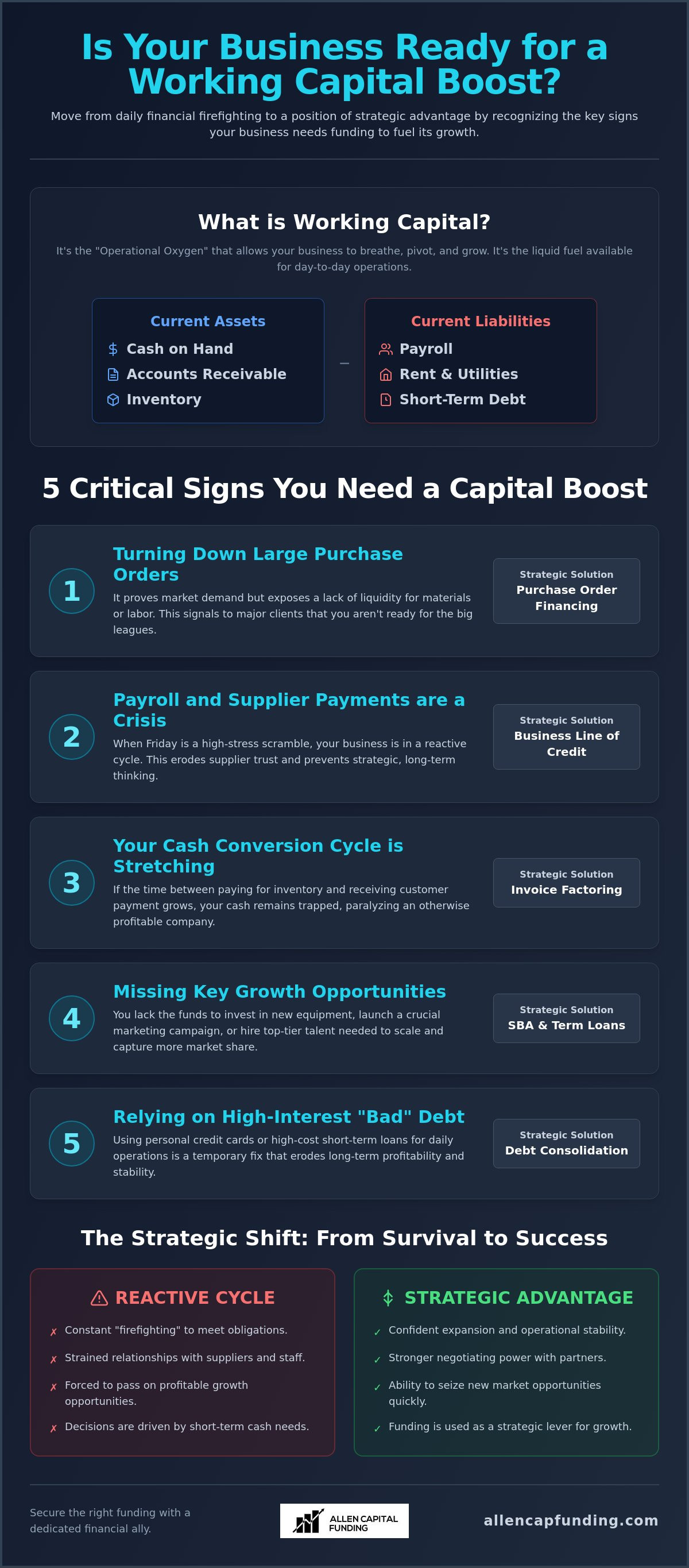
Every business needs a heartbeat; it also needs breath. In the current 2026 economic environment, where the Federal Reserve has held the Prime Rate steady at 6.75%, agility is your most valuable asset. Working capital is the liquid fuel that allows your business to pivot when the market shifts. It represents the difference between your current assets and your current liabilities. Essentially, it is the money you have available right now to manage day-to-day operations while you wait for future revenue to arrive.
Think of it as "operational oxygen." If your cash is tied up in slow-moving inventory or unpaid invoices, your business can't breathe. Growth requires resources, and if those resources are locked away, your expansion efforts will suffocate. Recognizing the signs you need working capital early is the difference between scaling your operations and simply trying to survive the week. It acts as a vital bridge, connecting your company's current financial state to its future strategic goals.
The Working Capital Formula Simplified
To understand your position, you must look at the two sides of your balance sheet. Your current assets include cash on hand, accounts receivable, and inventory that you expect to convert to cash within a year. Your current liabilities consist of accounts payable, short-term debt payments, and accrued expenses like payroll. This formula provides the safety margin your business needs to absorb unexpected shocks or seize sudden opportunities.
Current Assets: Cash, accounts receivable, and inventory.
Current Liabilities: Rent, utilities, payroll, and short-term loan repayments.
Liquidity: Your Business’s Ultimate Safety Net
There is a dangerous gap between "paper profit" and "spendable cash." You can have a record-breaking sales month and still find yourself unable to pay your team if your customers haven't settled their invoices yet. Liquidity ensures you don't have to make desperate, fire-sale decisions during a slow quarter. It allows you to maintain a position of strength when negotiating with vendors or hiring top-tier talent.
A healthy capital margin builds deep trust with your partners. Suppliers are more likely to offer better terms to a business that pays consistently; employees feel more secure when payroll is never a question. By staying ahead of the signs you need working capital, you protect these relationships and ensure your company remains a reliable force in your industry. This stability provides the calm efficiency needed to focus on long-term expansion rather than daily financial firefighting.
5 Critical Signs Your Company Needs a Working Capital Boost
Financial statements often lag behind the reality of your daily operations. By the time your balance sheet shows a crisis, the damage to your reputation or growth trajectory might already be done. Instead of waiting for the numbers to crash, you should look for the "friction" in your daily decision-making. These five signs you need working capital serve as an early diagnostic tool. They highlight both hidden risks and untapped opportunities for expansion before they become emergencies.
1. You Are Turning Down Large Purchase Orders
Turning down a large purchase order is a bittersweet milestone. It proves market demand, but it also exposes a lack of liquidity for materials or labor. It hurts to say no to growth. This rejection limits your market share and signals to major clients that you aren't ready for the big leagues. Utilizing Purchase Order Financing can bridge this gap. It allows you to fulfill orders based on the creditworthiness of your customers rather than your own cash on hand.
2. Payroll and Supplier Payments Feel Like a Crisis
When Friday morning becomes a high-stress scramble to time invoice payments, your business is in a reactive cycle. Robbing Peter to pay Paul might keep the lights on, but it destroys supplier trust. It also prevents you from thinking strategically. Why working capital matters is most evident here. It provides the buffer needed to maintain professional relationships and ensures your team feels secure and valued.
3. Your Cash Conversion Cycle is Stretching
A stretching cash conversion cycle is one of the most common signs you need working capital. If the time between paying for inventory and receiving customer payment grows, your cash remains trapped. Slow-paying clients can paralyze an otherwise profitable company. Factoring allows you to convert those outstanding invoices into immediate cash. This move accelerates your cycle and frees up funds for new projects without waiting thirty or sixty days for a check.
4. You Are Missing Out on Bulk Purchase Discounts
Missing out on bulk purchase discounts is a hidden cost of low liquidity. If you're forced to buy in small batches, you're paying a premium that eats into your margins. For example, a 10% discount on a large material order often outweighs the modest cost of capital required to secure it. Having the cash to buy in bulk lowers your cost of goods sold and directly increases your overall profitability. Capital isn't just an expense; it's a tool to lower other costs.
5. Seasonal Surges Leave You Scrambling
Seasonal surges shouldn't be a surprise, but they often leave businesses scrambling. Preparing for a peak season requires upfront investment in inventory and staffing well before the sales arrive. A Business Line of Credit is an ideal tool for this. It provides a reservoir you can draw from exactly when needed and repay once the season concludes. If these symptoms sound familiar, a quick Financial Check-Up can help identify the best path forward for your specific needs.
Working Capital vs. Cash Flow: Identifying the Real Gap
Cash flow and working capital are often used interchangeably, but they serve different roles in your financial strategy. Cash flow is the "flow" of money in and out of your business over a specific period. Working capital is the "reservoir" of liquidity that remains to cover your immediate obligations. You can have a high volume of cash moving through your accounts and still be dangerously low on the reservoir needed to survive a sudden drought. This is one of the subtle signs you need working capital that business owners often overlook until it’s too late.
Imagine a leaky bucket. You can pour water into it at a high rate (revenue), but if the holes at the bottom (liabilities and overhead) are too large or the bucket itself is too small (capital), you'll never maintain a stable level. A profitable business can still go bankrupt if its cash is tied up in accounts receivable or inventory while its bills come due. You must look at your balance sheet for the full picture. Your bank statement only tells you what you have today; your working capital tells you what you’ll have left after everyone else is paid.
This concept of a financial reservoir is equally vital for personal property management. To explore how similar liquidity strategies can be applied to your mortgage, learn more about The Home Loan Partners.
When Positive Cash Flow Masks Capital Shortages
High sales volume can be deceptive. When your business is growing fast, you might feel flush with cash, but you are also likely increasing your expenses just as quickly. This is a phenomenon known as "overtrading." It happens when you take on more work than your current capital can support. It's a dangerous position because one late payment from a major client could trigger a total collapse. Rapid growth without a dedicated credit line is like building a skyscraper on a foundation of sand. Recognizing these signs you need working capital during a boom is just as important as seeing them during a slump.
Static Health vs. Dynamic Movement
A midyear financial check-up provides a static snapshot of your company's health, but daily cash management is dynamic. You need to use both metrics to forecast when you'll hit a wall. Static health shows you the numbers as they stand on a specific date, while dynamic movement shows how those numbers change as you execute your strategy. For many owners, a Business Line of Credit: A Complete Guide for Owners is the best way to manage this dynamic movement. It provides the flexibility to draw funds when your reservoir gets low and repay them as the flow returns. This proactive approach ensures you're never caught off guard by the natural ebbs and flows of your industry.
Strategic Use Cases: Turning Capital Into a Growth Lever
Many business owners only look for signs you need working capital when they are in a financial bind. This reactive approach limits your potential and keeps you in a cycle of defensive management. Instead, you should view capital as a strategic lever. Having liquidity ready allows you to say "yes" to opportunities that your competitors are forced to decline. It changes the internal conversation from "how do we pay the bills?" to "how do we dominate the market?" When you are capital-ready, you can move with the speed and precision required to scale effectively. Think of interest not as a burden, but as an investment in the speed of your progress.
This concept of capital as a growth accelerator is also seen in specialized fields; for example, TradeFundrr enables traders to access large funded accounts, allowing them to scale their strategies far more aggressively than they could with personal funds alone.
The right funding partner doesn't just provide a check; they accelerate your path to progress. By removing the immediate stress of cash constraints, you free up your mental energy to focus on high-level strategy. This competitive advantage is often what separates stagnant companies from those that experience accelerated success. Being proactive ensures that when a strategic advantage appears, you have the resources to seize it immediately.
Investing in Efficiency and New Technology
Upgrading software or acquiring small tools often provides the highest return on investment. These improvements save time, reduce human error, and allow your team to focus on high-value tasks rather than manual processes. However, paying for these upgrades in a single lump sum can drain your cash reservoir. This is where Equipment Financing becomes a vital tool. It allows you to acquire the technology you need while preserving your working capital for other operational needs. By spreading the cost over time, you align the expense with the revenue the new equipment generates. This approach ensures your growth doesn't come at the expense of your daily liquidity.
Marketing and Market Expansion
Marketing is a powerful growth engine, but it rarely pays off instantly. There is almost always a significant "lag" between spending on a campaign and seeing the resulting revenue hit your bank account. Without a capital buffer, this lag can cause a cash flow crunch that forces you to scale back your efforts right when they are starting to gain traction. Entering a new territory or launching a product line requires a similar upfront commitment for staffing, inventory, and outreach. A dedicated credit line provides the confidence to fund these growth initiatives without risking your daily stability. It allows you to stay the course through the initial investment phase, ensuring you capture the full value of your market expansion.
If you recognize the signs you need working capital and want to use it for expansion rather than just survival, you need a partner who understands your vision. We act as a dedicated guide to help you unlock your company's full potential with tailored solutions. Ready to fuel your next big move? Apply for funding today to see how we can accelerate your path to progress.
Navigating Your Funding Options with Allen Capital Funding
Identifying the signs you need working capital is a vital first step, but it’s only half the battle. Once you recognize that your business needs a boost, you face the challenge of selecting the right financial tool. Many traditional banks offer a limited, "one size fits all" approach that doesn't account for the unique rhythm of your industry. At Allen Capital Funding, we operate as a strategic brokerage. This means we provide access to a diverse range of products from multiple sources rather than just one institution’s rigid criteria. We act as your dedicated consultant, helping you navigate the complex lending market with professional confidence and calm efficiency.
Our approach is built on partnership, not just transactions. We understand that speed is often the most critical factor in your decision-making. In the 2026 lending environment, we leverage advanced bank-statement aggregation to provide rapid decisions, often within 24 to 48 hours. This efficiency removes the traditional barriers to progress and ensures you can act on growth opportunities while they are still fresh. We don't just provide a loan; we offer a roadmap to go from daily survival to strategic expansion.
Selecting the Right Solution for Your Specific Sign
The most effective funding strategy matches the specific challenge your business is facing. For example, if you are struggling to fulfill large orders (Sign #1), Purchase Order Financing provides the upfront capital needed to pay suppliers without draining your cash reserves. If your primary issue is a slow cash conversion cycle due to late-paying clients (Sign #3), Factoring allows you to unlock the value of your outstanding invoices immediately. This ensures your "paper profit" becomes spendable cash when you need it most.
For service-based businesses or those managing seasonal surges (Sign #5), flexible Credit Lines offer a revolving reservoir of funds that you only pay for when you use them. If you are looking for long-term stability to fund major expansion, SBA Loans remain a powerful option. As of July 2026, variable-rate SBA 7(a) loans are hovering between 9% and 11.5% APR, offering a competitive way to secure larger amounts of capital for established businesses. Whatever your specific signs you need working capital might be, we tailor the solution to fit your specific operational needs.
Your Path to Accelerated Success Starts Here
Our process is designed to be as streamlined and respectful of your time as possible. It begins with a simple consultation where we listen to your goals and diagnose your current financial health. We move quickly from a broad overview of your capabilities to identifying the specific categories of assistance that will have the greatest impact on your bottom line. You won't find high-pressure sales tactics here; instead, you’ll find expert guidance and a focus on your long-term success.
We believe every business owner deserves to feel capable and well-supported. By acting as a bridge between your current state and your future goals, we help you unlock the full potential of your company. You don't have to navigate these choices alone. Book your strategic financial check-up with Allen Capital Funding today.
Fuel Your Future with Strategic Liquidity
Distinguishing between simple cash movement and a stable financial reservoir is the first step toward long-term stability. When you identify the signs you need working capital, you gain the clarity needed to shift from defensive management to proactive, strategic growth. Having liquidity ready ensures you can seize market opportunities without risking your daily operations. We want to help you move beyond the stress of survival and into a phase of confident, accelerated success.
Our dedicated national brokerage team provides the expert guidance required to navigate the complex lending market. We offer a fast-paced, methodical process that delivers tailored solutions, ranging from SBA loans for long-term stability to purchase order financing for immediate demand. We act as your proactive ally, removing the financial barriers that stand between your current state and your future goals. Empower your business with strategic capital, contact Allen Capital Funding today to begin your journey toward sustainable expansion. Your vision for growth is within reach; let's build the foundation it deserves together.
Frequently Asked Questions
Is negative working capital always a bad sign for my business?
Negative working capital isn't always a disaster; it depends on your specific business model. Retailers often operate this way because they sell inventory to customers before their bills to suppliers are due. For most other industries, however, it signals a significant risk that you can't meet short-term obligations. It's best to consult a professional to see if your negative balance is a sign of efficiency or a looming operational crisis.
How much working capital should a small business ideally have?
Most financial experts recommend maintaining a current ratio between 1.2 and 2.0. This means your current assets should be at least twenty percent higher than your current liabilities. Having this buffer ensures you can handle unexpected expenses without disrupting your daily operations. The exact amount varies by industry, so comparing your ratio to similar businesses in your sector provides the best benchmark for your specific needs.
What is the fastest way to increase my working capital without a loan?
The fastest non-loan method is to accelerate your accounts receivable collections. You can offer a small discount, such as 2%, for customers who pay their invoices within ten days. Simultaneously, try to negotiate longer payment terms with your vendors. These combined actions keep cash in your business reservoir longer, effectively increasing your available liquidity without taking on any new debt or interest payments.
Can I get a working capital loan if I have challenged credit?
You can absolutely secure funding with challenged credit by focusing on your business's actual performance. Many alternative lenders look at your monthly revenue and bank statements rather than just your FICO score. Factoring and revenue-based options are particularly accessible because they rely on the value of your invoices or sales. We specialize in finding tailored solutions that help business owners move forward regardless of their past credit history.
What is the difference between a working capital loan and a business line of credit?
A working capital loan provides a one-time lump sum of cash, while a business line of credit is a revolving resource. With a loan, you receive all the money at once and pay interest on the full amount immediately. A line of credit allows you to draw only what you need, when you need it. You only pay interest on the funds you actually use, making it a more flexible tool for managing ebbs and flows.
How does purchase order financing help with working capital?
Purchase order financing covers the cost of goods from your suppliers so you can fulfill customer orders without using your own cash. This is especially helpful when you see the signs you need working capital but don't want to drain your bank account for production. The lender pays the supplier directly, and you repay the balance once the customer pays for the finished goods. It's a great tool for rapid scaling.
What documents do I need to apply for working capital funding in 2026?
You generally need your last six months of business bank statements and your most recent tax returns to apply. In 2026, the process is more efficient due to digital aggregation services that allow lenders to verify your cash flow instantly. Some specialized products might require an accounts receivable aging report or specific purchase orders. Having these documents organized in advance ensures a methodical and fast-paced approval process that respects your time.
Will applying for working capital impact my business credit score?
Applying for funding usually involves a soft credit pull that won't significantly hurt your score. In the long run, securing a loan when you notice signs you need working capital protects your credit. It prevents late payments to suppliers or missed payroll, both of which can cause lasting damage to your reputation and score. Making consistent, on-time repayments to your lender is one of the most effective ways to build a strong business credit profile.


Comments