
Working Capital Management Strategies for Healthier Cash Flow
Growth can strain cash flow even when sales are rising. Effective working capital management strategies help businesses balance current assets against current liabilities so they can cover short-term obligations, keep daily operations moving, and make room for investment. A current ratio above 1 generally indicates that current assets are sufficient to meet short-term liabilities, though the right balance depends on the business.
It’s easy to focus on revenue and overlook cash tied up in inventory or unpaid invoices. Effective working capital management strategies matter because a shortage can disrupt operations, while excess funds held in low-yielding assets can limit growth opportunities.
This article explains how to assess working capital and choose practical ways to strengthen it. You’ll learn how to improve inventory decisions, forecast cash needs, coordinate payments and collections, and manage the pressures that growth can bring. Each approach connects day-to-day financial decisions with a clearer view of cash flow and business priorities.
Table of Contents
1. Why Is Efficient Working Capital Management Important?
Working capital equals current assets minus current liabilities. Current assets are resources a business expects to convert into cash within a year. Accounts receivable, inventory, and accounts payable all affect the calculation. For example, a company with $300,000 in current assets and $200,000 in current liabilities has $100,000 in working capital. This figure helps owners see what remains to support daily operations after short-term obligations.
Positive working capital alone doesn’t show whether cash will arrive before bills come due. A cash flow forecast maps expected customer receipts against payroll, supplier invoices, rent, and other planned spending. Update it with actual results and changing business conditions. Use it to guide spending decisions, spot timing gaps, and make better use of available capital. Accounting or ERP systems can improve visibility into cash, inventory, and receivables.
Liquidity ratios add context. Calculate the current ratio by dividing current assets by current liabilities; a result above 1 generally indicates enough current assets to cover short-term obligations. A ratio between 1.2 and 2.0 is generally considered satisfactory, but compare it with historical results and industry dynamics. The quick ratio offers a more conservative view because it excludes inventory. Calculate it by adding cash, accounts receivable, and marketable securities, then dividing by current liabilities.
Metrics can show where cash is getting stuck. The cash conversion cycle combines days inventory outstanding and days sales outstanding, then subtracts days payable outstanding. A shorter cycle typically signals stronger working capital efficiency. Track inventory turnover, receivables turnover, and payment terms alongside the cycle. Compare each measure with past performance and business needs, rather than treating one ratio as a universal target. These measures connect liquidity visibility with practical operating decisions.
Efficient management balances liquidity, profitability, and operational efficiency. Holding excess cash or inventory can tie up funds that might support useful investments. Keeping too little liquidity can make it difficult to pay obligations when due, potentially costing supplier discounts and harming credit ratings. For smaller companies, finding lenders willing to make loans of less than $500,000 may be a key requirement, while larger banks prefer larger loans because monitoring costs are generally the same regardless of loan size, according to the National Institute of Standards and Technology (NIST).
Overly aggressive working capital management can leave inventory too low, strain supplier relationships, or compromise quality. It can also make routine obligations harder to meet when customer payments arrive late. Preserve enough liquidity for operating needs, then adjust inventory, collections, and payment processes based on forecast results. This balance supports financial stability without leaving too much capital idle.
2. Cross-functional working capital accountability
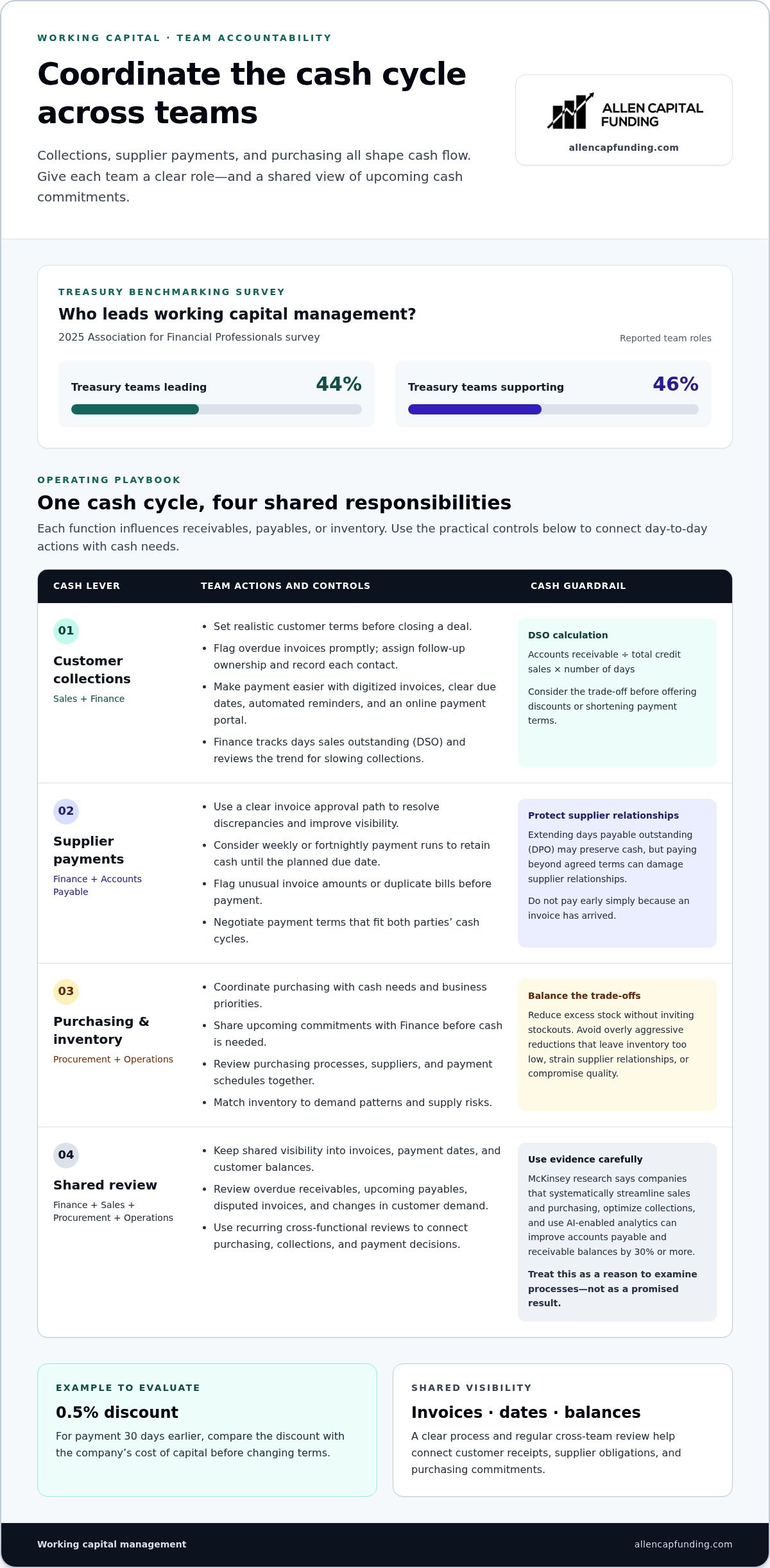
The main working capital management strategies are improving collections, aligning supplier payments with agreed terms, and coordinating purchasing with cash needs. Finance, sales, procurement, and operations should share responsibility because each team influences receivables, payables, or inventory. The 2025 Association for Financial Professionals Treasury Benchmarking Survey found that 44% of treasury teams led working capital management, while 46% played a supporting role.
Give each team a clear process and shared visibility into invoices, payment dates, and customer balances. Sales can set realistic customer terms before closing a deal and flag overdue invoices promptly. Finance can report days sales outstanding, or DSO, calculated by dividing accounts receivable by total credit sales and multiplying by the number of days. Reviewing the trend helps managers spot slowing collections.
Make payment easier for customers. Digitized invoices, clear due dates, automated reminders, and an online payment portal can reduce friction in the collection process. For overdue accounts, assign follow-up responsibility and record each contact. Early-payment discounts or shorter payment terms may encourage faster receipts, but evaluate the trade-off before changing terms. A 0.5% discount for payment 30 days earlier should be compared with the company’s cost of capital.
Accounts payable automation can improve processing efficiency and invoice visibility. A clear approval path helps resolve discrepancies sooner and may help the business capture worthwhile early-payment discounts. Avoid paying invoices early simply because they have arrived. Replacing daily processing with weekly or fortnightly payment runs can help retain cash until its planned due date, while keeping reliable records for each payable.
Extending days payable outstanding, or DPO, can preserve cash, but paying beyond agreed terms may damage supplier relationships. Instead, negotiate favorable terms that fit both parties’ cash cycles. Review purchasing processes, suppliers, and payment schedules together. Procurement should share upcoming commitments with finance, while accounts payable flags unusual invoice amounts or duplicate bills before payment.
Set a recurring cross-functional review to examine overdue receivables, upcoming payables, disputed invoices, and changes in customer demand. McKinsey research says companies that systematically streamline sales and purchasing, optimize collections, and use AI-enabled analytics can improve accounts payable and receivable balances by 30% or more. Use the finding as a reason to examine processes, not as a promised result. If a persistent timing gap requires external capital, explore working capital options as part of the cash plan.
3. Inventory optimization
Inventory decisions shape cash flow because every unsold item ties up funds that could support another operational need. Start by grouping products according to demand, margin, and supply reliability. Compare stock on hand with recent sales and open customer orders. This helps distinguish inventory needed to serve customers from stock accumulating without a clear purpose. The goal isn’t simply to hold less, but to keep the right items available while freeing cash for other business needs.
Measure inventory turnover to see how quickly stock moves. Divide cost of goods sold by average inventory for the period. A high turnover ratio can signal strong sales or efficient purchasing, while a low result may point to slow-moving items or excess stock. Interpret the measure alongside demand patterns and operational needs. Review the calculation over time, then investigate items whose turnover differs from the broader inventory trend. Don’t treat a single ratio as proof that stock levels are right.
Build demand forecasts from sales history, customer buying patterns, current orders, and known promotions. Use those estimates to set reorder points and purchasing quantities. Automated reordering can help maintain stock against planned demand, but review the inputs when customer behavior or supplier lead times change. For example, a product with declining sales may need a lower reorder level, while an item linked to confirmed orders may require more stock. Compare forecasts with actual sales and adjust as new information arrives.
Just-in-time purchasing can reduce inventory carrying costs and support cash flow when demand is predictable and stable. It requires disciplined coordination between purchasing, suppliers, and operations. Reordering too late can leave customers waiting or cause stockouts. Safety stock provides a buffer when demand is volatile or supplier lead times are long. Set that buffer according to disruption risk and the cost of holding stock, then revisit it as conditions change.
Use aging reports to identify stock that has remained unsold or no longer matches current demand. Consider pausing replenishment for those items and aligning new purchases with updated forecasts. Keep customer service and product quality in view while reducing surplus; aggressive cuts can cause shortages or strain supplier relationships. Compare inventory turnover with accounts receivable trends, since stock can leave the warehouse before customers pay. That timing affects how quickly the business can reuse cash.
Coordinate inventory plans with supplier payment terms and available cash. Early-payment discounts may be worthwhile, but weigh the savings against the company’s cost of capital before paying sooner. Avoid using credit to accumulate stock without a clear demand case. A practical review connects sales forecasts, current inventory, supplier lead times, and upcoming payment commitments. This gives purchasing and finance a shared basis for decisions, helping maintain operations while reducing cash tied up in excess stock.
4. Cash flow forecasting
A useful cash forecast shows when money should come in and go out, not just expected sales. Map customer receipts from outstanding invoices against supplier bills, payroll, taxes, and planned purchases. Include expected collection dates and payment terms, then compare forecast cash balances with current liabilities coming due. This schedule helps managers identify timing gaps while there’s time to adjust spending or arrange financing.
Accounting and ERP systems can improve visibility into cash, inventory, and accounts receivable. Forecasting software can combine purchase-order, accounts-receivable, and accounts-payable data to create near-real-time forecasts across business units. Some cash forecasting solutions use machine learning and artificial intelligence to improve prediction accuracy over time. Choose tools that make assumptions visible, let teams update expected dates, and connect planned transactions with actual results.
Keep the forecast current. Monitor and manage cash flow weekly, or daily when circumstances require it. Use a rolling forecast so each update extends the outlook and reflects new invoices, supplier commitments, and customer receipts. Compare actual cash movements with expected amounts, investigate differences, and revise assumptions. Updating the model as market conditions change helps teams plan effectively instead of relying on outdated estimates.
Connect the forecast to working capital metrics. Calculate the cash conversion cycle by adding days inventory outstanding and days sales outstanding, then subtracting days payable outstanding. A shorter cycle typically indicates stronger working capital efficiency. Monitor this measure alongside the current ratio, quick ratio, and payables and receivables turnover. Together, these indicators show whether cash is tied up in stock, outstanding invoices, or payment timing.
A working capital dashboard should turn those measures into clear action points. Show forecast cash balances, upcoming supplier payments, overdue receivables, inventory commitments, and changes in current liabilities. Assign each item to a responsible team and flag variances from the forecast. A sales delay, disputed invoice, or unexpected purchase can then prompt an update before it affects supplier relationships or planned operations.
Maintain a cash buffer for unexpected gaps, and assess short-term financing as another possible bridge. Businesses may consider a line of credit, term loan, or invoice financing, weighing borrowing costs against the timing and size of the need—resources such as lendingbox.co.uk can help compare diverse business finance products across the market. Match the option to the cause: delayed customer payments may call for a different response than a seasonal inventory build. Avoid treating financing as a substitute for accurate forecasts.
Use each forecast review to test likely changes in receipts, inventory needs, and payment dates. A delayed customer payment can be entered as a revised collection date, while a supplier’s updated delivery schedule may shift the related cash outflow. These adjustments show how the cash flow cycle responds to operating decisions. Regular updates help teams protect liquidity, plan commitments, and keep effective working capital aligned with current business needs.
5. Working capital challenges during business growth
Growth can increase sales and still tighten cash flow. A larger order may require more inventory, labor, and supplier commitments before customer payment arrives. That timing gap can widen as demand rises, especially when customers receive extended payment terms. Map each growth opportunity from purchase through delivery and collection. This reveals how long cash stays committed to the sale and which obligations come due first.
More activity also makes old assumptions less reliable. Rising demand can increase inventory needs, while new customers can add accounts receivable and collection work. Review forecast assumptions whenever sales volume, product mix, customer terms, or supplier lead times change. Compare planned receipts with accounts payable and other obligations. If the forecast shows pressure, consider adjusting purchasing schedules, negotiating terms, or staging expansion spending rather than committing all assets at once.
Small and large companies often need different controls. Smaller businesses may rely on owners to review cash, invoices, and purchasing directly, which can blur the line between running operations and personal life; collaborating with an accountant for work life balance can help establish financial systems that protect both business stability and personal well-being. Larger companies, by contrast, often need shared forecasts across departments or business units. Financing needs can differ too: according to the National Institute of Standards and Technology (NIST), finding lenders willing to make loans of less than $500,000 may be a key requirement for smaller companies, while larger banks prefer larger loans because monitoring costs are generally the same regardless of loan size.
Protect supplier relationships as volume grows. Delaying accounts payable beyond agreed terms may preserve cash temporarily but risks disrupting supply. Instead, negotiate payment terms that reflect the expanded order cycle, and match payment timing to expected customer receipts where possible. Evaluate early-payment discounts against the company’s cost of capital. A discount supports cash management only when its savings justify paying sooner and doing so won’t leave the business short for upcoming obligations.
Review growth plans before accepting a major contract or adding a product line. Estimate the additional inventory, staffing, delivery, and receivables workload. Then identify which cash arrives first and which commitments cannot wait. Test a slower collection scenario and a higher purchasing requirement in the forecast. This makes the funding gap visible early, when teams can adjust the project’s timing, purchasing plan, or payment terms.
Growth can call for outside capital when operational needs outpace incoming cash, but borrowing should fit the gap and repayment capacity. Compare the timing of the need with the expected cash conversion cycle, and include borrowing costs in the plan. If expansion is creating a working capital shortfall, explore working capital options to assess funding that may support day-to-day business needs. The key is to connect each financing decision to a defined cash-flow requirement, not sales growth alone.
Allen Capital Funding: Credit Lines
Allen Capital Funding helps business owners consider whether a Credit Line or Working Capital fits a cash-flow need. A credit line may suit timing gaps between operating expenses and incoming customer payments, while Working Capital can address broader business requirements. Start by connecting the funding need with your cash forecast, expected receipts, obligations, and growth plans.
Guidance on funding options can help clarify which approach aligns with your business priorities. Consider financing when your forecast shows a cash gap that operating adjustments alone can’t address comfortably. To discuss your business funding needs, contact Allen Capital Funding or visit allencapfunding.com.
Build a Cash Plan That Can Grow With You
The next step is to turn your cash-flow priorities into a deliberate funding plan. Identify what the business needs capital to accomplish, when funds are required, and how the decision supports longer-term goals. Effective working capital management strategies connect financing choices to a clear business purpose, rather than treating funding as a substitute for planning.
Allen Capital Funding offers Credit Lines, SBA Loans, and Real Estate options for different business financing needs. Consider which path best fits your priorities, whether you’re managing working capital, planning an expansion, or evaluating a real estate opportunity. A focused conversation can help you explore options relevant to your business.
Contact Allen Capital Funding today to discuss your financing goals and take a thoughtful next step toward sustainable growth.
Frequently Asked Questions
Why Is Efficient Working Capital Management Important?
Effective working capital management helps a business meet short-term obligations while keeping funds available for useful operations and investment. It matters especially when sales rise but customer payments arrive later than supplier bills. For example, a growing company may need to fund a larger order before collecting payment from its buyer. Reviewing cash timing alongside planned commitments helps leaders decide whether to adjust operations, delay spending, or seek financing.
What are the KPIs to track working capital performance?
Track the current ratio, quick ratio, cash conversion cycle, days sales outstanding, inventory turnover, days payable outstanding, and accounts receivable turnover. Each highlights a different pressure point: liquidity, collection speed, stock movement, or supplier payment timing. For a broader productivity view, calculate working capital turnover by dividing net sales by net working capital. Review trends over time and investigate changes that could affect cash availability or operating plans.
What does it mean to optimise working capital?
Optimising working capital means managing short-term assets and liabilities so cash supports operations without sitting unnecessarily idle. It isn’t simply about cutting inventory or delaying bills. A business might reduce slow-moving stock while protecting items needed to fulfill customer orders, then align supplier payments with expected receipts. The right decisions depend on demand, supplier reliability, customer terms, and the company’s need for liquidity and investment capacity.
What is working capital management and why is it important?
Working capital management is the ongoing process of overseeing a company’s short-term assets and liabilities. It matters because decisions about stock, customer invoices, and supplier bills affect the funds available for everyday business needs. For example, a company that sells on credit must manage the gap between delivering an order and receiving payment. Clear ownership of that timing helps teams make informed operating and funding decisions.
How do you calculate the working capital ratio and cash conversion cycle?
Calculate the working capital ratio, also called the current ratio, by dividing current assets by current liabilities. To calculate the cash conversion cycle, add days inventory outstanding and days sales outstanding, then subtract days payable outstanding. The result estimates how long cash remains tied up in operations. Compare the measures across periods and investigate shifts in collection timing, inventory movement, or supplier payments before changing business plans.
What are typical benchmarks for working capital ratios by industry?
There isn’t one ratio that fits every industry, since inventory requirements, customer payment practices, and supplier terms differ. A current ratio between 1.5 and 2.0 is usually considered healthy, while a range between 1.2 and 2.0 is generally considered satisfactory. Treat these as broad reference points, not universal targets. Compare your results with your company’s past performance and operating cycle to understand what the figures mean.
How can businesses optimize accounts receivable and reduce days sales outstanding?
Businesses can reduce collection delays by sending accurate invoices promptly, clarifying payment terms before work begins, and assigning someone to resolve disputes. Segment outstanding accounts by due date and follow up on overdue balances consistently. Review DSO alongside customer relationships and sales policies: faster collection can improve cash availability, but rigid terms may not suit every customer or contract. Use late-payment patterns to refine credit and collection processes.
What are best practices for inventory management and reducing excess stock?
Use sales history, open orders, and supplier lead times to set purchasing levels that match expected demand. Review stock by product so slow-moving items don’t trigger automatic replenishment, while essential or hard-to-replace goods remain available. Compare actual sales with forecasts and update reorder settings when buying patterns shift. This approach can release cash from excess stock without relying on uniform cuts that risk shortages or missed customer orders.



Comments