
Long Island Commercial Mortgage Lenders: 2026 Growth Guide
Updated: Sep 18
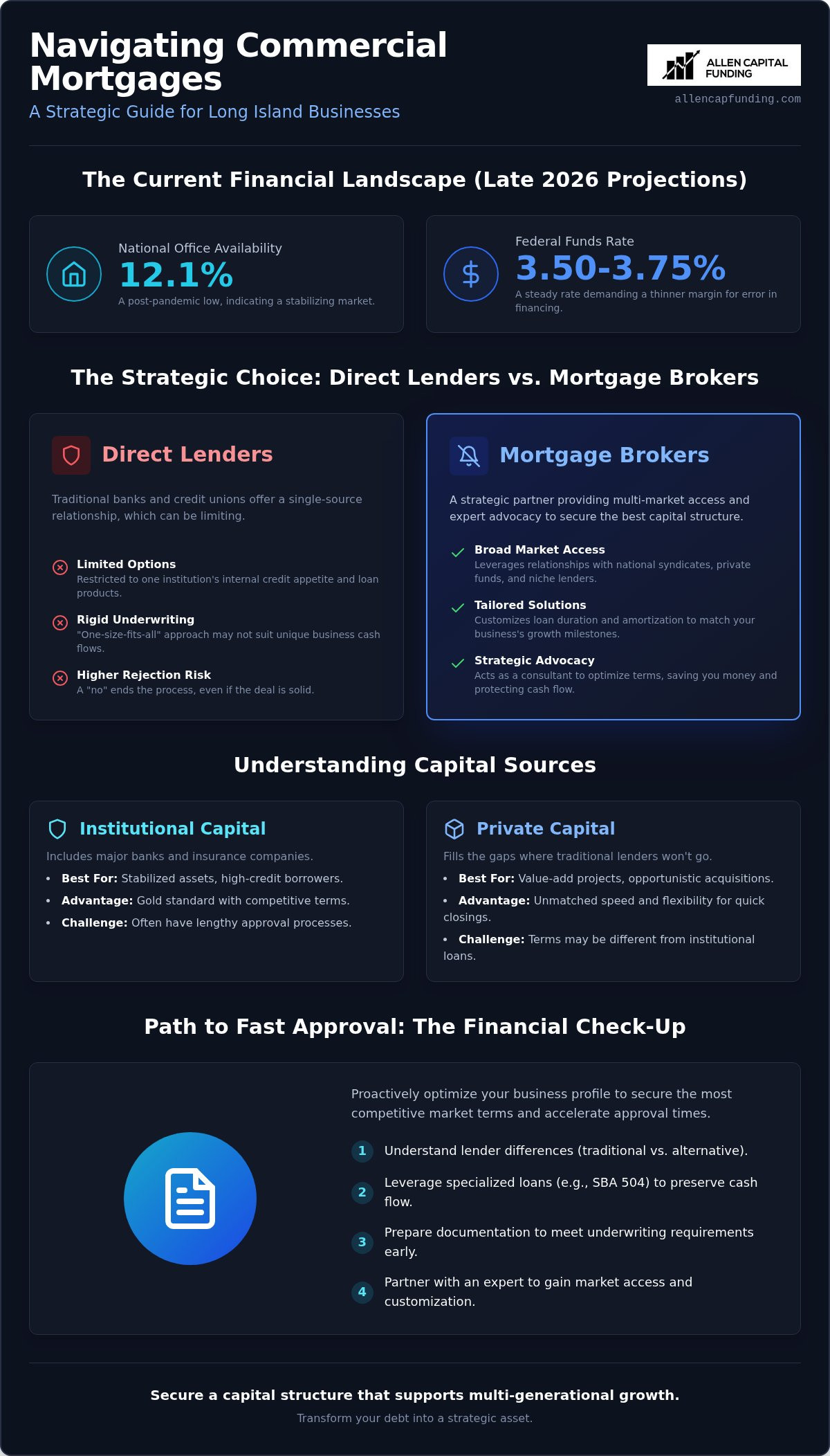
With national office availability rates hitting a post-pandemic low of 12.1% in late 2026, identifying the most effective commercial mortgage lenders long island has become a vital step for any expanding enterprise. You've likely found that while the broader market shows signs of stabilization, securing the right capital remains a complex hurdle. It's frustrating to face slow approval times from traditional banks or discover hidden fees in loan structures just as you're ready to capitalize on a property opportunity. In a landscape where the federal funds rate is holding steady between 3.50% and 3.75%, the margin for error in your financing strategy is thinner than ever.
We understand that navigating this environment requires more than just a list of names; it requires a strategic partner. This guide will help you master the complexities of real estate financing and show you how to secure the ideal capital structure for your expansion. We'll compare the strategic advantages of brokers over direct lenders, explore specialized SBA programs, and walk you through the preparation steps needed for a fast, tailored closing that matches your unique cash flow. By the end of this guide, you'll have the tools to transform your debt into a strategic asset for multi-generational growth.
Table of Contents
Understanding the Landscape of Commercial Mortgage Lenders
A Commercial mortgage is a debt-based funding solution secured by real property used exclusively for business purposes. This includes income-producing assets like multi-family complexes or owner-occupied spaces where you manage your daily operations. Finding the right commercial mortgage lenders long island requires looking beyond the local branch to understand the various tiers of capital available in the current market. Traditional banks, credit unions, and non-bank alternative lenders each occupy specific niches with varying risk tolerances and approval speeds.
The role of a loan facilitator is to help you navigate these diverse lending tiers without the frustration of repeated rejections. In late 2026, market conditions have stabilized with the federal funds rate holding steady between 3.50% and 3.75%. This environment demands a more sophisticated approach to capital sourcing. Lenders are more selective, making a proactive Financial Check-Up essential to identify profile gaps before you submit a formal application. Success today isn't just about getting a "yes"; it's about securing a structure that supports long-term expansion.
The Role of Institutional vs. Private Capital
Institutional lenders, including major banks and insurance companies, remain the gold standard for stabilized assets and borrowers with high-credit profiles. They offer competitive terms but often have lengthy approval processes. Private capital fills the vital gaps where speed and flexibility are paramount. If you're pursuing a value-add project or an opportunistic acquisition, private lenders provide the agility needed to close quickly. A dedicated funding specialist bridges the gap between these two worlds, matching your specific project needs with the capital source most likely to perform.
Why One-Size-Fits-All Lending Fails Small Businesses
Traditional banking often relies on rigid underwriting that doesn't account for the unique cash flow cycles of a growing business. This "one-size-fits-all" mentality can lead to loan structures that drain your operational liquidity. Customization is the most effective tool for preserving cash. By matching loan duration and amortization to your specific growth milestones, you ensure your debt remains a catalyst rather than a burden. We prioritize tailored solutions that respect your business's rhythm and provide the flexibility needed to capitalize on new property opportunities as they arise.
Direct Lenders vs. Mortgage Brokers: A Strategic Comparison
Choosing between a direct lender and a mortgage broker is a fundamental decision that shapes your capital structure. Direct lenders, such as traditional banks, offer a single-source relationship. While this feels familiar, it creates a significant limitation: you're restricted to that specific institution's internal credit appetite. If your project falls slightly outside their current risk profile, you'll face a rejection that doesn't reflect the quality of your deal. In contrast, working with commercial mortgage lenders long island through a brokerage model provides multi-market access. This approach allows you to bypass the single-source trap and find the institution whose current portfolio actually needs your specific asset type.
One common objection to using a broker is the associated fee. However, viewing this as a cost rather than an investment is a strategic mistake. An optimized interest rate or a more flexible amortization schedule often results in long-term savings that far exceed any upfront facilitation costs. Brokers act as expert advocates, ensuring you don't overpay for capital. They utilize SBA lender resources to identify which partners are actively deploying capital and which are pulling back. This level of insight transforms the broker from a transactional agent into a strategic consultant who protects your cash flow.
The Advantage of Broad Market Access
Brokers leverage deep relationships with national lending syndicates and private funds. This network includes shadow banking and niche commercial products that aren't available to the general public. These alternative sources often provide the flexibility needed for unconventional properties or complex financial profiles. For those looking for specialized government-backed solutions, our SBA Loan Brokers New York: Strategic 2026 Funding Guide details how these relationships accelerate the funding process. This broad access ensures your business isn't at the mercy of a single bank's shifting priorities.
Navigating Complex Underwriting with an Ally
Underwriting is where most commercial deals stall. A broker’s primary value lies in packaging your loan to maximize the probability of approval. They understand how to present multi-collateral deals and complex corporate structures in a way that aligns with a lender's specific requirements. This "one application, multiple offers" model saves you hundreds of hours of administrative labor. By identifying potential red flags early through a Financial Check-Up, you can address gaps before they become deal-breakers. This proactive advocacy removes the barriers between your current state and your future growth goals.
Navigating Commercial Loan Products: From SBA to Asset-Based
Understanding the specific mechanics of different loan products is the next step in your capital journey. While many commercial mortgage lenders long island offer a variety of programs, the strategic difference between government-backed debt and conventional financing determines your long-term ROI. Your choice depends largely on whether you intend to occupy the property or hold it as a passive investment. Each path has distinct underwriting hurdles and equity requirements that impact your immediate cash position.
For businesses looking to expand their physical footprint without depleting their cash reserves, specialized solutions like Asset-Based Lending for Small Business: Unlocking Balance Sheet Liquidity in 2026 can provide the necessary leverage. This strategy allows you to use existing business assets to secure the capital needed for real estate acquisition. It's an effective way to bridge the gap when a property opportunity arises faster than your liquid savings can support.
The Power of the SBA 504 Program
The SBA 504 program is a powerhouse for business owners who want to own their facility. It's designed for owner-occupied real estate and offers low down payments, often as low as 10%, alongside long-term fixed rates. This program is unique because it allows you to bundle several growth needs into one package. You can use the SBA 504 to finance the land, the construction of a new building, and even the heavy machinery required for your operations. For a deeper look at the equipment aspect, refer to our Strategic Business Equipment Financing: A Complete Guide to Growth in 2026. This structure preserves your working capital while locking in predictable monthly costs for decades.
Conventional Real Estate Financing for Investors
Conventional financing is the standard for non-owner-occupied commercial assets. Unlike SBA loans, these products focus heavily on the property's income-generating potential. Commercial mortgage lenders long island will scrutinize the Debt-Service Coverage Ratio (DSCR). This metric ensures the property’s net operating income can comfortably cover the annual debt obligations. If you're pursuing "fix-and-flip" commercial projects, bridge loans serve as a vital short-term tool. They provide the capital to acquire and renovate a distressed asset before you transition into a permanent, lower-interest mortgage. Conventional debt typically requires higher equity stakes, often 20% to 30%, but offers more flexibility regarding the property's use and tenant mix.
The Commercial Mortgage Application: A Step-by-Step Preparation Guide
Preparing a successful submission for commercial mortgage lenders long island requires a methodical approach that goes beyond filling out forms. In the current lending environment, precision is your greatest asset. Lenders aren't just looking at your ability to pay; they're evaluating the risk profile of your entire business ecosystem. Following a structured preparation guide ensures you present a narrative of stability and growth rather than just a collection of spreadsheets.
Step 1: Conduct a comprehensive Financial Check-Up to identify profile gaps before they become deal-breakers.
Step 2: Aggregate essential documentation, including three years of tax returns, year-to-date P&L statements, and current rent rolls.
Step 3: Analyze the property’s current valuation and its potential future value based on planned improvements or market trends.
Step 4: Align your capital request with the specific, documented goals of your business expansion.
Step 5: Engage a lending specialist to audit the entire package before formal submission to ensure it meets institutional standards.
This proactive strategy removes the friction from the underwriting process. By the time your application reaches a loan committee, it should already address potential red flags. To ensure your business is positioned for the most competitive terms, schedule your Financial Check-Up with our team today.
Mastering the Financial Profile
Liquidity and working capital often carry more weight in commercial approvals than a simple credit score. Lenders want to see that you have the "dry powder" to handle unexpected vacancies or rising maintenance costs. Your existing debt-to-income ratio is a critical metric that dictates your borrowing capacity. If your current cash flow is tied up in rigid debt structures, you might consider a Business Line of Credit: The Strategic Guide to Flexible Capital in 2026. This tool can help rebalance your operational liquidity, making your business look more attractive to long-term mortgage providers.
Property Due Diligence for Borrowers
Property type heavily dictates lender appetite in late 2026. For instance, with industrial vacancy rates holding tight at approximately 5.0%, lenders are often more aggressive in competing for warehouse deals compared to office spaces, which currently see an availability rate of 12.1%. You must prepare for rigorous environmental assessments and professional appraisals that reflect these market realities. A clear "Use of Funds" statement is non-negotiable. It tells the lender exactly how the capital will be deployed to increase the property's value or the business's efficiency, providing them with the security they need to move forward.
Securing Your Future with Tailored Capital Solutions
Securing a commercial mortgage is a pivotal milestone that transforms a business from a temporary tenant into a permanent owner. It's more than a debt obligation; it's a catalyst for building multi-generational wealth and establishing a physical legacy. While many commercial mortgage lenders long island treat these loans as simple transactions, the most successful business owners view them as the foundation of a sophisticated capital structure. A proactive approach to funding ensures you're prepared to move when the market is favorable, rather than scrambling for capital during a crisis. By partnering with a solution-focused ally, you remove the barriers that typically stall business expansion and replace them with a clear path toward strategic growth.
Our commitment to your accelerated success means we don't just provide a loan; we provide a strategic bridge. In a market where office availability has dropped to 12.1% and industrial space remains at a premium, having a reliable hand to guide your capital draws is essential. We focus on removing the friction of traditional banking, ensuring that your real estate acquisitions serve your broader business objectives. This partnership-driven approach fosters a sense of security, allowing you to focus on operations while we manage the complexities of the debt markets.
Beyond the Mortgage: A Holistic Funding Strategy
A single property loan shouldn't exist in a vacuum. A truly holistic strategy integrates your real estate debt with other essential tools, such as working capital and equipment lines. This integration ensures that your monthly mortgage obligations don't cannibalize the liquidity needed for daily operations. We recommend periodic financial reviews to confirm that your debt structures remain optimal as market conditions shift. Because our team operates with a national reach, we can support your growth as you expand into new markets, providing a consistent and reliable partnership regardless of where your next property is located. For those considering international diversification, services like Takeem offer innovative rental guarantees that help secure investment returns in the UAE.
Transitioning from the planning phase to active execution is a streamlined process. Booking an online consultation is the most efficient way to gain clarity on your current borrowing capacity. During your first strategic capital session, you can expect a transparent audit of your financial profile and a customized roadmap for your next capital draw. We'll help you identify exactly which products, from SBA 504 loans to asset-based solutions, align with your specific cash flow requirements. Book your strategic financial consultation with Allen Capital Funding today.
Accelerating Your Commercial Real Estate Success in 2026
Mastering the complexities of property acquisition requires more than just capital; it requires a strategic roadmap. You've learned that selecting the right partners among commercial mortgage lenders long island is the difference between a rigid debt burden and a flexible growth catalyst. By conducting a proactive Financial Check-Up and leveraging specialized SBA or asset-based programs, you position your business to capitalize on property opportunities with speed and precision. A streamlined application process isn't just about saving time; it's about securing the ideal capital structure to protect your cash flow for years to come.
Our team provides expert guidance and national access to specialized capital draws, ensuring you aren't limited by the appetite of a single local institution. We're dedicated to removing barriers and simplifying your path to progress through a partnership-driven approach. Empower your business with a strategic financial check-up and tailored commercial funding solutions. Your next phase of expansion is within reach, and we're here to act as your reliable guide in achieving accelerated success.
Frequently Asked Questions
What is the typical down payment for a commercial mortgage in 2026?
Down payments typically range from 10% to 30% depending on the loan program you select. SBA 504 loans are particularly attractive for owner-occupied properties because they often require only a 10% equity injection. Conventional commercial mortgage lenders long island usually require a higher stake, often between 20% and 25%. Your specific financial profile and the property type will ultimately dictate the final requirement. We help you evaluate which structure preserves the most operational liquidity for your business.
Can I get a commercial mortgage if my business credit is less than perfect?
You can still secure funding with less than perfect credit by leveraging asset-based solutions or private capital. While traditional banks have rigid credit score requirements, alternative lenders focus more on the property's value and your business's overall cash flow. Starting with a Financial Check-Up allows us to identify and address profile gaps early in the process. This proactive approach helps us present a stronger case to lenders who prioritize the strategic potential of your acquisition.
What is the difference between an SBA 7(a) and an SBA 504 loan for real estate?
The SBA 7(a) loan is a versatile product used for working capital, equipment, or real estate up to $5 million. In contrast, the SBA 504 loan is specifically designed for major fixed assets like land, buildings, and long-term machinery. The 504 program typically offers lower, long-term fixed interest rates and requires a smaller down payment. Choosing between them depends on whether you need general operational flexibility or a structured, long-term real estate financing solution for your facility.
How long does the commercial mortgage approval process usually take?
The approval timeline generally ranges from 45 to 90 days for traditional and SBA loans. Conventional banks often move slower due to complex internal committees and strict underwriting protocols. Working with a dedicated funding specialist can accelerate this process by ensuring your documentation is audit-ready before submission. Private capital or bridge loans can sometimes close in as little as two to three weeks, providing the speed necessary to capitalize on time-sensitive property opportunities in a competitive market.
What is a Debt-Service Coverage Ratio (DSCR) and why do lenders care?
The Debt-Service Coverage Ratio (DSCR) measures your property's ability to cover its annual debt obligations using its net operating income. Lenders use this metric to determine the risk level of the loan; a ratio of 1.25 or higher is typically preferred. It demonstrates that the property generates enough cash flow to pay the mortgage while maintaining a safety buffer. Understanding your DSCR helps you negotiate better terms and ensures your capital structure remains sustainable during market fluctuations.
Should I work with a bank or a commercial loan broker?
Working with a commercial loan broker provides access to a national network of lending partners rather than the single-source limitation of a bank. While a bank only offers its own internal products, brokers act as strategic consultants who match your deal with the most compatible commercial mortgage lenders long island. This multi-market access often results in more competitive interest rates and tailored terms that align with your specific cash flow needs and long-term business expansion goals.
Can I use a commercial mortgage to refinance existing business debt?
You can use a commercial mortgage to refinance existing business debt, which often results in lower monthly payments and improved cash flow. This strategy is effective for consolidating high-interest short-term loans into a single, long-term mortgage with more favorable rates. It also allows you to pull equity out of a property to fund other growth initiatives, such as purchasing equipment or expanding your workforce. We analyze your current debt to ensure the new structure provides a clear strategic advantage.
What documents are required for a commercial real estate loan application?
Lenders typically require three years of federal tax returns, current year-to-date profit and loss statements, and a detailed balance sheet. For investment properties, you must also provide updated rent rolls and existing lease agreements. Personal financial statements for all owners with more than a 20% stake are standard requirements. Having these documents organized and audited through a Financial Check-Up prevents delays and demonstrates a level of professional readiness that builds immediate trust with institutional underwriting teams.



Comments