
How to Cover Payroll During a Slow Month With Cash Flow Planning
A slow month doesn’t have to become a payroll crisis. To cover payroll during a slow month, forecast cash needs early, improve the timing of customer payments, bring in additional revenue, and consider a business line of credit for a temporary gap when repayment fits your cash flow.
When sales dip or invoices are paid after payday, the problem is often timing: payroll is due before expected cash arrives. Planning ahead can help you spot the shortfall and decide whether to improve collections, reserve cash, or arrange short-term financing.
This guide explains how cash-flow planning helps prepare for payroll, how customer payment terms affect available cash, and where additional revenue may help. It also covers using a line of credit to bridge a temporary gap and why you need a clear repayment plan before drawing funds.
Table of Contents
Payroll cash-flow planning
Payroll cash-flow planning matches expected income and expenses to pay dates. A 12-month calendar helps reveal slow periods and months with an extra payroll before they strain available cash.
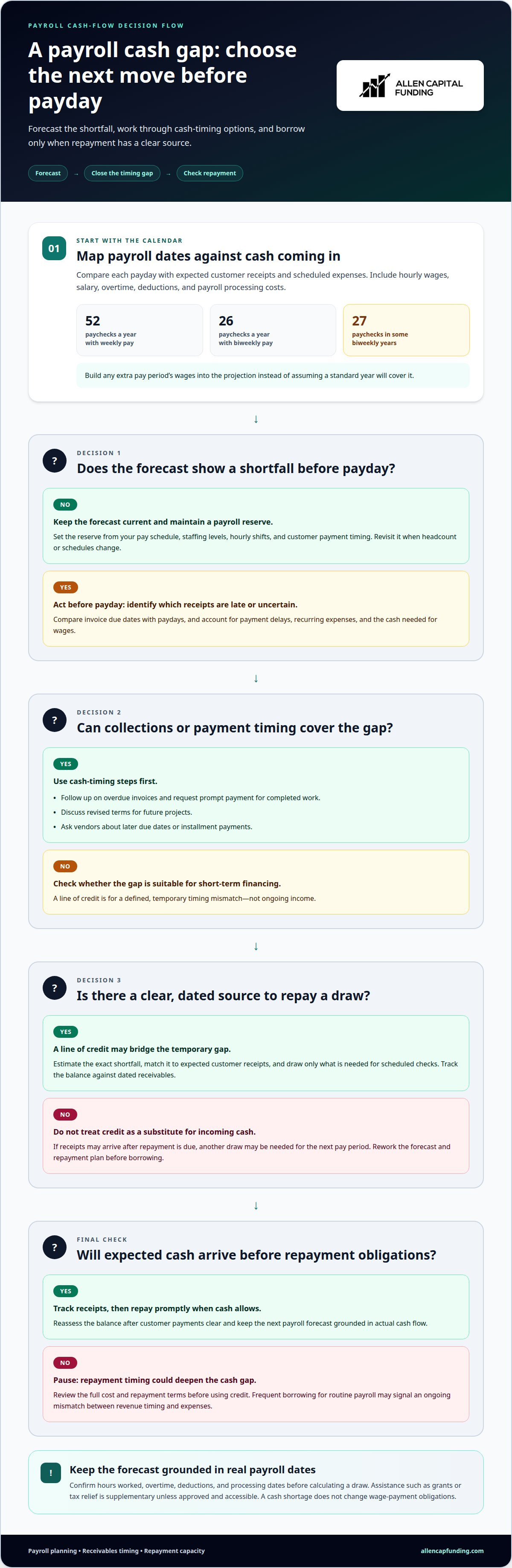
The U.S. Department of Labor defines a workweek as a fixed, recurring period of 168 hours, or seven consecutive 24-hour days. Track each pay period against that workweek, since hourly payroll depends on hours worked and timing. A biweekly schedule usually has 26 paychecks, but some years include 27. Build an extra pay period’s wages into projections instead of assuming an annual salary divided into 26 checks will cover it.
Projecting Cash Flow for Extra Payroll
A cash-flow projection estimates when money will enter and leave the business, including wages for an extra pay period. Add the additional payroll to the calendar, then compare the resulting outflow with expected customer receipts and other scheduled expenses. This view can show a shortfall in advance, giving each department time to plan spending and helping avoid a last-minute scramble.
Setting a Payroll Cash Reserve
A payroll reserve is cash set aside for wages and related obligations. The amount needed depends on your pay schedule, staffing levels, hourly shifts, and customer payment timing. Use payroll records and cash-flow projections to estimate a reserve for a slow period. Revisit that estimate when headcount or schedules change instead of relying on a fixed amount.
Government grants, tax relief, or small-business assistance may help in specific circumstances, but eligibility and timing vary. Treat potential assistance as supplementary, not as cash for a scheduled payday, unless the funds are approved and accessible.
Keep the forecast current by updating expected receipts and payroll costs as conditions change. If a sale comes in before a month with an extra payroll, set aside some proceeds for wages. This helps prevent a temporary revenue bump from being absorbed by unrelated expenses.
Aligning payroll with customer payment terms
Payroll can fall due before customers pay, even when sales look healthy on paper. Compare invoice due dates with employee paydays in the accounting calendar. For example, customers paying on 30-day terms at month end may leave cash short before payroll clears. This timing gap can strain working capital, especially when the business runs 52 annual payrolls instead of 24.
Map expected customer payments against each payroll date, rather than relying on monthly revenue totals. Include invoice timing, payment delays, recurring expenses, and the cash needed for wages. Separate hourly payroll from salary obligations, and record employee classifications, including exempt roles, in the forecast. This helps identify a cash gap in a particular week or workweek.
If your forecast shows a shortfall, act before payday. Follow up on overdue invoices, request prompt payment for completed work, and discuss revised terms for future projects. You may also be able to negotiate later vendor due dates or installment payments. These steps can preserve cash without assuming customers will pay early.
Pay-frequency rules vary by jurisdiction, so the payroll calendar must meet local requirements. In California, most employees must be paid at least twice during each calendar month on regular paydays designated in advance. Wages earned from the 1st through the 15th day of a calendar month must be paid by the 26th day of that month. Wages earned from the 16th through month-end must be paid by the 10th day of the following month.
If the business cannot make payroll, update the cash forecast promptly, pursue collectible customer payments, and discuss payment timing with vendors. Communicate clearly with employees, and get accounting and legal guidance before changing pay dates or amounts. A cash shortage does not change wage-payment obligations. Plan around the applicable state schedule and keep records of payroll calculations and payments.
Using a line of credit to cover payroll
A business line of credit can bridge a temporary gap when sales don’t cover payroll. Use it to address a defined timing mismatch, not as ongoing income. Estimate the exact shortfall, compare it with expected customer receipts, and identify which incoming funds will repay the draw.
Payroll timing affects the size of that gap. Weekly pay means 52 paychecks a year, while biweekly pay means 26. A slow-sales period can overlap with a payroll date even when invoices are expected soon. Include hourly wages, salary, overtime, deductions, and payroll processing costs in the amount you forecast. Then draw only what’s needed for the scheduled checks, and track the balance against dated receivables.
Repayment capacity matters as much as access to credit. If customer payments arrive after the line’s repayment obligations, you may need another draw for the next pay period. Before borrowing, model how the balance changes with expected receipts and slower collections. A line of credit is best suited to a short-lived cash-flow gap with a clear repayment source.
Credit cards and merchant cash advances can also have borrowing costs and repayment demands that reduce cash available for future payroll. Fees and total costs vary by agreement, so review the full cost and repayment terms before using either option. Frequent borrowing for routine payroll may point to an ongoing mismatch between revenue timing and expenses.
Keep the payroll calendar current through the end of each pay period. Confirm hours worked, overtime, deductions, and processing dates before calculating any draw. For a biweekly payday, project across the full pay period and the time until customer payments arrive. Reassess the balance after those receipts clear, then repay promptly when cash allows. This limits reliance on borrowed funds and keeps the next payroll forecast grounded in actual cash flow.
How much cash reserve should a small business keep for payroll?
There’s no single reserve amount that fits every small business. Set the target from scheduled payroll costs, pay frequency, and how reliably customer payments arrive. A weekly schedule has 52 paychecks a year, while a biweekly schedule has 26 and a semimonthly schedule has 24 pay periods. Those differences affect how often cash must be ready.
Start with the expected wages and related obligations for the next payroll. Then compare the following pay date with projected receipts and essential operating expenses. The reserve should cover payroll if collections arrive late or revenue falls, without counting the same cash for supplier invoices or other planned costs. Use payroll records to include variable shifts and overtime, not just predictable salaries.
For example, a business with biweekly payroll can compare its next two pay dates with expected customer receipts. If the first payday comes before a major invoice is paid, the forecast should show whether current cash can cover wages and other essential expenses until collection. A business with weekly payroll can make the same comparison across its closer pay dates. Update the reserve target when staffing, schedules, or payment timing changes.
Estimate payroll: Use recent payroll records and scheduled hours.
Map cash timing: Match pay dates with expected receipts and essential bills.
Review the gap: Identify periods when receipts may arrive after payroll is due.
Refresh the target: Recalculate after changes to headcount, shifts, or pay frequency.
Keep reserve cash distinct in your cash-flow forecast, even if it remains in the same business account. That separation makes it easier to see whether payroll is covered before committing funds elsewhere. Businesses also weighing property decisions alongside operating liquidity can explore real estate financing options as part of broader financial planning.
Allen Capital Funding
Allen Capital Funding helps small businesses assess funding options when payroll timing pressures working capital. A Credit Line may bridge a temporary gap between payroll dates and incoming customer payments, while Working Capital can support broader business cash needs. The right fit depends on the cash-flow challenge and the business’s repayment plan.
If slow periods recur, a Financial Check-Up can help clarify where cash is going and whether financing fits the business’s broader needs. For businesses considering property as part of their financial plans, Real Estate financing may also be relevant. Neither option replaces payroll forecasting or a clear repayment strategy.
Contact Allen Capital Funding to discuss your business’s cash-flow needs and potential funding options.
Build a more resilient payroll plan
Use your cash-flow outlook as an operating tool, not just a record of past activity. Revisit it when sales patterns, staffing, or customer payment habits change. This can help distinguish a temporary seasonal gap from recurring funding pressure, so you can plan before the next tight period. A clear view of upcoming needs also makes financing decisions more deliberate and easier to align with business priorities.
Allen Capital Funding offers Credit Lines, SBA Loans, and Real Estate financing among its business funding options. If you’re assessing how to cover payroll during a slow month, consider which financing approach aligns with your cash needs and repayment plan. Contact Allen Capital Funding to discuss your business’s funding needs and next steps.
With a thoughtful plan and the right support, you can approach future cash-flow challenges with greater clarity and confidence.
Frequently Asked Questions
What are the best ways for a small business to cover payroll during a slow month?
Start by protecting the cash needed for the next payday, then address the gap with the least disruptive options available. Follow up on completed invoices, pause nonessential purchases, and see whether scheduled vendor payments can be split. If these steps won’t cover the shortfall, a business line of credit may bridge the timing gap, provided incoming cash can support repayment.
What short-term financing options can businesses use to cover payroll, and what do they cost?
Businesses may consider a line of credit or other working capital financing, but the total cost depends on the terms. Review interest, fees, the repayment schedule, and the total amount due before using funds for wages. Compare that obligation with expected cash receipts, not projected sales alone. Avoid relying on a cost estimate without reviewing the financing terms.
Can a business use a line of credit or payroll loan to pay employees?
Yes. A business can use available credit to fund payroll when sales and cash on hand fall short. Treat the draw as temporary financing, not revenue, and identify the expected source of repayment before borrowing. “Payroll loan” is a general description, not a guarantee of a particular product or term. Assess financing by its repayment structure and overall cost.
What federal and state laws govern paying employees on time during a cash-flow shortfall?
Federal wage rules and state or local requirements can both apply. Under the Fair Labor Standards Act, covered nonexempt employees generally must receive required minimum wages and overtime on the regularly scheduled payday. Pay-frequency rules differ by jurisdiction, so the applicable state schedule matters too. A cash-flow shortfall does not change the payroll calendar or remove wage obligations.
Can employers delay, reduce, or defer wages when business is slow?
Employers shouldn’t assume they can delay scheduled wages because revenue has dropped. For covered nonexempt employees, federal rules require payment of wages due on the regularly scheduled payday. An hourly rate may be reduced only within applicable wage rules, including the federal minimum wage requirement; state rules may impose additional requirements. Review changes for compliance before they take effect, and handle them prospectively.
How can businesses forecast cash flow and plan for seasonal payroll expenses?
Build a forecast around payroll dates, seasonal revenue patterns, and customer collection timing. Separate dependable income from uncertain sales, then model a slower-collection scenario alongside the expected case. For example, a seasonal business can compare scheduled staffing during a quieter period with confirmed work and expected receipts. Update the forecast as bookings, hours, or invoices change.



Comments